


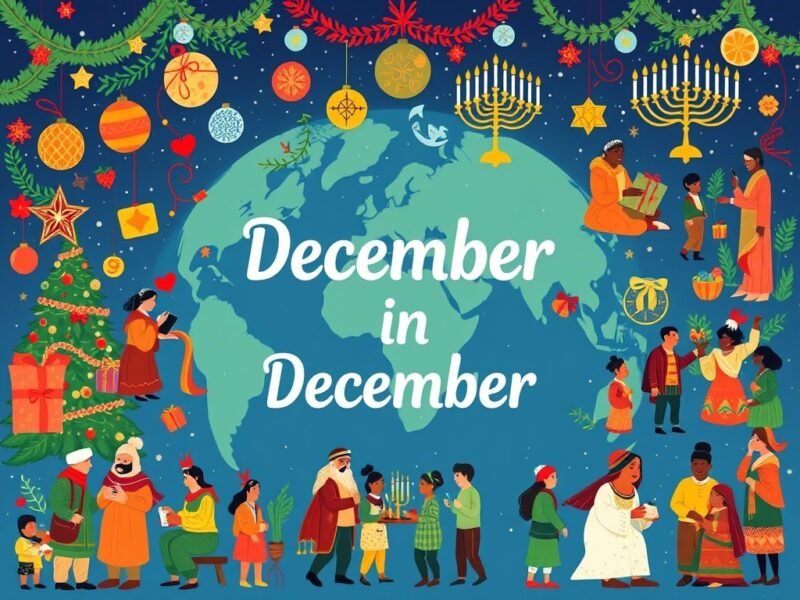
A plain-language guide to what the world is celebrating — and when December 2026 has 19 public holidays spread across more than 30 countries — from Hanukkah opening the month on December 4 to Japan’s Ōmisoka closing it on December 31. If you’re planning travel, managing a global team, or simply curious about what your colleagues around the world are observing, this guide has everything you need in one place.
One thing that surprises most people: several of these holidays overlap in the same week. Hanukkah, Qatar’s National Day, and Thailand’s Constitution Day all fall within a ten-day window — something worth knowing if you’re scheduling international meetings or campaigns in early December.
December 2026 Global Holidays at a Glance
Here’s every major observance this December, sorted by date. Holidays marked in bold dates involve official government or business closures in their respective countries.
| Date | Holiday | Celebrated In |
| December 1 | World AIDS Day | Worldwide |
| December 2 | UAE National Day | United Arab Emirates |
| December 4 | Farmer’s Day | Ghana |
| December 4–12 | Hanukkah (Festival of Lights) | Jewish communities worldwide |
| December 5 | King Bhumibol’s Birthday | Thailand |
| December 6 | Constitution Day / Independence Day | Spain / Finland |
| December 10 | Constitution Day | Thailand |
| December 12 | Day of the Virgin of Guadalupe | Mexico |
| December 13 | Santa Lucia Day | Scandinavia, Italy |
| December 16 | Victory Day / Day of Reconciliation | Bangladesh / South Africa |
| December 18 | National Day | Qatar |
| December 21 | Yule / Winter Solstice | Pagan & Wiccan communities |
| December 23 | Festivus | United States |
| December 23 | Unduvap Full Moon Poya | Sri Lanka |
| December 24 | Christmas Eve | Worldwide |
| December 25 | Christmas Day / Quaid-e-Azam Day | Worldwide / Pakistan |
| December 26 | Boxing Day / Kwanzaa begins / St. Stephen’s Day | UK, US, Canada, Australia & others |
| December 30 | Rizal Day | Philippines |
| December 31 | New Year’s Eve / Ōmisoka | Worldwide / Japan |
A Closer Look at the Major Holidays
Hanukkah — December 4 to 12
Hanukkah 2026 starts at sundown on Friday, December 4 — the earliest it has fallen in the Gregorian calendar since 2021. This eight-night Jewish festival marks the rededication of the Second Temple in Jerusalem in 165 BCE, after it was reclaimed from the Seleucid Empire.
Each night, families add one candle to the menorah (called a “hanukiah” when used specifically for Hanukkah), eat foods fried in oil — latkes (potato pancakes) and sufganiyot (jam-filled doughnuts) — and play dreidel, a spinning top game where each Hebrew letter on the sides stands for a phrase meaning “A great miracle happened there.”
Planning note: Hanukkah is not a government holiday in Israel or the US — businesses and schools stay open. But Jewish communities worldwide observe it as a significant cultural and religious celebration.
Santa Lucia Day — December 13
In Sweden, Norway, and parts of Italy, December 13 is one of the most visually striking celebrations of the year. A young girl is chosen as “Lucia” and leads a procession wearing a white dress and a crown of candles, followed by classmates singing traditional songs in the dark.
The tradition honours St. Lucia of Syracuse, a 4th-century martyr who, according to legend, brought food to persecuted Christians hiding in Roman catacombs, wearing candles on her head to keep her hands free. In Scandinavia, the day historically marked the longest night of the year under the old Julian calendar, which is why light plays such a central role.
Yule / Winter Solstice — December 21
December 21 is the winter solstice in the Northern Hemisphere — the shortest day and longest night of the year. For pagan and Wiccan communities, this is Yule, one of the eight seasonal festivals (called Sabbats) on the Wheel of the Year.
Traditions vary widely, but typically include lighting a Yule log (documented in European records as far back as the 12th century), feasting, decorating with holly and evergreen, and staying up through the night to greet the sun’s return at dawn. An estimated 1–3 million Wiccan and pagan practitioners worldwide observe Yule, though many of its symbols — the decorated tree, candles, gift-giving — were later absorbed into Christmas customs.
Festivus — December 23
Festivus became widely known through a 1997 episode of Seinfeld, but here’s the detail most articles miss: it was based on a real family tradition. Writer Dan O’Keefe’s father invented Festivus in 1966 — 11 years before the show aired — as a protest against the commercialisation of the holiday season.
The original Festivus had a tape recorder and a clock nailed to a bag. The TV version gave it the now-iconic aluminium pole (unadorned, because tinsel is distracting), the “Airing of Grievances” dinner, and the “Feats of Strength.” It’s observed with genuine affection by people who enjoy a self-aware, low-pressure alternative to December’s commercial frenzy.
Christmas — December 25
Christmas is observed by an estimated 2.2 billion Christians worldwide and celebrated culturally by hundreds of millions more. It marks the birth of Jesus Christ, though the December 25 date was formally set by the Roman church in the 4th century — the actual birth year and date remain historically debated.
Traditions differ dramatically by country. In Ethiopia (where Christmas is called Genna and falls on January 7 under the Orthodox calendar), it’s marked by a hockey-like game. In the Philippines, Christmas music starts playing in September and celebrations run through January 6. In Armenia, Christmas is observed on January 6, the same day as Epiphany. The gift-giving and decorated-tree version most people picture is largely a 19th-century development, popularised in Germany and spread globally through British and American cultural influence.
For global teams: December 25 is an official public holiday in over 160 countries. If you’re coordinating across time zones, December 24–26 is effectively a global pause.
Kwanzaa — December 26 to January 1
Kwanzaa was created in 1966 by Dr. Maulana Karenga, a professor at California State University Long Beach, as a way to reconnect African Americans with African cultural heritage after the Watts uprising. It was never intended to replace Christmas — many families celebrate both.
The seven-day celebration is built around seven principles called the Nguzo Saba: Umoja (unity), Kujichagulia (self-determination), Ujima (collective work and responsibility), Ujamaa (cooperative economics), Nia (purpose), Kuumba (creativity), and Imani (faith). Each night, a candle is lit on the kinara (a candle holder holding seven candles — three red, three green, one black). An estimated 10–20 million people across the African diaspora observe Kwanzaa annually, according to the National African American Heritage Museum.
Ōmisoka — December 31
Ōmisoka is Japan’s New Year’s Eve, but it feels nothing like the countdowns and fireworks familiar in the West. The day is spent cleaning the house from top to bottom — a practice called “osoji” — to clear out the old year’s dust, literally and spiritually. Families gather to eat toshikoshi soba (“year-crossing noodles”), whose long strands symbolise longevity and continuity.
At midnight, Buddhist temples across Japan ring their bells 108 times — one strike for each of the 108 earthly desires in Buddhist teaching that humans struggle to overcome. It’s called joya no kane, and the sound is broadcast live on national television every year.
New Year’s Eve — December 31
New Year’s Eve is the one moment where much of the world counts down together, timezone by timezone. Sydney fires the first major fireworks display at midnight local time, followed by Dubai, then Moscow, then Paris, London, New York, and finally the US West Coast. The Times Square ball drop in New York City has happened every year since 1907, with only two exceptions: 1942 and 1943, when wartime blackout restrictions kept the celebration dark and quiet.
Traditions are wildly different by culture. In Spain, people eat 12 grapes at midnight — one per bell strike — for good luck in each month of the coming year. In Brazil, white clothes are worn to bring peace. In Scotland, Hogmanay celebrations include “first-footing,” where the first person to enter your home after midnight brings symbolic gifts.
Planning Around December 2026
December is the hardest month to coordinate across borders, and the reason is simple: the holidays don’t follow a single calendar. You’re working across the Gregorian calendar (Christmas), the Hebrew calendar (Hanukkah), the Islamic calendar (National Days in Gulf states), and Buddhist observances (Sri Lanka’s Poya) — all simultaneously.
The most practically useful thing to know: the window from December 22–27 is the most universally affected period. Christmas Eve, Christmas Day, and Boxing Day fall there, along with Festivus, the start of Kwanzaa, and Ōmisoka approaching. If you need global availability, the first two weeks of December and the first full week of January are your best options.
Frequently Asked Questions
Which December 2026 holidays involve official business or school closures?
The holidays that typically trigger mandatory closures include: UAE National Day (Dec 2), Thailand’s Constitution Day (Dec 10), Qatar National Day (Dec 18), Christmas Day (Dec 25 — 160+ countries), Boxing Day (Dec 26 — UK, Canada, Australia, and others), and Rizal Day (Dec 30 — Philippines). Hanukkah, Kwanzaa, Festivus, and Yule are cultural or religious observances without government-mandated closures.
Why do so many major celebrations happen in December?
Two reasons converge. First, the winter solstice (December 21 in the Northern Hemisphere) has been a pivotal astronomical event for human civilisations for thousands of years — it marks the “turning of the sun,” the point after which days get longer. Many December celebrations, including Yule, Saturnalia (Roman), and elements absorbed into Christmas, originated around this event. Second, the end of the calendar year naturally invites reflection and renewal across cultures, which is why you see so many “fresh start” traditions — Ōmisoka’s cleaning, New Year’s resolutions, and Kwanzaa’s seven principles — concentrated in late December.
Does Hanukkah always fall in December?
No. Hanukkah follows the Hebrew lunisolar calendar and begins on the 25th of Kislev, which can fall anywhere from late November to late December. In 2026, it starts December 4 — earlier than average. In some years (like 2013), it began as early as November 27.
Can non-Jews celebrate Hanukkah? Can non-Christians celebrate Christmas?
These are questions of cultural respect rather than strict rules. Many Jewish communities welcome guests to Hanukkah celebrations, particularly when approached with genuine curiosity rather than appropriation. Similarly, Christmas has become a secular cultural event in many countries — Japan, for example, has no significant Christian population but has enthusiastically adopted Christmas decorations, KFC Christmas dinner (a marketing campaign from 1974 that became a national tradition), and couples’ celebrations on December 25.
What is the significance of the 108 bell strikes on Ōmisoka?
In Buddhist teaching, humans are said to have 108 earthly desires or delusions (bonno in Japanese) that cause suffering. Ringing the temple bell 108 times on New Year’s Eve is believed to cleanse these desires and begin the new year with a clear spirit. The tradition is called joya no kane and takes place at Buddhist temples across Japan starting just before midnight.