




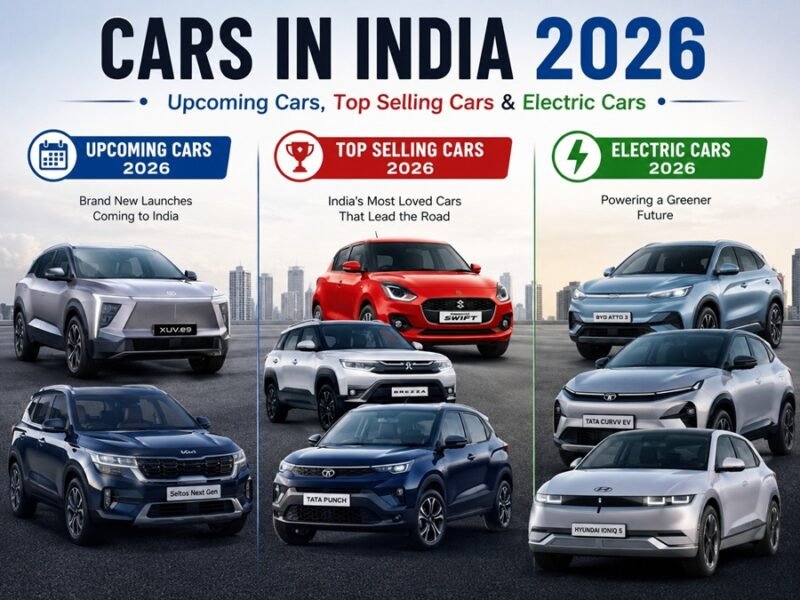
If you’re planning to buy a car this year, you’re not alone. India’s car market is buzzing right now — new SUVs are landing almost every month, electric cars are getting cheaper, and old favourites like the Maruti Dzire are still topping the charts, believe it or not.
At V3 Cars, we track every launch, every sales number, and every price change so you don’t have to. Here’s your one-stop guide to what’s selling, what’s coming, and what’s worth waiting for.
Top Selling Cars in India Right Now
Everyone assumes SUVs rule India. They mostly do — but here’s a twist. The Maruti Suzuki Dzire, a plain old sedan, has been outselling every SUV in the country for months now. It even finished as India’s best-selling car for the full 2025-26 financial year.
Here’s what’s dominating showrooms:
- Maruti Suzuki Dzire – Still the No. 1 seller, thanks to taxi and fleet demand plus a loyal private buyer base. Low running cost and a huge service network keep it on top.
- Maruti Fronx – Climbing fast, now regularly the second best-seller with strong year-on-year growth.
- Maruti Ertiga – India’s favourite 7-seater MPV, has already crossed the 1 million sales mark.
- Tata Punch – The compact SUV that made SUV-style motoring affordable, now available with petrol, CNG and EV options.
- Tata Nexon – A fixture in the top 5 since 2017, and the only car in India sold with petrol, diesel, CNG and electric powertrains.
- Mahindra Scorpio – Recently overtook the Hyundai Creta to become India’s best-selling SUV in some months.
- Hyundai Creta – Still India’s most-loved midsize SUV, even with a slight dip in growth.
- Kia Seltos – The new-generation model launched in January 2026 posted a massive jump in sales, one of the sharpest gains in the entire market.
Why do buyers keep choosing these cars?
- Strong resale value
- Wide service network across small towns
- Multiple fuel options (petrol, diesel, CNG, EV)
- Good crash-test safety ratings
If you’re buying your first car, sticking with a proven bestseller isn’t boring — it’s smart. Lower ownership headaches, easier resale, and parts availability everywhere.
New Car Launches in India: What’s Arriving in July 2026
July 2026 is turning out to be a genuinely busy month. Here’s what to expect:
Renault Kwid Facelift — Launching early July with a fresh face, new LED lights and a bigger touchscreen. Still an affordable option for first-time buyers, likely priced between ₹4.80–6.50 lakh.
Nissan Tekton — This one’s a big deal. Nissan is making its global debut of this midsize SUV on 9 July 2026, right here in India. It will take on the Creta, Seltos and Grand Vitara, and shares its engines with the Renault Duster — 1.0-litre turbo-petrol, 1.3-litre turbo-petrol, and a 1.8-litre turbo-petrol hybrid.
Maruti Suzuki Brezza Facelift — Expected around 23 July, this mid-life update may switch to a smaller 1.0-litre turbo-petrol engine (borrowed from the Fronx). Why does that matter? A smaller engine means lower GST, which could make the new Brezza more competitively priced.
Honda ZR-V — Honda’s new flagship SUV for India, likely with a 2.0-litre petrol-hybrid engine, expected to be priced between ₹18–25 lakh.
Toyota Hilux (next-gen) — The updated pickup truck gets a fresh design and a new grille, but keeps its familiar 2.8-litre diesel engine.
Skoda Kodiaq RS — A performance-focused flagship SUV. Interestingly, the first 50 units allotted to India sold out even before the official price announcement.
JSW MG’s new 7-seater SUV — Expected to be a rebadged global model, likely offered in both PHEV and full-EV versions.
Quick Tip Before You Book a New Launch
New launches look exciting, but don’t rush. Wait at least 2–3 months after launch to let early owners report real-world mileage, service issues, and software glitches — especially with feature-loaded SUVs that run on complex software.
Upcoming Cars in India: What’s Coming Later in 2026
Beyond July, there’s a long list of cars headed to Indian showrooms. Around 51 new models are expected to launch through 2026, and most of them — over 40 — are SUVs.
Some names worth watching:
- Mahindra Bolero 2026 and Mahindra Thar E (electric version of the cult-favourite Thar)
- Kia Syros EV
- Honda Elevate EV
- Tata Altroz EV
- Audi A6 e-tron — expected with a 100kWh battery and a claimed range of up to 756km
- MG Majestor — a new 7-seater SUV option
Basically, if you can wait a few months, the choices are only going to get better — especially on the electric side.
Electric Cars in India 2026: Prices & Real-World Range
EVs in India have finally moved from “future tech” to genuine daily-driver territory. Prices now start well under ₹10 lakh, and range has improved a lot compared to just two years ago.
Popular electric cars and their starting prices:
| Model | Starting Price (approx.) |
|---|---|
| Tata Tiago EV | ₹6.99 lakh |
| Tata Punch EV | ₹9.69 lakh |
| Maruti Suzuki e Vitara | ₹15.99 lakh |
| Mahindra BE 6 | ₹18.90 lakh |
| Tata Sierra EV | ₹18.79 lakh |
Prices are ex-showroom and can vary by variant and city. Always check the latest price on V3 Cars before booking.
How Much Does It Actually Cost to Charge an EV?
This is the question most first-time EV buyers ask. Here’s the honest answer:
- Home charging: roughly ₹1.06–1.20 per km
- Public fast charging (DC): roughly ₹2.50–3.30 per km
- Equivalent petrol car: around ₹7.00–7.50 per km at current fuel prices
So even with public charging, an EV still works out cheaper to run than petrol. But home charging is where the real savings are.
Real-World Range: What to Actually Expect
Claimed range and real-world range are two different things. As a rough rule:
- A 30kWh battery gives about 220–250km in real conditions
- A 50kWh battery gives about 330–380km
- A 79kWh battery (like in the Mahindra BE 6 or XEV 9e) gives 430–460km
Expect 20–30% less than the claimed figure once you factor in AC usage, traffic, and highway speeds.
Should You Buy an EV in 2026?
Buy one only if:
- You have reliable home or workplace charging
- Your daily driving is mostly within city limits
- You’re comfortable planning ahead for long highway trips
Skip it for now if you live in an apartment without dedicated charging access, or if most of your driving is long-distance highway travel.
FAQs: Upcoming Cars, Top Selling Cars & EVs in India
Q1. Which is the best-selling car in India right now?
The Maruti Suzuki Dzire currently holds the top spot, followed closely by the Maruti Fronx and Ertiga.
Q2. Which new cars are launching in India in July 2026?
Key launches include the Renault Kwid facelift, Nissan Tekton, Maruti Brezza facelift, Honda ZR-V, and the Toyota Hilux.
Q3. What is the cheapest electric car in India in 2026?
The Tata Tiago EV and Tata Punch EV are among the most affordable options, with prices starting under ₹10 lakh.
Q4. Are electric cars worth buying in India in 2026?
Yes, if you have reliable charging access. Running costs are significantly lower than petrol or diesel cars, and range has improved a lot in recent models.
Q5. Which SUV is the best-selling in India?
The Mahindra Scorpio and Hyundai Creta have been trading the top SUV spot in recent months, with the Tata Punch and Nexon also performing strongly.
Whether you want a reliable bestseller, a brand-new July 2026 launch, or your first electric car, India’s market has more good options right now than ever before. For daily-updated prices, launch dates, and honest comparisons, keep checking V3 Cars.
Disclaimer: Prices and launch dates are based on the latest available reports and may change. Please confirm final pricing with your nearest dealership before purchase.







One response to “Upcoming Cars, Top Selling Cars & Electric Cars in India 2026: Complete Guide by V3 Cars”