



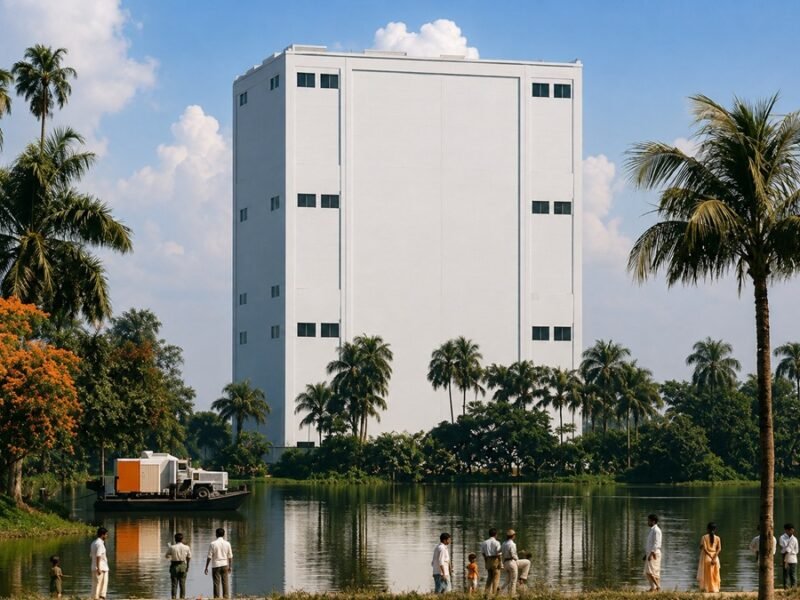
Summit Group wants to switch on Bangladesh’s first large-scale data centre within eighteen months of signing an outside partner. Chairman Muhammed Aziz Khan laid out the plan in comments Nikkei Asia reported in early January, and the pitch rests on three assets the conglomerate already owns rather than any it still needs to build.
A Timeline Built on Existing Assets
Most data centres take years to plan, permit and construct. Khan told Nikkei Asia his company can skip most of that runway. “While data centres can take several years to develop, we can make them available for customers in a year and a half,” he said, according to The Business Standard.
The compressed schedule depends on bundling capacity Summit already operates. The company plans to build near Dhaka, adjacent to gas plants run by Summit Power International, its energy subsidiary and Bangladesh’s largest private power producer. Khan is seeking a partner with data centre construction and marketing experience, and he told Nikkei Asia that some of the “Magnificent 7” (his term for Alphabet, Amazon, Apple, Meta Platforms, Microsoft, Nvidia and Tesla) have shown interest, though he did not name a company or describe how advanced any talks are. Summit is hoping to sign a customer sometime this year.
Aziz Khan founded Summit Group roughly 40 years ago, and the company’s move into power generation came later, with its first independent plant built in 1997. The data centre plan is a continuation of that build-out rather than a break from it, according to Yan-Bin Wu, Summit Power International’s deputy chief executive and chief financial officer. In a January outlook Wu described a two-fold problem facing global technology firms: grid congestion and land scarcity in established markets, paired with cooling limits and volatile energy prices. Summit’s answer, in Wu’s framing, is to offer power, fiber and land as one package rather than three separate negotiations. Power purchase agreements between Summit and the Bangladeshi government typically run 15 to 20 years and pay for available capacity rather than electricity actually delivered, a structure that leaves some of Summit’s generation underused in ordinary operation. Wu has described that spare capacity as the asset the data centre plan is built around, since data centres need continuous baseload power that solar and wind, without significant battery storage, cannot reliably supply.
The Numbers Behind Summit’s Pitch
Aziz Khan frames the project around three inputs: electricity, fiber and land. Summit Power International’s own disclosures put its generation fleet at 11 plants totaling 2,012 megawatts, about 7 percent of Bangladesh’s installed capacity, according to the company’s about-us page. A sister company, Summit Communications, operates a fiber network stretching more than 59,000 kilometres across all 64 of the country’s districts and carrying roughly a fifth of national internet bandwidth, according to Summit’s own materials. That reach matters for a data centre in a way generation capacity alone does not: facilities built to serve global cloud customers need low-latency routes to internet exchange points and submarine cable landing stations as much as they need a steady supply of power.
Land is the third piece, and the least discussed of the three. Summit already holds property beside its gas plants near Dhaka, some of it through a subsidiary called Summit Technopolis Hi Tech Park, which Khan has said would let a data centre draw power directly from generation without transmission losses or delays connecting to the grid. Combined, the three inputs are what Khan means when he tells prospective partners that Summit’s edge is speed rather than scale. A greenfield developer would need to secure land, negotiate a power connection and build fiber routes before construction even begins. Summit’s pitch is that it can start from where those developers would end up.
The gas theme runs through Khan’s own description of the plan. “Summit Group’s next phase [of growth] focuses on integrating energy and data, leveraging our LNG and fibre-optic expertise,” he told Nikkei Asia. The LNG piece is not incidental. Summit operates Bangladesh’s second floating storage and regasification unit, with a daily send-out capacity of 500 million cubic feet of gas, and the company has framed that supply chain as the reason its gas-fired plants can offer steadier output than generators dependent on domestic production alone, which has been declining for years.
A Market Moving Faster Than the Grid
Bangladesh’s data centre sector is still tiny by regional standards, but growth is fast. The country’s installed IT load reached 23.55 megawatts in 2025 and is on track to reach 150.6 megawatts by 2030, a compound annual growth rate near 45 percent, according to Mordor Intelligence’s Bangladesh Data Center Market report. Hyperscale tenants, the large cloud and technology firms that sign decade-long, multi-megawatt contracts, already occupied 62 percent of the country’s commissioned capacity in 2024, the same report found.
Domestic operators such as Felicity IDC and Red.Digital currently serve that demand at a smaller scale, and the government runs an Uptime Institute Tier IV-certified facility in Dhaka, according to Data Center Dynamics. None of the existing players controls Summit’s combination of power generation, fiber and land, which is the argument Khan is making to prospective partners.
A Regulation That Could Help
Government policy may add to demand. Bangladesh’s president issued the Personal Data Protection Ordinance in November 2025, restricting the transfer of certain personal data outside the country. Parliament has since replaced that ordinance with a permanent law, the Personal Data Protection Act, 2026, enacted in April and formally numbered Act No. 63 of 2026, which keeps a narrower version of the residency rule. That rule applies to categories such as national ID numbers, passport numbers and biometric data rather than all personal information, according to a Securiti overview of the law. The law’s broader enforcement machinery, including a chief data officer requirement and a formal complaints process, is not due to take effect until May 2027, though the narrower residency rule itself has already applied since the original amendment took effect in February.
Akihiro Shoji, a Japan International Cooperation Agency expert, told Nikkei Asia the rule could further increase demand for local data centres by limiting the overseas transfer and processing of personal data. Shoji also cautioned that private investment so far has stayed limited to small-scale facilities because of shaky power and internet infrastructure, along with political risk. Even so, he said Bangladesh’s potential to serve as a regional data centre hub “is not low, as the domestic market is expected to grow steadily.”
The Climate Problem Summit Cannot Ignore
Summit’s plan leans on gas-fired generation at a moment when Bangladesh is trying to move away from fossil fuels. Renewable sources supplied about 2 percent of the country’s electricity in 2024, according to the energy think tank Ember, while the government has set a target of 25 percent by 2035.
Khan does not dispute the tension. “Until about two years back, we were trying to target ourselves to be along with the whole world, [thinking] that by 2050 we should be disposing of all our hydrocarbon-based generation,” he told Nikkei Asia. “Now, Bangladesh’s circumstances as well as global circumstances have changed, so we have to recast that model” to include technologies such as carbon capture. Summit is also exploring cross-border solar and hydropower imports from India, Nepal and Bhutan, though Khan said bilateral politics have slowed that work.
Politics as the Wild Card
Khan made his comments to Nikkei Asia before Bangladesh held parliamentary elections on Feb. 12, 2026, the country’s first national vote since the 2024 ouster of former Prime Minister Sheikh Hasina. The Bangladesh Nationalist Party won a commanding majority, taking 209 of 297 contested seats, according to broadcaster reporting on the results, with newly elected lawmakers sworn in on Feb. 16.
At the time he spoke with Nikkei Asia, Khan described that vote as the thing investors were waiting on. “For investment, the essential foundations are rule of law, democracy and policy predictability,” he said. “A prime minister elected by the people would hopefully be able to give at least five years of certainty in their policymaking.” Potential backers had grown “very cautious” amid the political uncertainty of the past two years, Khan said, even as he maintained that the underlying appetite for investing in Bangladesh, drawn by its large middle class and export base, had not gone away.
Whether the new government delivers the predictability Khan described will bear on more than the data centre. Summit’s 500-megawatt offshore wind project with Danish investors, still targeting operations around 2030, has faced delays that Khan has attributed to the ordinary hurdles of early-stage development rather than to any single policy decision. A separate onshore LNG terminal Summit had proposed for Matarbari Island has stalled since the interim government scrapped the 2010 law that had provided a legal framework for energy-sector contracts, a move officials said was meant to improve transparency. Both projects sit alongside the data centre as tests of whether Bangladesh’s newly elected government moves faster than its predecessor did.
Read Also: Aziz Khan Wants Summit Group to Become Bangladesh’s First Data Centre Hyperscaler