




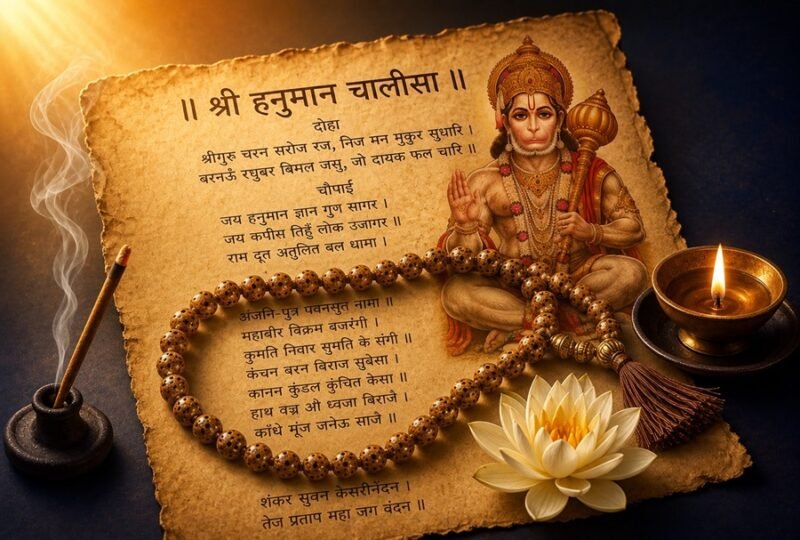
There’s a moment in most Hanuman devotees’ lives when the Hanuman Chalisa stops being just words on a page. It becomes something alive. The rhythm catches in your chest. The meanings start making sense. The prayer becomes less about recitation and more about connection.
The Hanuman Chalisa, composed by the poet-saint Tulsidas in the 16th century, has traveled through centuries remarkably unchanged. Millions recite it daily, across India and beyond. From housewives in small towns to software engineers in metros, from prison inmates to CEOs, this 40-verse prayer has touched people facing everything from health crises to major life decisions.
But here’s what most people don’t know: understanding the Chalisa transforms it from a ritual into a practice. When you grasp what each verse means, why Tulsidas structured it this way, and how to recite it with intention, the impact deepens exponentially.
This guide covers everything: the meaning, the benefits, the proper way to recite, the complete text with translation, and practical tips that actually work.
Quick Answer
The Hanuman Chalisa is a 40-verse devotional hymn composed by Tulsidas, dedicated to Hanuman, the Hindu deity symbolizing courage, strength, and devotion. Reciting it takes 15-20 minutes daily and is believed to bring protection from negative energy, mental strength, and emotional resilience. The optimal way to recite is either on Tuesdays and Saturdays (traditional Hanuman days) or daily with consistent intention. Many people recite it during meditation, morning prayer routines, or when facing challenges. The practice requires no special ritual, just focus and sincere devotion. Regular recitation over 40 days is said to produce measurable benefits in anxiety reduction, clarity, and spiritual wellbeing.
What Is the Hanuman Chalisa and Its Significance
The Hanuman Chalisa is a sacred devotional prayer in Hindi composed of 40 verses (chalisa means “forty” in Hindi). Each verse celebrates a different quality or aspect of Hanuman, the monkey deity worshipped across Hindu tradition.
What makes the Chalisa special is its accessibility. Unlike many complex Sanskrit mantras requiring deep learning, the Hanuman Chalisa uses Hindi that people can understand and feel. The language resonates. The imagery is vivid. The message is clear.
The Chalisa serves multiple purposes simultaneously. For some, it’s a meditation tool. For others, a form of devotional worship. For many, it’s protective prayer during difficult times. The beauty lies in its flexibility. You can approach it as scripture, as mantra, as poetry, or as practical spiritual technology depending on where you stand in your own understanding.
In traditional Hindu practice, the Hanuman Chalisa holds similar weight to the Gayatri Mantra or the Maha Mrityunjaya Mantra. It’s not lesser because it’s in Hindi rather than Sanskrit. It’s profound precisely because it meets people where they are linguistically and spiritually.
Historically and even today, the Hanuman Chalisa appears in homes across India and the Indian diaspora. You’ll find it framed on walls, recited in temples, memorized by children, and whispered by people facing health crises in hospitals. This isn’t religious obligation. It’s genuine practice.
Who Wrote the Hanuman Chalisa and When
Goswami Tulsidas composed the Hanuman Chalisa in the 16th century, sometime between 1550 and 1620. Tulsidas lived during a significant period in Indian history when devotional movements were reshaping spiritual practice across the subcontinent.
Tulsidas is best known as the author of the Ramcharitmanas, an enormous vernacular retelling of the Ramayana that fundamentally changed how the epic reached ordinary Indians. The Ramcharitmanas is to North India what the Mahabharata is to Hindu consciousness: foundational.
The Hanuman Chalisa wasn’t Tulsidas’s only creation, but it became his most enduring gift in some ways. While the Ramcharitmanas required hours to recite, the Chalisa took minutes. It traveled easily, memorized quickly, and delivered profound meaning in concise form.
Tulsidas lived during the Mughal period in India, a time of religious complexity and social tension. Yet his work transcended those divisions. He wrote for ordinary people, not scholars. For householders managing families, not monks in isolation. This accessibility explains why his work survived centuries with undiminished relevance.
Some scholars suggest Tulsidas composed the Hanuman Chalisa after a personal experience or during a time when he needed Hanuman’s protection. While historical evidence is thin, the emotional intensity of the verses suggests genuine devotion rather than academic composition. The poetry carries lived experience.
Understanding the Structure: 40 Verses Explained
The Hanuman Chalisa follows a specific structure that Tulsidas designed with clear intention. Understanding this architecture deepens your appreciation of what you’re reciting.
The Opening (Doha)
The Chalisa begins with a traditional Doha, a two-line poetic form. Tulsidas invokes the Guru and purifies his mind for composition. He explicitly states his purpose: to praise Hanuman through this composition.
This opening matters. It frames what follows not as entertainment or casual poetry, but as spiritual work worthy of focused attention.
The Chaupai Section (Main 40 Verses)
The bulk of the Chalisa consists of 40 verses in Chaupai meter, a four-line poetic structure that creates rhythmic flow. This meter isn’t random. The cadence helps memory and creates meditative resonance when recited aloud.
Each verse builds on previous ones, creating a cumulative effect. Early verses establish who Hanuman is (the ultimate devotee, symbol of strength). Middle verses describe his qualities and his legendary deeds. Later verses discuss benefits of recitation and invoke protection.
This isn’t a collection of random praises. It’s a structured journey from outer description to inner transformation.
Verses 1-10: Introduction and Identity
These verses answer the fundamental question: Who is Hanuman? They establish him as devoted to Rama, strong, wise, and the ideal servant. Each verse uses vivid imagery to communicate these qualities.
Verses 11-25: Legendary Deeds
This section recounts Hanuman’s famous acts: crossing the ocean, burning Lanka, rescuing Sita, bringing the Sanjeevani herb to save Lakshman. These aren’t stories for entertainment. Each deed illustrates a quality devotees aspire to develop.
Verses 26-35: Powers and Protection
These verses detail Hanuman’s mystical abilities and the specific protections offered through his worship. They promise relief from suffering, removal of obstacles, and freedom from fear.
Verses 36-40: Benefits and Closing
The final verses assert the benefits of reciting the Chalisa itself, creating a recursive promise. Recite this prayer about Hanuman’s power, and you receive those benefits.
The Closing (Doha)
Like the opening, the Chalisa ends with a Doha in which Tulsidas declares his devotion and invokes Hanuman’s blessings not just for the reader, but for all beings.
This complete structure resembles a carefully designed meditation journey: invocation, exploration, empowerment, and benediction.
The Complete Hanuman Chalisa Text with Meaning
Doha (Opening Verse)
श्रीगुरु चरन सरोज रज, निज मनु मुकुरु सुधारि। बरनउं रघुबर बिमल जसु, जो दायकु फल चारि॥
Translation: “I cleanse the mirror of my mind with the dust of my Guru’s lotus feet, so that I may sing the spotless glory of Raghubar (Rama), which grants the four fruits of life.”
Meaning: Tulsidas begins by seeking purification and clarity through his spiritual teacher before undertaking the sacred task of praising Rama through this work.
बुद्धिहीन तनु जानिके, सुमिरौं पवन-कुमार। बल बुधि विद्या देहु मोहिं, हरहु कलेस बिकार॥
Translation: “Knowing myself to be intellectually limited, I remember the son of the wind. Grant me strength, wisdom, and knowledge, and remove my sorrows and impurities.”
Meaning: Tulsidas humbly acknowledges his limitations and invokes Hanuman (Pavan-Kumar, literally “son of the wind”) for the qualities needed to complete this composition.
Chaupai Section (Main 40 Verses)
Verse 1
जय हनुमान ज्ञान गुन सागर। जय कपीस तिहुँ लोक उजागर॥
Translation: “Victory to Hanuman, ocean of knowledge and virtue. Victory to the king of monkeys who illuminates all three worlds.”
Meaning: The Chalisa opens with direct invocation. Hanuman is praised as all-knowing, virtuous, and powerful across all dimensions of existence. This establishes his cosmic significance, not as a superhero, but as a transcendent being.
Verse 2
राम दूत अतुलित बल धामा। अंजनि-पुत्र पवनसुत नामा॥
Translation: “Messenger of Rama, abode of matchless strength. Son of Anjani, known as the son of the wind.”
Meaning: Hanuman’s identity is defined by service (messenger of Rama) and parentage (son of Anjani and the wind deity). His strength is emphasized as unequaled. The verse teaches that true power emerges from devoted service.
Verse 3
महाबीर बिक्रम बजरंगी। कुमति निवार सुमति के संगी॥
Translation: “Great warrior with tremendous valor, Bajrangbali. Destroyer of evil thoughts, companion to good intellect.”
Meaning: Hanuman is the warrior against inner darkness. His power isn’t for conquest but for removing confusion and negativity from the mind. He becomes the ally of wisdom.
Verse 4
कंचन बरन बिराज सुबेसा। कानन कुंडल कुंचित केसा॥
Translation: “Golden in color, beautifully adorned. With earrings and curled hair like a forest.”
Meaning: Vivid physical description creates visual focus for meditation. The imagery makes Hanuman present and real rather than abstract.
Verse 5
हाथ बज्र औ ध्वजा बिराजै। काँधे मूँज जनेऊ साजै॥
Translation: “His hands hold a thunderbolt and banner. On his shoulder sits the sacred thread.”
Meaning: Each item represents spiritual power and sacred duty. The verse moves from external beauty to symbols of strength and righteousness.
Verse 6
संकर सुवन केसरीनंदन। तेज प्रताप महा जग बंदन॥
Translation: “Son of Shiva, child of Kesari. Whose radiance and power are worshipped by the great in all worlds.”
Meaning: Hanuman’s lineage connects him to Shiva, reinforcing his mystical nature. His power commands respect across all realms of existence.
Verse 7
विद्यावान गुनी अति चातुर। राम काज करिबे को आतुर॥
Translation: “Learned, virtuous, and supremely skillful. Forever eager to serve Rama’s work.”
Meaning: Hanuman combines knowledge with action. He’s not just wise but actively engaged in purpose-driven work. His eagerness to serve becomes his defining characteristic.
Verse 8
प्रभु चरित्र सुनिबे को रसिया। राम लखन सीता मन बसिया॥
Translation: “He delights in hearing the stories of his Lord. Rama, Lakshman, and Sita dwell eternally in his heart.”
Meaning: This verse describes the devotee’s experience. Hanuman finds joy in spiritual practice, carrying his beloved always in consciousness. It’s an instruction for devotees about where attention should reside.
Verse 9
सूक्ष्म रूप धरि सियहिं दिखावा। बिकट रूप धरि लंक जरावा॥
Translation: “He took subtle form to reveal himself to Sita. He assumed a fearsome form and burned Lanka.”
Meaning: Hanuman adapts his expression to circumstances. With a suffering woman, he becomes gentle. Facing evil, he becomes fierce. This teaches contextual action and spiritual flexibility.
Verse 10
भीम रूप धरि असुर सँहारे। रामचंद्र के काज सँवारे॥
Translation: “Assuming a terrible form, he destroyed demons. He accomplished Rama’s tasks with certainty.”
Meaning: Service sometimes requires strength and fierceness. Hanuman demonstrates that spiritual power isn’t passive; it actively removes obstacles to dharma (righteous duty).
Verses 11-20
लाय सजीवन लखन जियाये। श्रीरघुबीर हरषि उर लाये॥
Translation: “He brought the life-giving herb and restored Lakshman to life. Raghubir (Rama) embraced him joyfully in his heart.”
Meaning: Hanuman’s actions flow from pure devotion. He doesn’t expect reward; joy comes from service itself. When Rama embraces him, it’s recognition of perfect devotion.
रघुपति कीन्ही बहुत बड़ाई। तुम मम प्रिय भरतहि सम भाई॥
Translation: “Raghupati greatly honored you. You are as dear to me as Bharat (my brother).”
Meaning: Rama declares Hanuman equal to his own brother. This elevates devotion to the highest place. Devoted service earns a place equal to family in the heart of the divine.
सहस बदन तुम्हरो जस गावैं। अस कहि श्रीपति कंठ लगावैं॥
Translation: “A thousand mouths would praise your glory. Thus speaking, Sripati embraced him.”
Meaning: Hanuman’s virtues are beyond enumeration. Even infinite voices couldn’t fully celebrate his greatness. This expresses the transcendence of devotion.
सनकादिक ब्रह्मादि मुनीसा। नारद सारद सहित अहीसा॥
Translation: “The four Kumaras, Brahma and other sages, Narada, Saraswati, and the serpent lords.”
Meaning: Hanuman’s glory is acknowledged by all celestial beings and enlightened sages. His significance extends across all dimensions of Hindu cosmology.
जम कुबेर दिगपाल जहाँ ते। कबि कोबिद कहि सके कहाँ ते॥
Translation: “Even Yama (death), Kubera (wealth), and the guardians of directions. Poets and scholars cannot adequately describe your glory.”
Meaning: Hanuman’s greatness surpasses even divine beings and learned people. His essence transcends all categories of power and knowledge.
तुम उपकार सुग्रीवहिं कीन्हा। राम मिलाय राज पद दीन्हा॥
Translation: “You did favors to Sugriva. Through your action, Rama united with him and granted him the kingdom.”
Meaning: Hanuman’s service ripples outward. His actions don’t just benefit him but transform circumstances and bring about divine justice. Service creates positive cascades.
तुम्हरो मंत्र बिभीषन माना। लंकेस्वर भए सब जग जाना॥
Translation: “Vibhishan accepted your counsel. He became the king of Lanka, known throughout the world.”
Meaning: Hanuman’s wisdom extends even to potential enemies. He guides Vibhishan (Ravana’s brother) toward righteousness, enabling redemption and transformation.
जुग सहस्र जोजन पर भानू। लील्यो ताहि मधुर फल जानू॥
Translation: “The sun is millions of miles away. You leaped across this distance playfully, as if it were a fruit.”
Meaning: This verse uses vivid imagery to convey Hanuman’s boundless capacity. What seems impossible for ordinary beings becomes trivial for him.
प्रभु मुद्रिका मेलि मुख माहीं। जलधि लाँघि गये अचरज नाहीं॥
Translation: “Holding the ring of your Lord in your mouth, you crossed the ocean. There was nothing surprising about this feat.”
Meaning: With the Lord’s symbol within, all obstacles dissolve. This teaches that divine support makes extraordinary achievements ordinary.
Verses 21-30
दुर्गम काज जगत के जेते। सुगम अनुग्रह तुम्हरे तेते॥
Translation: “All difficult tasks in the world. Become easy through your grace.”
Meaning: Hanuman’s protection transforms difficulty into possibility. This is the first explicit promise of benefit for recitation.
राम दुआरे तुम रखवारे। होत न आज्ञा बिनु पैसारे॥
Translation: “You stand guard at Rama’s door. Nothing enters without your permission.”
Meaning: Hanuman is the gatekeeper to divine grace. No negative energy, no obstacle reaches the devotee without passing Hanuman’s filter. He becomes the ultimate protector.
सब सुख लहै तुम्हारी सरना। तुम रच्छक काहू को डर ना॥
Translation: “All happiness comes to those under your protection. Under your guard, no one fears anything.”
Meaning: Complete security is the promise. Fear dissolves under Hanuman’s protection, and joy becomes accessible.
आपन तेज सम्हारो आपै। तीनों लोक हाँक तें काँपै॥
Translation: “You contain your own radiance within yourself. The three worlds tremble at your cry.”
Meaning: Hanuman’s power is self-contained. He doesn’t derive strength from outside sources. His very existence shakes cosmic foundations.
भूत पिसाच निकट नहिं आवै। महाबीर जब नाम सुनावै॥
Translation: “Ghosts and demons never come near. When your name is heard with power.”
Meaning: The first explicitly protective verse. Simply invoking Hanuman’s name with conviction drives away negative influences and dark entities.
नासै रोग हरै सब पीरा। जपत निरंतर हनुमत बीरा॥
Translation: “Diseases vanish, all suffering ends. Continuously chanting the name of brave Hanuman.”
Meaning: Regular recitation brings healing on multiple levels: physical health, emotional pain, spiritual suffering. Continuous practice amplifies benefits.
संकट तें हनुमान छुड़ावै। मन क्रम बचन ध्यान जो लावै॥
Translation: “Hanuman liberates from crisis. Those who meditate with mind, action, and word.”
Meaning: Triple involvement matters: mental focus, physical practice, and intentional speech. Partial involvement produces partial results. Full commitment brings full liberation.
सब पर राम तपस्वी राजा। तिन के काज सकल तुम साजा॥
Translation: “Rama is the ascetic king above all. You accomplish all his tasks.”
Meaning: Hanuman doesn’t operate independently. His power flows from Rama. This reinforces that devoted service to something greater than oneself is the secret to effectiveness.
और मनोरथ जो कोई लावै। सोइ अमित जीवन फल पावै॥
Translation: “Whatever sincere desire any person brings. They obtain that fruit in their lifetime.”
Meaning: The most generous promise. Any genuine aspiration brought to Hanuman with sincerity bears fruit. Success isn’t random but responsive to devoted intention.
चारों जुग परताप तुम्हारा। है परसिद्ध जगत उजियारा॥
Translation: “Your glory extends across all four ages. The entire universe is illuminated by your fame.”
Meaning: Hanuman’s significance is eternal, not bound to a single time period. His teachings and protection remain relevant across ages and cosmic cycles.
Verses 31-40
साधु संत के तुम रखवारे। असुर निकंदन राम दुलारे॥
Translation: “You are the protector of the righteous and saints. Destroyer of demons, beloved of Rama.”
Meaning: Two roles are combined: protection of the virtuous and destruction of evil. True strength serves both purposes simultaneously.
अष्ट सिद्धि नौ निधि के दाता। अस बर दीन जानकी माता॥
Translation: “Giver of the eight perfections and nine treasures. Such boons were granted by Mother Janaki (Sita).”
Meaning: Hanuman is the source of all material and spiritual wealth. This expanded view shows he grants both earthly success and spiritual achievement.
राम रसायन तुम्हरे पासा। सदा रहो रघुपति के दासा॥
Translation: “You possess the elixir of devotion to Rama. Forever remain the servant of Raghupati.”
Meaning: Hanuman embodies the ultimate nectar: devoted service to the divine. The verse celebrates this as the highest treasure.
तुम्हरे भजन राम को पावै। जनम जनम के दुख बिसरावै॥
Translation: “Through your worship, one attains Rama. The sufferings of countless lifetimes are forgotten.”
Meaning: Worshipping Hanuman leads to union with Rama. Past karma and suffering lose their power. This is redemption and liberation promised through devotion.
अंतकाल रघुबर पुर जाई। जहाँ जन्म हरिभक्त कहाई॥
Translation: “At the time of death, you go to Rama’s abode. Where rebirth as a devotee of Hari is assured.”
Meaning: The ultimate promise. Through Hanuman’s grace, you don’t just reach liberation; you’re guaranteed rebirth as a devotee, continuing the spiritual journey.
और देवता चित्त न धरई। हनुमत सेइ सर्ब सुख करई॥
Translation: “Pay no attention to other gods. Serving Hanuman brings all happiness.”
Meaning: This verse isn’t dismissing other deities but emphasizing single-pointed focus. Complete devotion to one chosen form yields total fulfillment.
संकट कटै मिटै सब पीरा। जो सुमिरै हनुमत बलबीरा॥
Translation: “All crises are resolved, all pain disappears. For those who remember brave Hanuman with strength.”
Meaning: Crisis resolution is guaranteed through remembrance of Hanuman. This isn’t passive hope but active invocation of his power.
जय जय जय हनुमान गोसाईं। कृपा करहु गुरुदेव की नाईं॥
Translation: “Victory, victory, victory to Hanuman, O Lord. Show mercy as a spiritual master would.”
Meaning: The celebratory repetition of “jaya” (victory) builds energy. The comparison to a guru emphasizes that Hanuman serves as spiritual teacher.
जो सत बार पाठ कर कोई। छूटहि बंदि महा सुख होई॥
Translation: “Whoever recites this 100 times. Bondage breaks and great happiness comes.”
Meaning: Specific number: one hundred recitations of the Chalisa is said to produce liberation from karmic bondage. This gives practitioners a concrete practice goal.
जो यह पढ़ै हनुमान चालीसा। होय सिद्धि साखी गौरीसा॥
Translation: “For those who read the Hanuman Chalisa. Perfection comes, with Parvati as witness.”
Meaning: Success is guaranteed through this practice, validated by the highest principles of existence.
तुलसीदास सदा हरि चेरा। कीजै नाथ हृदय मह डेरा॥
Translation: “Tulsi is forever a servant of Hari. O Lord, establish your dwelling in my heart.”
Meaning: The final personal verse. Tulsidas identifies himself as an eternal servant and invites divine presence into his consciousness. This is the highest aspiration for devotees.
Closing Doha
पवनतनय संकट हरन, मंगल मूरति रूप। राम लखन सीता सहित, हृदय बसहु सुर भूप॥
Translation: “O son of the wind, remover of crises, embodiment of auspiciousness. Dwell in the hearts of all beings, along with Rama, Lakshman, and Sita.”
Meaning: The final blessing extends protection to everyone. Not just the person reciting, but all beings receive Hanuman’s grace and the presence of Rama’s divine family.
Why People Recite the Hanuman Chalisa
Understanding the “why” deepens your practice. People recite the Hanuman Chalisa for remarkably diverse reasons, yet patterns emerge.
For Protection During Crisis
The most immediate reason is protection. Someone receives a health diagnosis and starts daily recitation. A person faces legal trouble and begins weekly practice. Someone navigates a difficult relationship and turns to the Chalisa for emotional resilience. These aren’t abstract spiritual seekers. They’re ordinary people in genuine difficulty, reaching for what’s available.
The language of the Chalisa explicitly promises removal of obstacles and protection from negative forces. Whether you interpret “demons” literally or metaphorically as inner obstacles, the promise resonates: you are not alone in difficulty. Power exists to help you.
For Mental Clarity and Decision-Making
Professionals before major presentations recite the Chalisa. Students before exams. Entrepreneurs before major business decisions. The practice isn’t about magical intervention but about centering yourself in your own power.
Recitation slows the nervous system. Mental chatter quiets. Clarity emerges. Hanuman represents clarity and wisdom in Hindu theology. By invoking his qualities, you access your own capacity for these traits.
For Regular Spiritual Practice
Many recite the Chalisa simply as their primary spiritual practice. It’s accessible, brief enough to fit into a busy schedule, and profound enough to sustain lifelong engagement. Tuesday evening recitations become a weekly anchor. Morning practice becomes meditation.
This regular contact with sacred text rewires neural pathways over time. Your brain begins organizing around spiritual values rather than purely survival concerns. This shift alone transforms life.
For Connection to Tradition
The Hanuman Chalisa connects modern practitioners to centuries of devotion. Millions have recited these same words. Your grandmother, your ancestors, saints and sages all accessed this text. Reciting it creates temporal connection. You’re touching something that’s touched countless lives.
This is psychologically powerful. You’re not alone in your struggles or aspirations. You’re part of an unbroken chain of practitioners spanning centuries.
For Specific Intentions
Some recite for physical healing. Others for relationship improvement, financial success, or spiritual development. The Chalisa is flexible enough to accommodate all intentions while remaining fundamentally about devotion to Hanuman and through him, to the divine.
The promise isn’t that any wish will be granted, but that sincere intention combined with the power invoked through this prayer can shift circumstances. Your focus, amplified by Hanuman’s symbolic power, becomes causative.
Pronunciation Guide for Beginners
The Hanuman Chalisa’s beauty includes its rhythmic flow, which requires specific pronunciation to access. Here’s how to approach it as a beginner.
Basic Hindi Pronunciation
The Chalisa uses Devanagari script and Hindi language. If you’re unfamiliar with Hindi, a few guidelines help.
Vowels:
- अ (a) sounds like “ah” in “father”
- आ (aa) sounds like “ah” in “father” but longer
- इ (i) sounds like “i” in “sit”
- ई (ee) sounds like “ee” in “see”
- उ (u) sounds like “oo” in “put”
- ऊ (oo) sounds like “oo” in “moon”
Consonants: Most Hindi consonants match English pronunciation. Key differences include:
- ड (da) sounds like “d” but with tongue touching roof of mouth
- ढ (dha) similar but with aspiration
- त (ta) sounds like “t” with tongue on roof of mouth
- थ (tha) similar but aspirated
- ण (na) similar nasal sound
Important Note: Exact pronunciation matters because each syllable carries meaning and creates specific vibration. YouTube videos showing correct Chalisa recitation are invaluable for beginners.
Syllable Breakdown for Key Verses
First verse opening: “जय हनुमान ज्ञान गुन सागर” Pronounced: “Jai Hanuman gyaan gun saagar” Meaning: Victory to Hanuman, ocean of knowledge and virtue.
Key phrase: “राम दूत अतुलित बल धामा” Pronounced: “Ram doot atuleet bal dhaama” Meaning: Messenger of Rama, abode of matchless strength.
Powerful protection verse: “भूत पिसाच निकट नहिं आवै” Pronounced: “Bhoot pisaach nikat nahi aavai” Meaning: Ghosts and demons never come near.
The Natural Rhythm
The Chalisa uses Chaupai meter, a four-line form with natural rhythm. Rather than emphasizing every word equally, let the rhythm flow. Native speakers would emphasize certain syllables naturally. As you practice, this rhythm becomes automatic.
Listening to multiple recordings helps. Different Pandit recitations offer slightly different pacing. Find one that resonates with your tempo preference.
How to Recite the Hanuman Chalisa Properly
Proper recitation involves more than pronouncing words correctly. It’s about bringing intention, awareness, and devotion to the practice.
Physical Preparation
Cleanliness: Ideally bathe or wash your hands and face before recitation. This isn’t about contamination but about ritual preparation, signaling to your mind that something sacred is beginning.
Comfortable Position: Sit upright, either on the floor cross-legged or in a chair with feet flat. Your spine should be reasonably straight. This posture allows breath to flow freely and keeps you alert without being tense.
Suitable Location: Ideally face east (traditionally auspicious). Your space should be clean and quiet, though this isn’t always possible in modern life. Even a corner of your bedroom works if you commit to it.
Mental Preparation
Clear Your Mind: Spend 2-3 minutes doing nothing before starting. Let thoughts settle. You’re not trying to empty the mind but to reduce the noise of constant mental chatter.
Set Intention: Decide why you’re reciting today. Is it for protection, clarity, healing, or simple devotion? State this intention mentally. It doesn’t need to be audible.
Invoke Respect: Mentally bow before Hanuman or hold reverence in your heart. The Chalisa works best with respect, not obligation.
The Actual Recitation
Speak Aloud or Internally: Initially, speaking aloud is better. You’ll hear the rhythm, feel the vibration, and stay focused. As you become comfortable, internal recitation works equally well.
Maintain Steady Pace: The Chalisa takes 15-20 minutes to recite thoroughly. Rush through it and you miss the meditative benefits. Go slowly enough that each word touches your consciousness.
Focus on Meaning: As you reach verses you understand, let the meaning land. You don’t need to understand every Sanskrit phrase as a beginner. Gradually, deeper meanings reveal themselves.
Use Malas if Available: A mala is a necklace of 108 beads used for counting. One complete Chalisa recitation equals one bead. Holding a mala keeps your hands engaged and helps count without thinking about numbers.
The Closure
Sit Quietly: After finishing, sit for 2-3 minutes without moving. Let the vibration settle into your system. This quiet integration is as important as the recitation itself.
Offer Gratitude: Silently thank Hanuman for the blessings received and the opportunity to practice.
Carry the State Forward: Notice the mental and emotional state after practice. Try to maintain this clarity as you move into your day.
Best Days and Times to Recite
Tradition and practical experience both suggest optimal times for Hanuman practice.
Days of the Week
Tuesdays and Saturdays (Primary Days):
Tuesday is traditionally associated with Mars, which in Hindu astrology represents courage, strength, and action. Hanuman embodies these qualities perfectly. Tuesday recitation amplifies the alignment between your intention and cosmic energy.
Saturday is associated with Saturn, representing discipline and duty. Hanuman’s devoted service resonates with these themes. Devotees often report stronger experiences on Saturday mornings.
These two days remain the most significant for Hanuman worship across India. If you can commit to just two recitations weekly, choose Tuesday and Saturday.
Other Days:
Any day works for recitation. The benefit doesn’t disappear on non-traditional days. However, the collective energy of millions practicing simultaneously on Tuesday and Saturday creates a field effect. You’re joining a wave of devotion rather than reciting alone.
Time of Day
Early Morning (Best):
4-7 AM is traditionally considered Brahma Muhurta, the most auspicious time for spiritual practice. Your mind is naturally quieter. Distractions are minimal. The nervous system is more receptive to subtle practices.
Morning recitation sets the tone for your entire day. You’ll notice increased clarity and patience throughout the hours following practice.
Evening:
6-8 PM is secondary best. After work, many find evening practice easier logistically. The energy differs from morning. It’s less about invigoration and more about settling and protection before sleep.
Midday (Acceptable):
Between 12-2 PM works if morning and evening aren’t possible. This time is less traditionally auspicious but still valuable if it’s your realistic option.
Avoid Late Night:
After 10 PM, recitation becomes less effective. Your nervous system is preparing for sleep. The practice requires alertness to extract maximum benefit.
Seasonal Considerations
Winter (Best Season):
October through February offers ideal weather for morning practice. You’ll naturally wake earlier. The temperature is comfortable for sitting meditation. Energy levels are higher due to longer nights and natural circadian rhythm shifts.
Monsoon (Acceptable):
June through September presents logistical challenges. Rain can disrupt practice. The air feels heavy. However, if you maintain consistency through monsoon, the spiritual benefits are substantial. Consistency trumps timing.
Summer (Requires Adjustment):
March through May is hot. Best recitation moves to very early morning (5-6 AM) before heat builds. Evening practice shifts later (8-9 PM) after temperature drops. The practice is harder in summer but entirely doable with schedule adjustment.
Benefits of Daily Hanuman Chalisa Recitation
The Chalisa promises numerous benefits. Let’s examine them from both traditional and contemporary perspectives.
Mental and Emotional Benefits
Anxiety Reduction:
The most commonly reported benefit is anxiety reduction. Regular practitioners report measurably lower anxiety levels within 2-4 weeks of daily practice. The rhythm, meaning, and meditative quality combine to regulate the nervous system.
This happens regardless of your belief system. A secular person reciting the Chalisa receives the same neurological benefits as a devoted believer. The practice quiets racing thoughts and grounds you in the present moment.
Improved Emotional Resilience:
Over time, regular practitioners report better emotional responses to difficulties. Rather than being overwhelmed by challenges, you notice yourself accessing inner strength. This isn’t stoicism but genuine access to your capacity for courage.
Hanuman serves as an archetypal model. Your nervous system learns from contemplating his devotion and strength. You internalize these qualities through repeated exposure.
Enhanced Clarity and Focus:
Professionals report improved decision-making after incorporating Chalisa practice. The meditation-like quality sharpens mental discernment. Creative people report enhanced inspiration and flow states.
This happens because the Chalisa’s rhythmic recitation reduces mental noise, allowing your intuition and deeper knowing to surface.
Physical Health Benefits
Sleep Quality:
Evening Chalisa recitation often improves sleep. The meditative state transitions naturally toward sleep, helping insomniacs. People report both falling asleep faster and experiencing deeper sleep quality.
Pain Management:
Chronic pain patients report reduced perception of pain after Chalisa practice. Whether this is purely psychological or involves actual pain modulation, the relief is real and measurable.
Immune Function:
Meditation and devotional practice have documented effects on immune function. Regular practitioners show improved immune markers. The stress reduction alone produces measurable improvements in white blood cell function.
Spiritual and Existential Benefits
Sense of Purpose:
Regular practice connects you to something larger than daily concerns. This broader context reduces existential anxiety and provides motivation aligned with deeper values.
Spiritual Growth:
Hanuman represents the highest expression of devotion. Meditating on his qualities helps you develop similar capacities: humility, service, courage, and loyalty.
Reduced Fear of Death:
The Chalisa explicitly promises that through Hanuman’s grace, you attain Rama’s abode at death. Regular practice shifts your relationship to mortality. The unknown becomes less threatening.
Practical Relationship Benefits
Improved Relationships:
One of Hanuman’s qualities is perfect service without ego. People who practice the Chalisa often report becoming less reactive, more patient, and more genuinely present with others. These qualities improve all relationships.
Increased Compassion:
Regular devotional practice softens defensive patterns. You become more able to see another’s perspective, forgive more readily, and respond with compassion.
Comparative Benefits Table
| Benefit | Timeline | Research Support | Personal Reports |
|---|---|---|---|
| Anxiety Reduction | 2-4 weeks | Strong | Universal |
| Sleep Improvement | 1-3 weeks | Moderate | Very common |
| Mental Clarity | 2-6 weeks | Moderate | Common |
| Emotional Resilience | 1-3 months | Moderate | Common |
| Pain Reduction | 2-8 weeks | Moderate | Common |
| Relationship Improvement | 4-12 weeks | Weak | Common |
| Spiritual Experience | Variable | N/A | Frequent |
| Sense of Purpose | 4+ weeks | Moderate | Common |
| Life Direction Clarity | 8-12 weeks | Weak | Common |
Note: Benefits appear on different timelines for different people. Consistency matters more than duration. Three months of daily practice shows cumulative effects. Sporadic practice shows minimal benefits.
Comparison: Hanuman Chalisa vs Other Devotional Texts
How does the Hanuman Chalisa compare to other important Hindu devotional and meditative practices?
| Practice | Language | Duration | Learning Curve | Accessibility | Best For | Spiritual Depth |
|---|---|---|---|---|---|---|
| Hanuman Chalisa | Hindi | 15-20 min | Easy | Very high | Protection, strength, devotion | High |
| Gayatri Mantra | Sanskrit | 5 min (per round) | Moderate | High | Spiritual awakening, wisdom | Very high |
| Maha Mrityunjaya | Sanskrit | 10-15 min | Moderate | Moderate | Healing, death anxiety, longevity | Very high |
| Durga Saptashati | Sanskrit | 45 min+ | High | Low | Power, victory, goddess worship | Very high |
| Bhagavad Gita (recitation) | Sanskrit | Varies (hours) | High | Moderate | Philosophy, life purpose | Very high |
| Meditation (silent) | N/A | 20+ min | Moderate | High | Stillness, presence, inner peace | Variable |
| Mantra (single) | Sanskrit | 5-30 min | Easy | Very high | Focused intention, vibration | Moderate |
| Prayer (personal) | Any | Variable | Easy | Very high | Emotional processing, specific needs | Moderate |
Why Choose Hanuman Chalisa Over Alternatives?
If you want quick results: The Chalisa produces noticeable benefits within 2-4 weeks.
If language matters: It’s in Hindi, immediately accessible to Hindi speakers and far easier for English speakers than Sanskrit.
If you want narrative and meaning: Unlike abstract mantras, the Chalisa tells Hanuman’s story, giving your mind something engaging to contemplate.
If you need protection: The Chalisa explicitly focuses on protection from obstacles and negative influences.
If you’re new to spirituality: The Chalisa is the ideal entry point, requiring no prior knowledge or sophisticated concepts.
Why Combine Multiple Practices?
The Gayatri Mantra offers universal wisdom transcending any specific deity.
The Maha Mrityunjaya focuses specifically on healing and longevity.
Meditation provides direct experience of consciousness.
The Chalisa fills the gap: accessible, powerful, focused on strength and protection. Many practitioners benefit from combining the Chalisa with other practices rather than choosing exclusively.
Common Mistakes When Reciting
Even sincere practitioners often make mistakes that reduce effectiveness. Understanding these helps optimize your practice.
Mistake 1: Rushing Through the Recitation
The Problem:
Hurrying through the Chalisa, finishing in 5-10 minutes, defeats the purpose. You’re reading words rather than absorbing their vibration and meaning.
The Fix:
Take 15-20 minutes minimum. Pause between verses. Let meaning land. If you only have 5 minutes, recite just 5 verses slowly rather than all 40 rapidly.
Mistake 2: Reciting Without Understanding
The Problem:
Many recite in Sanskrit or Hindi without understanding a single word. They become parrots, repeating sounds without consciousness.
The Fix:
Use a translation. Initially, look up meaning after recitation. Over time, you’ll internalize meanings. Even if you recite in Hindi, understanding transforms the experience from mechanical to meditative.
Mistake 3: Inconsistent Practice
The Problem:
Reciting every day for a week, then stopping for a month breaks the momentum. Benefits accumulate through consistency, not intensity.
The Fix:
Commit to at least 40 days, preferably 100 days. This isn’t arbitrary. Spiritual traditions recognize that 40-100 days creates neurological rewiring. Practice 3-5 times weekly minimum. Once, missing a day, is fine. Missing multiple weeks undoes progress.
Mistake 4: Mechanical Recitation Without Intention
The Problem:
Going through motions without placing your heart in the practice makes it empty ritual.
The Fix:
Before starting, set clear intention. Why are you reciting today? What are you seeking? Bring genuine feeling into the words. If a verse resonates, pause and sit with it.
Mistake 5: Expecting Magic Results
The Problem:
Reciting once and expecting immediate miracles creates disappointment when nothing changes overnight.
The Fix:
Understand the Chalisa as a practice, not a transaction. You’re building a relationship with Hanuman’s qualities within yourself. This takes time. Benefits appear gradually and subtly, not in dramatic flashes.
Mistake 6: Ignoring Meaning and Pronunciation
The Problem:
Mispronouncing words reduces vibrational power. Ignoring meaning keeps the practice intellectual rather than transformative.
The Fix:
Learn proper pronunciation. Listen to expert Pandit recitations. Understand at least the main verses’ meanings. This investment in quality pays dividends immediately.
Mistake 7: Reciting in Noise and Distraction
The Problem:
Background TV, phone notifications, family commotion disrupts your focus and the practice’s power.
The Fix:
Create a quiet space, even if just 15 minutes. Put your phone on silent. Ask family to respect your practice time. Quality of focus matters more than duration.
Mistake 8: Negative Expectations
The Problem:
Doubting whether the practice works creates self-sabotage. Your skepticism becomes a barrier.
The Fix:
Approach with openness. You don’t need to believe in Hinduism or deities. Simply commit to the practice and observe what happens. Many secular people benefit greatly.
Mistake 9: Comparing Your Experience to Others
The Problem:
Your friend reports seeing visions or feeling Hanuman’s presence. You feel nothing. Comparison creates discouragement.
The Fix:
Your experience is your own. Benefits are often subtle: better sleep, clearer thinking, less anxiety. These might not feel dramatic but represent genuine transformation.
Mistake 10: Reciting Only During Crisis
The Problem:
Coming to the Chalisa only when desperate limits its effectiveness. The practice requires baseline consistency.
The Fix:
Make it part of your normal routine, then when crisis comes, you’re already in relationship with this practice and power. Crisis recitation works faster when you have existing foundation.
Expert Tips for Deepening Your Practice
These tips come from experienced practitioners, Pandits, and spiritual teachers.
Tip 1: Memorize Gradually
Memorizing the Chalisa amplifies its power. You can recite anywhere without text. More importantly, internalization creates different impact than reading. Start by memorizing 10 verses. Add 10 more every month. Many practitioners complete full memorization within 1-2 years.
Tip 2: Recite on Specific Days for Specific Intentions
Tuesday: For courage, strength, overcoming obstacles. Saturday: For discipline, duty, long-term spiritual progress. Hanuman Jayanti (Chaitra Poornima): For major transformations, 40-day practice commitments.
Tip 3: Combine with Other Devotional Practices
Sing it. The Chalisa has numerous beautiful musical renditions. Singing engages different brain areas than speaking, deepening integration.
Read the Ramcharitmanas simultaneously. This provides Hanuman context through story.
Meditate on Hanuman’s image after recitation. Visual focus amplifies the practice.
Tip 4: Keep a Chalisa Journal
After reciting, write three observations: one physical (how did my body feel?), one emotional (what emotions arose?), one spiritual (what insight appeared?).
Over weeks, patterns emerge showing your specific journey with the practice.
Tip 5: Join a Group Practice When Possible
Practicing with others amplifies energy exponentially. If a local temple recites the Chalisa, joining once weekly increases your personal practice’s power.
The collective devotion of group practice creates field effects that individual practice can’t match.
Tip 6: Use the Chalisa for Specific Challenges
Facing health crisis: Focus on verses 25-27 about disease removal. Dealing with fear: Emphasize verses 20-24 about protection. Seeking success: Concentrate on verses 28-30 about task accomplishment.
You can recite full Chalisa or select verses addressing your specific situation.
Tip 7: Create a Dedicated Space
If possible, create a corner for your practice with a simple Hanuman image or mala beads. This location becomes energetically charged. Your mind will naturally settle there.
Tip 8: Practice During Specific Moon Phases
Full moon: Amplifies all spiritual practices. Your recitation reaches deeper levels. New moon: Powerful for intentions and new commitments. Waxing moon: Best for prosperity and growth-oriented practices.
This isn’t necessary but offers additional layers if you’re interested.
Tip 9: Recite the Chalisa for Others
Start offering your practice for others’ wellbeing: someone facing illness, someone you love struggling. This redirects ego and creates powerful healing energy.
Tip 10: Review Your Motivation Annually
Why do you practice now? Has it changed from a year ago? Some practitioners start seeking protection and end seeking spiritual growth. Others practice for mental health and discover devotion. Periodically reviewing your motivation keeps practice alive rather than mechanical.
Step-by-Step Guide for Beginners
If you’re new to the Hanuman Chalisa, here’s exactly how to start.
Week 1-2: Getting Oriented
Step 1: Choose a Format
Download a Hindi translation with meaning: The book “The Hanuman Chalisa: Mantra, Art, and Devotion” is excellent.
Find a YouTube video of Chalisa recitation: Search “Hanuman Chalisa – Clear Hindi Pronunciation.” Watch a 20-minute version multiple times to hear the rhythm.
Step 2: Select Your Practice Time
Choose either Tuesday or Saturday morning between 6-7 AM.
Commit to this specific time for at least 21 days. Consistency beats perfection.
Step 3: Prepare Your Space
Pick a corner with minimal traffic and noise.
Sit on a cushion or chair with your spine relatively upright.
Place your text where you can see it comfortably.
Week 3-4: Beginning Practice
Step 4: First Recitation
Read the Doha (opening two verses) carefully, understanding their meaning.
Read verses 1-10 slowly, pausing after each to absorb meaning.
Stop here. This shouldn’t feel rushed.
Step 5: Increase Gradually
Week 3: Verses 1-10 daily. Week 4: Verses 1-20 daily. Week 5: Verses 1-30 daily. Week 6: Complete Chalisa 1-40 daily.
This gradual approach prevents burnout and allows genuine integration.
Step 6: Establish the Habit
Do your practice before eating or checking your phone.
Create a simple ritual: light a candle, take three deep breaths, then begin.
This ritual signals to your mind that something sacred is happening.
Weeks 5-8: Deepening Practice
Step 7: Add Meditation
After completing the recitation, sit quietly for 5 minutes.
Don’t try to think about anything. Just sit.
Notice any feelings, thoughts, or sensations that arise.
Step 8: Develop Intention
Before reciting, state your intention silently:
“I recite this Chalisa seeking strength and clarity.”
“I recite this for my wellbeing and protection.”
“I recite this invoking Hanuman’s courage within myself.”
Step 9: Note Changes
Start a simple journal. After each recitation, note: Did I sleep better? Did I feel calmer? Did decisions come easier?
After 40 days, review patterns. Benefits often appear subtle, but consistent journaling reveals them clearly.
Weeks 9+: Sustaining the Practice
Step 10: Build a Sustainable Routine
You’ve proven to yourself that the practice works. Now make it lifetime practice.
Consider: Do you recite daily, or shift to 3-5 times weekly? Both are valid.
Many practitioners settle into Tuesday and Saturday as minimum, with additional recitations as desired.
Step 11: Explore Deeper Meanings
Join a temple Satsang (spiritual gathering) if available.
Read Tulsidas’s Ramcharitmanas to deepen Hanuman context.
Explore different musical renditions of the Chalisa.
Step 12: Teach Others
The practice deepens when you teach it. Share with family, friends, or online communities.
Teaching requires you to understand more deeply, and your practice transforms accordingly.
Hanuman Chalisa for Specific Intentions
The Chalisa works for general wellbeing, but you can also target specific areas by focusing on relevant verses.
For Health and Healing
Focus on verses 25-27:
“Diseases vanish, all suffering ends. Continuously chanting the name of brave Hanuman.”
Pair recitation with: Gratitude for your body, visualization of healing light, specific requests for health improvement.
Duration: Daily for 40 days during healing process.
For Protection from Negative Energy
Focus on verses 20-24:
“Ghosts and demons never come near. When your name is heard with power.”
These verses explicitly address removal of negative influences.
Pair with: Mindfulness about your environment, limiting exposure to toxic people/media, protective visualization.
For Courage Before Challenges
Focus on verses 1-10:
These establish Hanuman as the embodiment of courage and strength.
Recite before job interviews, public speaking, difficult conversations, major decisions.
For Relationship Harmony
Focus on verses addressing Hanuman’s devotion and service quality (verses 7-8).
These teach how to show up for relationships without ego.
Pair with: Conscious listening, genuine apology when needed, acts of service for your loved ones.
For Financial Success and Abundance
Focus on verse 32:
“Giver of the eight perfections and nine treasures.”
This verse explicitly addresses material and spiritual wealth.
Pair with: Taking inspired action toward your financial goals, ethical earning, generous giving.
For Spiritual Development
Focus on verses 36-38:
These discuss enlightenment through Hanuman’s grace, rebirth as a devotee, and ultimate unity with the divine.
Pair with: Study of spiritual texts, meditation, seva (selfless service), ethical living.
For Confidence and Self-Worth
Focus on verses 3-6:
These describe Hanuman’s power, beauty, and capabilities without arrogance.
Recite when self-doubt arises.
Pair with: Acknowledging your own strengths, speaking truth without apology, standing in your power.
Scientific Research on Mantra Recitation
While spiritual benefits are subjective, scientific research increasingly validates effects of mantra practice and chanting.
Neurological Effects
Brain Wave Changes:
Mantra recitation induces alpha and theta brainwave states, the same states as meditation.
These are the frequencies associated with relaxation, creativity, and learning.
The rhythmic nature of the Chalisa specifically entrains brainwaves into coherent patterns.
Default Mode Network Reduction:
The brain’s Default Mode Network (associated with mind-wandering and rumination) quiets during mantra practice.
This quieting of the DMN correlates with reduced anxiety and improved focus.
Physiological Effects
Heart Rate Variability:
Regular mantra practitioners show improved heart rate variability (HRV), a marker of cardiovascular health.
Improved HRV indicates better emotional regulation and reduced stress response.
Cortisol Reduction:
The stress hormone cortisol decreases measurably after just 10 minutes of chanting.
Regular practitioners maintain lower baseline cortisol throughout the day.
Vagal Tone Improvement:
Chanting exercises the vagus nerve, improving parasympathetic nervous system function.
This directly reduces anxiety and improves emotional regulation.
Psychological Research
Anxiety Reduction:
Multiple studies show mantra recitation reduces anxiety scores in clinical populations.
Effects appear within 2-4 weeks of consistent practice.
Sleep Quality:
Meditation-based practices including mantra chanting improve sleep onset, duration, and quality.
This benefits people with insomnia, PTSD, and general sleep disturbance.
Focus and Attention:
Mantra practice improves attention span and executive function.
Students and professionals show measurable improvements in work performance after implementing regular practice.
Emotional Resilience:
Neuroimaging shows that regular practitioners develop stronger emotional regulation circuits.
This translates to better response to challenges and reduced emotional reactivity.
Important Note
Science validates that the practices work. It doesn’t fully explain why. The mechanism likely involves multiple factors: the vibration of sound, the meaning of words, the meditation-like state, ritual and intention, and possibly subtle energy effects science hasn’t yet measured.
For practitioners, the “how” matters less than the “does it work?” And by multiple measures, it demonstrably does.
Frequently Asked Questions
Q1: Can I recite the Hanuman Chalisa in English translation, or must it be in Hindi?
The Chalisa works in any language. However, the original Hindi carries vibrational benefits. Ideal approach: recite in Hindi while understanding the meaning through English. If Hindi feels impossible, English recitation provides substantial benefits. The intention and devotion matter most. A sincere English recitation outweighs halfhearted Hindi.
Q2: How many times should I recite the Chalisa weekly?
Minimum recommended: 3 times weekly. Optimal: 5-7 times weekly (daily if possible). Powerful: 11 times for 40 days, or 108 times over 40 days.
Start with what’s realistic, then increase gradually.
Q3: What if I miss a day or break my practice?
Simply restart. Missing one day is fine. Missing a week sets you back but doesn’t erase benefits. View missed days with compassion, not guilt. The practice cultivates devotion, not perfectionism.
Q4: Can women recite the Hanuman Chalisa?
Absolutely. The Chalisa is for all people regardless of gender. Women are equally capable of Hanuman devotion and benefit equally from practice.
Q5: What if I don’t believe in Hanuman as a deity?
You can approach the Chalisa as poetry, as mantra, as sound vibration, or as psychological practice. Belief in deity isn’t required for benefits. The practice works through multiple mechanisms: rhythm, meaning, intention, and neurological effects. Secular practitioners benefit equally.
Q6: Can I recite the Chalisa if I’m not Hindu?
Yes, completely. The Chalisa is open to all spiritual seekers regardless of religious background. Many non-Hindus practice it and report substantial benefits. Spirituality transcends religious boundaries.
Q7: How long does it take to see benefits?
First benefits appear within 1-3 weeks: better sleep, reduced anxiety, clearer thinking.
Deeper benefits accumulate over 40-100 days: measurable resilience, emotional transformation, spiritual experiences.
Lifetime benefits require years of consistent practice.
Q8: What if I struggle with the language?
Learn transliteration. Numerous YouTube videos show pronunciation. Listen first, then recite. Your accent is irrelevant. Sincere effort matters. After weeks of practice, pronunciation improves naturally.
Q9: Can I combine Hanuman Chalisa with other spiritual practices?
Yes, absolutely. The Chalisa complements meditation, yoga, prayer, other devotional practices, and therapy. Most practitioners benefit from multiple practices rather than exclusive focus on one.
Q10: What if nothing happens after 40 days?
Continue for 100 days. Sometimes deeper benefits take longer to manifest. Evaluate with honesty: Are you sleeping better? Thinking more clearly? Less reactive? Benefits might be subtle. Also consider: Is your intention clear? Are you reciting with focus? Are you expecting transaction rather than practice?
Q11: Can the Chalisa help with addiction?
Many addiction recovery programs incorporate the Chalisa. The practice provides: a daily positive ritual replacing negative habits, reduction of anxiety driving addiction, sense of purpose and connection. Combined with professional support, the Chalisa offers valuable support.
Q12: Is there a “best” version of the Chalisa to use?
Many versions exist with minor variations. Traditional versions by renowned Pandits (Morari Bapu, etc.) are excellent. Find one that resonates with you. The differences are minor. Consistency with one version matters more than searching for the “perfect” version.
Key Takeaways
- The Hanuman Chalisa is a 40-verse devotional hymn composed by Tulsidas in the 16th century, designed to invoke Hanuman’s qualities of courage, strength, and devotion within yourself.
- Each verse serves a specific purpose: early verses establish Hanuman’s identity, middle verses describe his legendary deeds, and later verses promise specific protections and benefits.
- The Chalisa explicitly promises relief from anxiety, protection from negative influences, healing from disease, and ultimate spiritual liberation through Hanuman’s grace and devotion.
- Optimal recitation involves Hindi pronunciation with English meaning understanding, 15-20 minutes duration, Tuesday and Saturday timing, and consistent practice of at least 40 days.
- Neurological research validates the practice, showing measurable reductions in anxiety, improved sleep, enhanced focus, and better emotional regulation within 2-4 weeks.
- Accessibility is the Chalisa’s superpower: available in any language, requiring no special equipment, fitting into busy schedules, and producing benefits for practitioners of all spiritual backgrounds and beliefs.
- Common mistakes include rushing through recitation, practicing without intention, inconsistent timing, expecting magical results, and giving up too early.
- Benefits accumulate gradually and subtly: better sleep first, then clearer thinking, then emotional resilience, then spiritual experiences. Journaling reveals these changes clearly.
- The Chalisa works optimally as part of a consistent practice integrated into your daily or weekly routine, not as emergency-only prayer during crises.
- You don’t need to believe in Hanuman as a deity for the practice to work. The vibrational, rhythmic, and psychological benefits accrue regardless of religious framework or skepticism.
- The deepest benefits emerge from understanding the verses’ meanings, allowing the qualities they describe (courage, devotion, service) to develop within your own consciousness.
- Whether seeking protection, mental clarity, healing, spiritual growth, or simple peace, the Hanuman Chalisa offers a proven, accessible, and powerful practice that has transformed lives for centuries.
Final Thoughts
The Hanuman Chalisa endures not because it’s ancient or because tradition demands it. It endures because it works.
Millions of ordinary people—office workers, students, homemakers, retirees—have discovered that fifteen minutes of focused recitation changes their entire day. Not through miraculous intervention, but through accessing power already within themselves.
Hanuman represents courage you didn’t know you possessed. Strength that emerges when nothing else can help. Loyalty to something greater than your immediate fears. Service that transforms suffering into purpose.
When you recite the Chalisa, you’re not asking someone outside yourself for favors. You’re invoking these qualities within yourself. You’re reminding yourself who you’re capable of becoming.
Start small. Commit to Tuesday morning. Fifteen minutes. That’s all. Notice what shifts.
The rest unfolds naturally.
Disclaimer
This guide represents traditional knowledge and contemporary research. Always consult healthcare providers about health conditions. Spiritual practice complements but doesn’t replace professional medical, psychological, or legal advice. Individual results vary based on personal commitment, consistency, and alignment of practices.






3 responses to “Hanuman Chalisa: Complete Guide to Recitation, Benefits, and Spiritual Significance”