



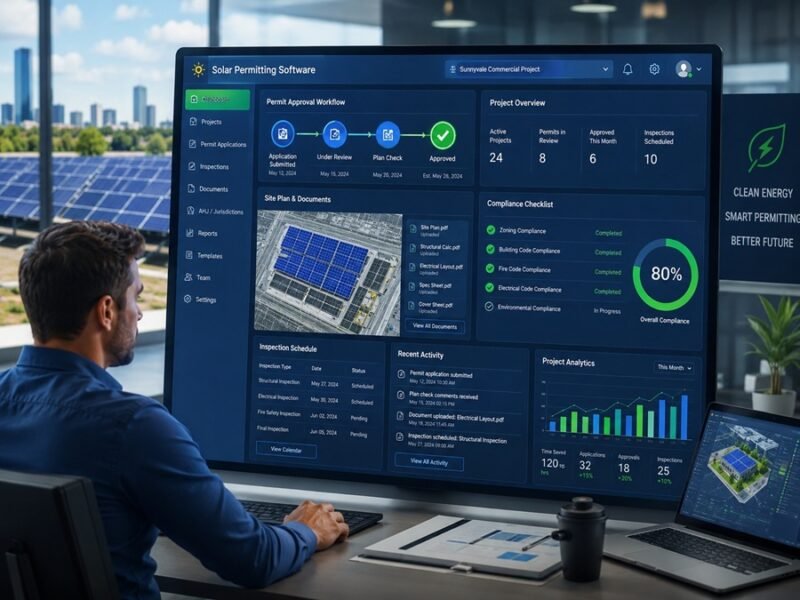
The solar energy industry is growing at a remarkable pace. According to the Solar Energy Industries Association (SEIA), the U.S. solar market is now a multi-billion-dollar industry — and installations are happening faster than ever before.
But here’s the challenge: getting a solar project approved is still painfully slow.
For most solar installers and EPC contractors, permit management is one of the biggest bottlenecks. Paperwork, local code variations, inspection delays, and back-and-forth communication with local authorities drain time, money, and team morale.
That’s exactly where solar permitting software comes in. These purpose-built digital platforms streamline the entire permit lifecycle — from application to approval — so your team can focus on what really matters: installing more solar.
What Is Solar Permitting Software?
Solar permitting software is a specialized digital tool designed to automate, manage, and track the permitting process for solar energy installations. It replaces manual, paper-based workflows with a centralized system that handles everything from permit package generation to AHJ (Authority Having Jurisdiction) submissions.
At its core, this software handles:
- Automated permit document creation based on project specifications
- AHJ database integration for jurisdiction-specific code compliance
- Digital document management and e-signatures
- Real-time project tracking from submission to final approval
- Inspection scheduling and coordination with local officials
Think of it as a project management platform built specifically for the unique regulatory demands of solar installation work. Whether you’re a solo residential installer or a large-scale utility developer, it simplifies what used to be a week-long manual process into something that takes hours.
Why Solar Projects Face Permit Delays
Before we dive into the solution, it helps to understand the problem. Permit delays are one of the top reasons solar projects go over budget and miss timelines.
Here are the most common culprits:
1. Complex and Inconsistent Local Regulations
Every jurisdiction has its own set of rules. What’s accepted in one county might be rejected in the next. Solar contractors working across multiple cities or states have to navigate a maze of local building codes, zoning laws, and fire safety requirements — all of which can differ significantly.
2. Manual Paperwork and Human Error
Traditional permitting relies heavily on paper forms, spreadsheets, and email chains. A single missing signature, wrong document version, or incorrectly filled form can send a project back to square one.
3. Communication Gaps Between Contractors and Authorities
When permits are rejected or additional information is requested, the back-and-forth between solar teams and permit offices is often slow and unstructured. Without a centralized system, things get lost in inboxes.
4. Inspection Scheduling Bottlenecks
Even after a permit is approved, scheduling inspections with local authorities can add weeks to a project timeline — especially during peak installation seasons.
These delays aren’t just frustrating. They directly impact revenue, customer satisfaction, and business growth.
Key Features of Solar Permitting Software
The best solar permitting tools pack a powerful set of features designed specifically for the solar industry’s compliance needs. Here’s what to look for:
Automated Permit Generation
The software pulls project data — system size, equipment specs, site layout — and automatically generates jurisdiction-compliant permit packages. No more manually filling out forms for every project.
AHJ Database Integration
A comprehensive AHJ approval software maintains an up-to-date database of local codes, fee schedules, and submission requirements. When you start a new project, it automatically applies the correct rules for that specific jurisdiction.
Digital Document Management
All plans, engineering documents, product datasheets, and permits are stored in a centralized cloud repository. Your team can access, update, and share documents from anywhere — no more searching through email folders.
Inspection Scheduling
Integrated scheduling tools let you coordinate inspections directly through the platform, send automated reminders to inspectors and project managers, and track inspection outcomes in one place.
Real-Time Project Tracking
From the moment a permit application is submitted, every status update is visible on a live dashboard. You can see where each project stands — pending, under review, approved, or flagged for correction — at a glance.
Compliance Verification
Built-in compliance checks flag potential issues before submission, reducing rejection rates and helping teams stay ahead of code updates.
E-Signatures and Digital Submissions
Most modern platforms support legally binding e-signatures and allow direct electronic submission to permit offices that accept digital applications — eliminating physical trips and postal delays.
Cloud-Based Team Collaboration
Multiple stakeholders — engineers, project managers, sales teams, and subcontractors — can collaborate on the same project within a shared workspace, reducing miscommunication and duplication of effort.
Reporting Dashboards
Management teams get high-level visibility into permit status across the entire project portfolio — a critical feature for scaling solar businesses managing dozens or hundreds of simultaneous projects.
Benefits of Using Solar Permitting Software
Investing in a dedicated solar permit management platform delivers measurable results. Here’s what solar businesses typically experience:
- Faster project approvals — Automated workflows and pre-checked documents reduce submission errors and speed up AHJ reviews by days or even weeks.
- Reduced administrative workload — Your team spends less time on paperwork and more time on high-value tasks.
- Improved compliance accuracy — Real-time code databases mean fewer rejected applications and fewer costly corrections.
- Lower operational costs — Less rework, fewer delays, and reduced administrative overhead directly improve project margins.
- Better cross-team communication — Centralized platforms keep everyone aligned, from sales to engineering to installation crews.
- Faster solar installation timelines — Quicker permits mean installations happen sooner, customers are happier, and your pipeline moves faster.
- Scalability — As your business grows, the software grows with you — handling more projects without proportional increases in admin staff.
For growing solar businesses, the ROI on a quality solar installation workflow platform can be significant within the first few months of use.
How Solar Installers Use Solar Permitting Software: A Step-by-Step Workflow
To make this concrete, here’s how a typical residential solar project flows through a digital permitting system:
Step 1 — Project Creation The project manager creates a new project in the software, entering the customer’s address, property details, and system design specifications.
Step 2 — Site Data Upload Site survey data, shading analysis, and roof measurements are uploaded. The software maps the address to the correct AHJ jurisdiction automatically.
Step 3 — Automated Permit Package Generation The platform generates a complete permit package — including electrical diagrams, structural calculations, equipment specifications, and required forms — tailored to the local authority’s specific requirements.
Step 4 — Submission to Local Authorities The permit package is submitted directly through the platform, either electronically to digital-ready offices or formatted for manual drop-off where required. Submission confirmation is logged automatically.
Step 5 — Inspection Coordination Once the permit is approved, the team uses the integrated scheduling tool to book the required inspections. Automated reminders keep all parties on track.
Step 6 — Approval Tracking Real-time status updates notify the project manager of any requests for corrections, approvals, or inspection outcomes — so nothing falls through the cracks.
Step 7 — Final Project Completion With all permits approved and inspections passed, the project is marked complete in the system. Final documentation is archived securely in the cloud for future reference.
This kind of structured solar project management workflow reduces the average permitting time significantly compared to manual processes.
Who Benefits Most from Solar Permitting Software?
Solar permitting software isn’t just for large corporations. It delivers value across the entire solar industry:
- Residential solar installers managing high volumes of rooftop projects across multiple jurisdictions
- Commercial solar companies dealing with complex multi-site permits and longer approval cycles
- EPC (Engineering, Procurement, and Construction) contractors who need to coordinate across engineering, procurement, and field teams simultaneously
- Renewable energy firms operating at a utility scale where compliance and documentation requirements are especially demanding
- Utility-scale solar developers managing large ground-mount systems that involve federal, state, and local permitting layers
Even smaller installation teams with just a few projects a month benefit from the reduced error rates and faster approval timelines.
Common Challenges Without Solar Permitting Software
Without a dedicated permit automation software solution, solar companies often run into a predictable set of problems:
- Project bottlenecks caused by one person holding all permit documentation manually
- Human errors on application forms that trigger rejection and restart the entire submission process
- Missed compliance requirements because local codes changed and no one was notified
- Revenue delays as projects sit idle waiting for permits that could have been expedited
- Poor customer experience from extended timelines that erode trust and referrals
- Difficulty scaling when every new project adds more administrative burden to an already stretched team
For businesses serious about growth, sticking with manual permitting is increasingly a competitive disadvantage.
The Future of Solar Permitting Technology
The solar compliance tools space is evolving rapidly. Here’s what’s on the horizon:
AI-Powered Permit Automation
Machine learning models are being trained to predict permit outcomes, flag likely rejections before submission, and suggest document corrections in real time.
Smart Compliance Systems
Future platforms will auto-update local code databases as regulations change — so your team always submits compliant documentation without manual research.
CRM and ERP Integration
Leading renewable energy software platforms are increasingly connecting with CRM tools (like Salesforce) and ERP systems to create fully connected business operations — from sales lead to system commissioning.
Mobile Permitting Tools
Field crews can already access permit documents on mobile devices. Next-generation tools will allow real-time permit status checks, digital inspection sign-offs, and on-site document capture from smartphones.
GIS and Satellite Integration
Geographic Information System (GIS) tools combined with satellite imagery will make site assessments and permit document generation even faster and more accurate.
Faster Municipal Approval Systems
More local governments are adopting digital permitting portals. Solar permitting software that integrates directly with these portals will make the submission-to-approval cycle dramatically shorter.
How to Choose the Best Solar Permitting Software
With several platforms on the market, here’s a practical checklist for evaluating your options:
- Ease of use — Can your team learn it quickly without extensive training?
- AHJ database coverage — Does it cover the jurisdictions where you operate?
- Integration capabilities — Does it connect with your CRM, project management, or accounting tools?
- Scalability — Will it handle your project volume as your business grows?
- Customer support — Is there responsive technical support when issues arise?
- Pricing model — Is it per-project, per-seat, or subscription-based? Does it fit your budget?
- Security and cloud access — Is project data encrypted and accessible securely from any device?
Request a demo before committing. Most reputable platforms offer trial periods or pilot programs.
Conclusion
The solar industry is moving fast — and permit management should not be the thing that slows you down.
Solar permitting software transforms one of the most time-consuming parts of solar project delivery into an efficient, automated, and traceable workflow. It reduces human error, accelerates approvals, improves compliance, and lets your team scale without being buried in paperwork.
Whether you’re a residential installer looking to shorten your project timelines or an EPC contractor managing complex multi-site projects, investing in the right solar project management and permitting platform is one of the smartest operational decisions you can make right now.
The future of solar is digital. The companies that embrace that reality today will be the ones leading the industry tomorrow.
Frequently Asked Questions (FAQs)
Q1. What is solar permitting software used for?
Solar permitting software is used to automate and manage the permitting process for solar energy installations. It generates permit packages, tracks submission statuses, schedules inspections, and ensures compliance with local AHJ requirements — replacing slow, manual paperwork-based workflows.
Q2. How does solar permitting software speed up project approvals?
By automatically generating jurisdiction-specific permit documents, flagging compliance issues before submission, and providing real-time status tracking, solar permitting software significantly reduces the back-and-forth with local authorities. This can cut approval timelines from several weeks to just a few days in many cases.
Q3. Is solar permitting software suitable for small solar installation businesses?
Yes. While large EPC companies and utility developers benefit greatly, smaller installers also gain from reduced administrative work, fewer rejected applications, and faster project completions. Many platforms offer pricing tiers suitable for businesses of all sizes.
Q4. What is an AHJ in the context of solar permitting?
AHJ stands for Authority Having Jurisdiction — the local government body responsible for enforcing building and electrical codes in a specific area. Solar permitting software typically includes an AHJ database that stores jurisdiction-specific requirements, making it easier to create compliant permit applications for any location.
Q5. Can solar permitting software integrate with other tools?
Yes. Leading solar permitting platforms offer integrations with CRM systems, project management tools, ERP platforms, and even CAD design software. These integrations help create a seamless workflow from sales and design through installation and final approval.