


Introduction: Starting a Business in India Has Its Own Paperwork — Here’s One You Can’t Miss
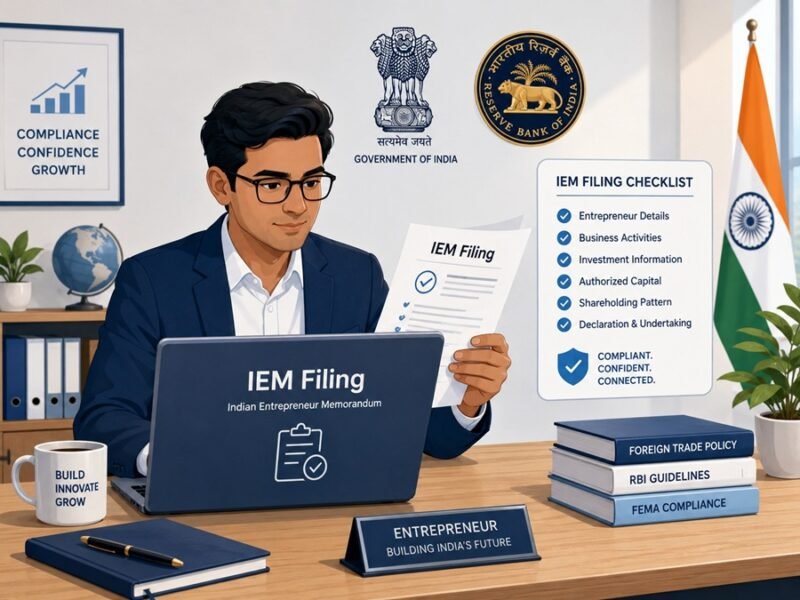
If you’re planning to set up a manufacturing unit or an industrial business in India, chances are you’ve come across the term “Industrial Entrepreneurs Memorandum” — or IEM. It sounds formal, maybe even a little intimidating. But once you understand what it actually is and why the government requires it, the whole process becomes a lot less confusing.
Think of IEM as your industry’s official introduction to the Government of India. It’s a declaration that says, “Hey, I’m setting up this business, here’s what I’ll be producing, and here’s the investment I’m putting in.” You’re not asking for permission — you’re informing the government, and that’s an important distinction.
This guide breaks it all down in plain language — what IEM is, who needs to file it, how the process works, and what happens after you submit. Whether you’re a first-time entrepreneur or a business owner expanding operations, this is one compliance step you want to get right from day one.
What Is Industrial Entrepreneurs Memorandum (IEM)?
The Industrial Entrepreneurs Memorandum, commonly known as IEM, is a mandatory filing that industrial units in India must submit to the Department for Promotion of Industry and Internal Trade (DPIIT) — which operates under the Ministry of Commerce and Industry, Government of India.
Here’s the key context: Under the Industries (Development and Regulation) Act, 1951, certain industries in India require an Industrial License before they can start production. However, a large number of industries have been de-licensed over the years, meaning they no longer need prior government approval to set up operations.
For these de-licensed industries, the IEM is the required compliance step. Instead of applying for a license, entrepreneurs simply inform the government of their intent to set up an industrial unit. This notification system was introduced as part of India’s broader economic liberalisation reforms, aimed at reducing red tape and making it easier to do business.
In simple terms:
- Licensed industries → Require Industrial License before starting
- De-licensed industries → Require filing of IEM (notification, not approval)
The IEM system reflects the government’s shift toward a trust-first, ease-of-doing-business approach — entrepreneurs are trusted to self-declare their project details, and the government maintains a record for planning and monitoring purposes.
Who Needs to File an IEM?
Not every business in India needs to file an IEM. This requirement applies specifically to industrial undertakings that meet the following conditions:
- The business falls under a de-licensed sector (most manufacturing sectors today are de-licensed)
- The proposed investment is above ₹10 crore (this threshold has evolved over the years, so always verify the current limit with DPIIT)
- The unit is engaged in manufacturing or processing activities covered under the IDR Act, 1951
Small Scale Industries (SSIs) and Micro, Small & Medium Enterprises (MSMEs) below the prescribed investment threshold are generally exempt from IEM filing. They follow separate registration processes under the Udyam Registration system.
If you’re unsure whether your business falls under a licensed or de-licensed category, it’s advisable to consult a professional or check the official government portal. Speaking to qualified industrial entrepreneur memorandum consultants can save you time and help avoid mistakes in documentation.
Why Is IEM Important? The Business Case for Compliance
You might wonder — if it’s just a notification and not an approval, why does it matter so much?
Here’s the thing: the IEM isn’t just about ticking a compliance box. It serves several practical purposes that directly benefit your business:
1. Legal Standing Filing the IEM establishes your industrial unit as formally recognised in government records. This is important for future interactions with government departments, especially for subsidies, incentives, and land allotments.
2. Access to Industrial Benefits Many state and central government schemes — including incentives for power, land acquisition, and export promotion — require you to produce your IEM acknowledgment as proof of your status as a registered industrial unit.
3. Required for Bank Financing Banks and financial institutions often ask for the IEM number when processing term loans for industrial projects. It signals that your project is genuine and government-acknowledged, which builds credibility.
4. Monitoring and National Industrial Planning The government uses IEM data to map industrial growth across sectors and regions. Your filing contributes to national economic data, which in turn informs infrastructure planning and policy decisions.
5. IEM Number — Your Unique Business Identifier Once your IEM is filed and accepted, you receive an IEM number (also called an acknowledgment number). This is a unique reference that identifies your industrial project in all government records. Keep it safely — you’ll need it for future correspondence with DPIIT and other agencies.
How to File an IEM: Step-by-Step Process
The good news is that the entire IEM filing process has been digitised. You no longer need to visit a government office or submit physical paperwork. The filing is done through the eBiz portal — the government’s integrated services platform.
Step 1 — Visit the Official eBiz Portal
Go to the government’s single-window portal at ebiz.gov.in (also referred to in official documentation as the “ebiz gov content services filing industrial entrepreneurs memorandum” platform). This portal integrates multiple central and state government services for businesses.
Step 2 — Register or Log In
Create an account on the eBiz portal if you haven’t already. If you have an existing account, simply log in with your credentials.
Step 3 — Access the IEM Filing Service
Navigate to the DPIIT services section. Look for “Industrial Entrepreneurs Memorandum” under the industrial registration or new project services.
Step 4 — Fill in the IEM Form
The IEM form typically requires the following information:
- Name and address of the industrial undertaking
- Type of industry and National Industry Classification (NIC) code
- Products to be manufactured and their quantities
- Proposed capital investment (plant and machinery)
- Location of the plant (state, district)
- Source of raw materials
- Employment to be generated
- Power requirement
- Market (domestic/export)
Fill in all sections carefully and accurately. Errors in IEM filings can lead to delays or complications down the line.
Step 5 — Submit and Pay (If Applicable)
Review your entries and submit the form. In most cases, there is a nominal processing fee. Once submitted, you’ll receive an acknowledgment receipt with your unique IEM number.
Step 6 — Receive Your IEM Acknowledgment
The acknowledgment is typically issued electronically and is available for download from your eBiz account. This document confirms that your IEM has been filed and is now on record with DPIIT.
Pro Tip: Always download and store a copy of your IEM acknowledgment in both digital and printed form. It is a key document for multiple future regulatory and financial processes.
IEM vs. Industrial License: Understanding the Difference
This is one of the most common points of confusion, so let’s clear it up directly.
| Feature | IEM (Memorandum) | Industrial License |
|---|---|---|
| Nature | Notification/Declaration | Prior Permission |
| Required for | De-licensed industries | Licensed industries |
| Approval needed | No | Yes |
| Processing time | Quick (online) | Longer |
| Government review | For records only | Active evaluation |
| When issued | At project intent stage | Before production begins |
India has progressively reduced the list of industries requiring compulsory licensing. Today, only a handful of sectors — primarily those related to defence, hazardous chemicals, and a few others — still require a formal Industrial License. The vast majority of manufacturing businesses go through the IEM route.
Role of IEM Consultants — Do You Need One?
Filing an IEM is not extremely complicated, but for larger or more complex projects, many entrepreneurs choose to work with industrial entrepreneur memorandum consultants — professionals who specialise in industrial regulatory compliance.
These consultants can help you:
- Identify the correct NIC codes for your product line
- Ensure your application is complete and error-free
- Coordinate documentation across multiple government departments
- Advise on state-level industrial policies that may apply alongside your IEM filing
If your project involves significant investment, multiple product lines, or any grey areas in classification, professional guidance is worth considering. You can find registered consultants through industry chambers like CII, FICCI, or ASSOCHAM, or through reputable business advisory platforms.
For more information on industrial business strategy, regulatory updates, and entrepreneurship guidance, platforms like Apzo Media provide regularly updated resources that can support informed business decision-making.
Common Mistakes to Avoid When Filing IEM
Based on real-world experience from business owners and industry consultants, here are the errors that most commonly cause problems during or after IEM filing:
- Incorrect NIC Code: Using the wrong National Industry Classification code for your product
- Underestimating Investment: Declaring lower capital investment than planned — this can cause mismatches later
- Incomplete Product Details: Not clearly specifying the products and quantities to be manufactured
- Ignoring State-Level Compliances: IEM is a central government requirement; many states have additional industrial registrations that run parallel
- Not Updating DPIIT Post-Commencement: After you begin production, you’re required to submit a production commencement report; many entrepreneurs forget this step
After Filing: What Comes Next?
Filing the IEM is not a one-time-and-done affair. There are important follow-up steps that ensure your compliance remains in good standing:
Commencement of Production Report Once your industrial unit begins production, you must inform DPIIT through a production commencement report. This closes the loop on your IEM and updates government records with your actual output data.
Annual Returns Depending on the scale of your operations and sector, you may be required to submit periodic returns to DPIIT or your state industrial authority.
Amendments If you expand your product range, increase capacity, or change your location, you need to file an amendment to your existing IEM. You cannot simply continue operating under old IEM details if major project parameters have changed.
Frequently Asked Questions (FAQ)
Q1. What is an IEM number and where do I find it?
The IEM number is a unique acknowledgment number issued by DPIIT once your Industrial Entrepreneurs Memorandum is successfully filed. It serves as your project’s official identifier in government records. You can find it on the acknowledgment document downloaded from the eBiz portal after submission.
Q2. Is IEM the same as Udyam Registration for MSMEs?
No, these are two separate registrations. Udyam Registration is for Micro, Small, and Medium Enterprises (MSMEs) and is managed through the MSME Ministry. IEM is for larger industrial undertakings that fall under the IDR Act and are handled by DPIIT. Businesses may need both, depending on their size and sector.
Q3. How long does IEM filing take online?
The online IEM filing process through the eBiz portal is fairly quick — the form can typically be completed and submitted within a few hours if all documents and information are ready. The acknowledgment is usually generated instantly or within a short processing window.
Q4. Can I file IEM without a consultant?
Yes, you can file IEM yourself through the eBiz portal. The online system is designed to be user-friendly. However, for large projects or complex product classifications, working with an experienced industrial consultant can help avoid errors and save time.
Q5. What happens if I start production without filing IEM?
Operating an industrial unit that is required to file IEM without doing so puts you in violation of the Industries (Development and Regulation) Act, 1951. This can lead to regulatory action, disqualification from government incentives, and complications when seeking bank financing or government approvals in the future. Always file before commencing operations.
Conclusion: IEM Is a Foundation Step — Get It Right from the Start
The Industrial Entrepreneurs Memorandum may not be the most glamorous part of starting a business, but it is one of the most foundational. It formally positions your industrial unit within India’s regulatory framework and opens doors to government schemes, bank financing, and institutional credibility.
The process is now entirely online, relatively straightforward, and accessible to any entrepreneur with a clear business plan and the right documentation. Whether you’re setting up a food processing unit in Gujarat, a textile plant in Tamil Nadu, or a metal fabrication facility in Maharashtra — if your project meets the IEM criteria, filing it is not optional.
Take the time to understand the form, fill it accurately, and follow up with the post-commencement requirements. If in doubt, consult a professional. The cost of getting IEM right from day one is far less than the cost of fixing regulatory problems later.
India’s industrial ecosystem is growing fast — make sure your business grows with the right foundation in place.
For more business insights, regulatory guides, and entrepreneurship resources, visit Apzo Media.