



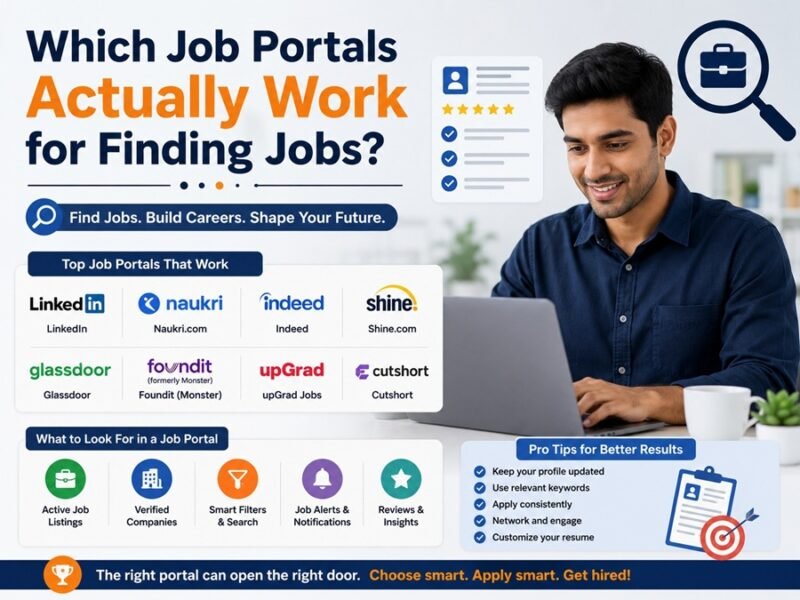
Almost every job seeker asks the same question: “Should I use Naukri or LinkedIn? I keep applying on Indeed, but nothing is working.”
Here’s the honest answer: no single portal is “the best.” Each platform is built for a different purpose. The confusion happens when people apply the same way everywhere and expect the same result.
This article breaks down every major job portal in practical terms — who it actually works for, what to watch out for, and a simple strategy that can genuinely get you more interview calls.
First, Understand This: The “Best” Portal Depends on Your Profile
Job portals compete on traffic and volume. But what matters to you is your response rate — how many applications actually turn into interview calls.
So the first step is figuring out which category you fall into:
- Fresher or student
- Experienced professional (IT or non-IT)
- Blue-collar or frontline job seeker
- Freelancer or remote worker
- Government job aspirant
Now let’s look at which portal fits each one.
Naukri — India’s Largest Job Database
Naukri.com has been running since 1997 and still holds one of India’s largest resume databases. Recruiters, especially at IT services companies like TCS, Infosys, and Wipro, rely heavily on Naukri for bulk hiring.
When to use it:
- You’re an experienced professional (2+ years)
- You’re targeting IT services or corporate roles
- You want recruiters to find you through resume database search
Things to watch out for:
- Spam calls are a real issue — expect unrelated sales or insurance calls once your number is listed
- The interface feels a bit dated
- Startups and product companies are less active here
LinkedIn — Best for Networking and Quality Connections
LinkedIn isn’t just a job portal, it’s a professional network. You don’t just apply here — you can directly connect with people at the company, which is sometimes more powerful than the application itself.
When to use it:
- You’re looking at mid-to-senior roles, or IT and startup positions
- You want to quietly signal “Open to Work” to recruiters only
- You want to try referrals or direct outreach
Practical tip: Before applying, send a short, polite message to someone who works at the company. A personalized message gets a far better response than a random application.
Indeed — Fast, Free, and Wide Reach
Indeed is an aggregator — it pulls listings from multiple sources, including company career pages directly. Its biggest strength is speed and free access.
When to use it:
- You want to see a large number of openings quickly
- You’re looking for entry-level or high-volume hiring roles
- You want to set up job alerts and search passively
Things to watch out for:
- Listings can be duplicate or expired
- Don’t click “Easy Apply” blindly — check the company details first
- There’s no networking feature here
Apna and WorkIndia — Best for Freshers and Blue-Collar Jobs
If you’re in a Tier 2 or Tier 3 city, or looking for a blue-collar or frontline job, mobile-first apps like Apna and WorkIndia are far more practical.
What works well here:
- Support for regional languages
- Verified employers with a direct chat option
- Quick apply — sometimes interviews happen the same day
For high-volume roles like delivery, retail, customer support, or data entry, these apps often deliver faster results than Naukri or LinkedIn.
Niche and Specialist Portals
If your field is specific, a niche site usually works better than a generic one:
- Instahyre / Hirect — Tech roles, faster recruiter matching
- Internshala — Freshers, internships, campus hiring
- Wellfound (formerly AngelList) — Startup jobs
- Foundit (formerly Monster India) — Traditional IT and mid-level roles
- Government portals (NCS, UPSC, SSC) — Official sources for government jobs
Niche platforms have less competition, so matches tend to be more relevant.
How to Avoid Job Portal Scams
Whichever portal you use, keep these red flags in mind:
- No legitimate company ever asks for a “registration fee” or “training fee”
- Real interviews always happen over video or in person, never just over text or email
- Bank details or ID numbers are only asked for at the offer stage, not during application
- If a salary sounds too good to be true, verify it before going further
A Simple Strategy That Actually Works
Depending on just one portal is the biggest mistake job seekers make. This approach tends to work better:
- Pick one all-rounder — Naukri or LinkedIn, based on your category
- Add one niche portal — matched to your industry
- Keep your profile 100% complete — incomplete profiles rank lower in recruiter search
- Apply within 24 hours — early applicants on new postings get noticed more
- Check the company’s career page too — some jobs are only posted there, not on any portal
Quality applications will always beat quantity.
FAQs
Q1. Is it fine to rely on just one job portal?
No. Combining one all-rounder portal (Naukri or LinkedIn) with a niche platform usually works better.
Q2. Which portal is best for freshers?
Internshala and Apna work well for freshers, especially for internships and entry-level roles.
Q3. Why do I get fewer responses on LinkedIn?
LinkedIn has more competition, and most people apply without personalizing anything. A short message or a referral can noticeably improve your response rate.
Q4. Do I need a paid job portal subscription?
Not necessarily. Free versions work well if your profile is properly optimized. Paid features mostly boost visibility — they don’t guarantee results.
Q5. How do I spot a fake job listing?
If someone asks for a fee, or the entire interview happens over chat with no video call, treat it as a red flag.
Related Article: RRB NTPC UG Application Status 2026 Released