


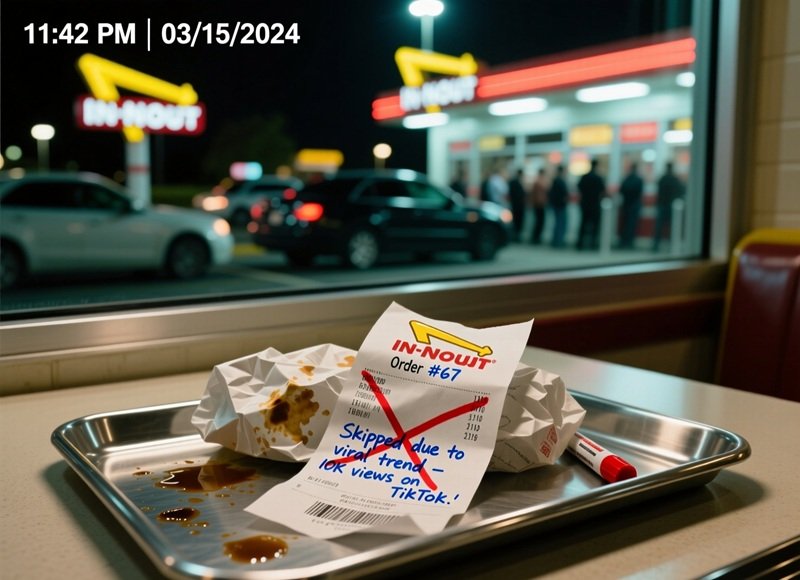
If you’ve visited an In-N-Out Burger recently and wondered why the order numbers jumped strangely from 66 to 68, you aren’t imagining things. The West Coast burger giant has officially pulled the number 67 from its ordering system.
Why? It’s not a glitch—it’s a direct response to a viral TikTok trend that turned a simple lunch rush into a chaotic spectacle.
For weeks, mobs of teenagers have been flooding locations, phones recording, waiting for the moment an employee calls out “Order 67!” to erupt into cheers. Now, In-N-Out has had enough. Here is everything you need to know about the ban, the “6-7” phenomenon, and why this specific number caused such a headache.
What is the “6-7” Trend?
To understand why a fast-food chain would alter its Point of Sale (POS) system, you have to look at the bizarre world of Gen Alpha humor.
The “6-7” trend (pronounced six-seven) is a viral internet sensation that took over TikTok in late 2025. It’s categorized as “brainrot” humor—content that is intentionally nonsensical, repetitive, and confusing to anyone outside the demographic.
The Origins
The obsession traces back to a few key cultural moments:
- The Anthem: Underground rapper Skrilla’s track “Doot Doot (6 7)” features the ad-lib “6-7” on a loop.
- The Athlete: NBA star LaMelo Ball, who stands 6’7″, became the face of the meme in fan edits.
- The Action: The trend involves shouting “Six-Seven!” while weighing your hands up and down like a scale.
It doesn’t have a deep philosophical meaning. It’s an inside joke for the internet, and In-N-Out just happened to become the stage for it.
Why In-N-Out Banned Number 67
In-N-Out prides itself on efficiency and a family-friendly atmosphere. The “6-7” trend disrupted both.
According to reports from employees on Reddit and confirmation from outlets like People, the decision was operational. When the order number 67 was called, groups of teens would scream, jump, and film the employees.
The disruption caused:
- Service Delays: Staff couldn’t hand out food amidst the mock celebrations.
- Noise Complaints: The sudden eruptions of noise disturbed other diners.
- Privacy Issues: Employees were being filmed non-consensually for TikTok content.
An employee at a Los Angeles location noted that the system update was pushed quietly in November 2025. Now, after order 66 is taken, the next receipt automatically prints as 68.
Insider Insight: This isn’t the first time In-N-Out has censored its receipt tape. The number 69 has been banned from their system for years due to its sexual connotation. The number 67 is now the second casualty of maturity (or lack thereof).
In-N-Out vs. Other Brands: The “No-Nonsense” Approach
While In-N-Out chose to shut the trend down, other competitors decided to cash in. This highlights a massive difference in brand identity.
| Brand | Response to “6-7” Trend |
|---|---|
| In-N-Out | Banned it. Removed the number to maintain order and tradition. |
| Wendy’s | Monetized it. Launched a limited-time 67-cent Frosty deal. |
| Pizza Hut | Embraced it. Offered 67-cent wings to attract younger customers. |
In-N-Out has historically avoided gimmicks. They don’t change their menu, they don’t do wacky collabs, and they clearly don’t want their dining rooms turning into TikTok soundstages.
The Employee Perspective
If you look at online forums where In-N-Out associates congregate, the mood is overwhelmingly relieved.
One worker shared on a thread, “We stopped calling it out weeks ago. Kids would just stand there waiting for it, not even ordering food sometimes. It was exhausting.”
Another noted that the “6-7” ban is actually a mercy for the staff, who were becoming unwilling extras in thousands of social media videos. By skipping the number, the chain effectively “breaks” the game—if the number never comes up, the prank doesn’t work.
Frequently Asked Questions
1. Is number 67 permanently banned at In-N-Out? Yes, for the foreseeable future. Much like number 69, which was removed years ago, it is unlikely to return until the cultural association with the number completely fades, which could take years.
2. What happens if I am the 67th customer? You won’t know it. The Point of Sale (POS) system is programmed to skip the integer entirely. Your receipt will simply print “Order #68,” and the customer before you will have “Order #66.”
3. Did In-N-Out release an official statement? No. In-N-Out is famously private and rarely issues press releases regarding internal operational changes. The confirmation came through store employees and direct observation by customers and journalists.
4. Why is the “6-7” trend so popular? It is a classic example of “brainrot” or Gen Alpha humor, where the humor lies in the repetition and the confusion it causes older generations. It went viral due to the catchiness of the Skrilla song and the popularity of NBA player LaMelo Ball.
5. Are other fast food places banning it? No other major chains have reported banning the number. In fact, brands like Wendy’s used the number for discounts. In-N-Out’s unique ordering system, where numbers are called out loud via microphone, made them uniquely vulnerable to the disruption.
Final Thoughts
The removal of number 67 is a fascinating case study in how digital culture impacts physical reality. What started as a harmless lyric in a rap song evolved into a real-world headache for one of America’s most beloved burger chains.
In-N-Out’s decision reinforces their brand values: food first, nonsense second. While teens might be disappointed they can’t get their viral clip, the rest of us are just happy to get our Double-Double a little faster.