
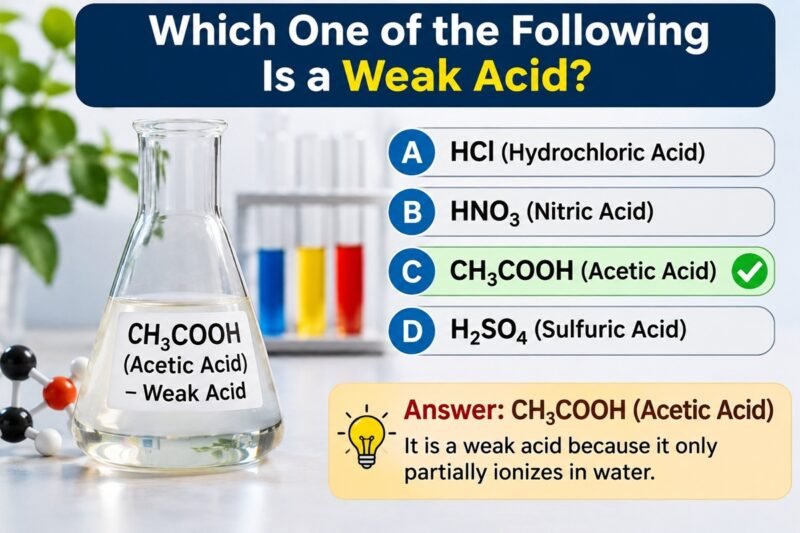



Acetic acid (CH₃COOH) is the weak acid you will most often find in this question, because it only partly breaks apart in water. If the options also list HCl, HNO₃, H₂SO₄, HBr, HI or HClO₄, rule those out, since they are strong acids, and pick the acid that remains.
Which One of the Following Is a Weak Acid?
A weak acid is an acid that only partly ionizes in water, so most of its molecules stay intact. Acetic acid is the classic case: in a 0.10 M solution, only about 1.3% of its molecules release a hydrogen ion.
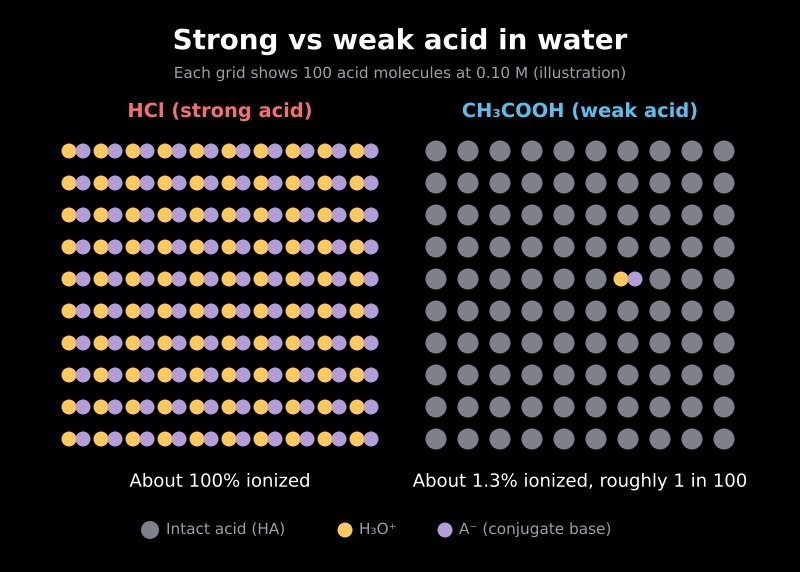
The reaction runs in both directions, which is why chemists write it with a double arrow:
\mathrm{HA} + \mathrm{H_2O} \rightleftharpoons \mathrm{H_3O^+} + \mathrm{A^-}The acid dissociation constant, Ka, tells you how far that reaction goes:
K_a = \frac{[\mathrm{H_3O^+}][\mathrm{A^-}]}{[\mathrm{HA}]}A small Ka, well below 1, marks a weak acid. The pKa is the negative log of Ka, so a larger pKa means a weaker acid. Acetic acid has a Ka of about 1.8 × 10⁻⁵ and a pKa of about 4.76.
At Pro Business Cop, we write for people who need an answer fast and need to trust it. So this guide gives you the answer first, then a method you can reuse, then the proof.
Which acids are strong? Rule these out first
Six acids cover almost every strong-acid question in school and early college chemistry. Learn them once, and for common acids in water, anything else on the list is weak.
| Strong acid | Formula | Worth remembering |
|---|---|---|
| Hydrochloric acid | HCl | Found in stomach acid |
| Hydrobromic acid | HBr | Stronger than HCl |
| Hydroiodic acid | HI | One of the strongest hydrohalic acids |
| Nitric acid | HNO₃ | Strong, unlike nitrous acid (HNO₂) |
| Sulfuric acid | H₂SO₄ | Strong for the first proton only |
| Perchloric acid | HClO₄ | Among the strongest common acids |
Some sources count seven strong acids by adding chloric acid (HClO₃), as PrepScholar’s list does. Many textbooks stop at six. Follow the list in your own course notes, because that is the one your exam will use.
The Pro Business Cop 4-step method for any “which one is weak” question
Run these four checks in order. Steps 1 and 2 settle most questions, and steps 3 and 4 catch the tricky ones.
- Screen out the strong acids. Cross off HCl, HBr, HI, HNO₃, H₂SO₄ and HClO₄. If the options are HCl, HNO₃, CH₃COOH and HClO₄, only CH₃COOH survives, so it is the weak acid.
- Read the Ka or pKa if the question gives one. A Ka below 1 (a pKa above 0) points to a weak acid. The bigger the pKa, the weaker the acid.
- Apply the structure rules. Three patterns cover most of what you will see:
- Hydrohalic acids: HCl, HBr and HI are strong, but HF is weak.
- Oxoacids: count the oxygen atoms that are not bonded to hydrogen. Two or more usually means strong (HNO₃, H₂SO₄, HClO₄). Zero or one means weak (HClO, HNO₂, H₃PO₄). A rough estimate is pKa ≈ 8 − 5n, where n is that count.
- Carboxylic acids (anything ending in COOH): almost always weak, as with acetic, formic, citric and benzoic acid.
- Test the conjugate base. The conjugate bases of strong acids, such as Cl⁻ and NO₃⁻, do not affect pH. The conjugate base of a weak acid does. A 0.10 M sodium acetate solution has a pH of about 8.9, which is the fingerprint of a weak parent acid.
Weak acid examples ranked by strength
The table runs from the strongest weak acid to the weakest. For comparison, every strong acid from the earlier list has a pKa below 0.
| Weak acid | Formula | Approx. Ka | Approx. pKa | Where you meet it |
|---|---|---|---|---|
| Phosphoric acid | H₃PO₄ | 7.1 × 10⁻³ | 2.15 | Cola |
| Hydrofluoric acid | HF | 6.8 × 10⁻⁴ | 3.17 | Glass etching |
| Nitrous acid | HNO₂ | 4.5 × 10⁻⁴ | 3.35 | Lab reagent |
| Formic acid | HCOOH | 1.8 × 10⁻⁴ | 3.75 | Ant stings |
| Benzoic acid | C₆H₅COOH | 6.3 × 10⁻⁵ | 4.20 | Food preservative |
| Acetic acid | CH₃COOH | 1.8 × 10⁻⁵ | 4.76 | Vinegar |
| Carbonic acid | H₂CO₃ | 4.3 × 10⁻⁷ | 6.37 | Soda water, blood |
| Hydrogen sulfide | H₂S | 1.0 × 10⁻⁷ | 7.0 | Rotten egg smell |
| Hypochlorous acid | HClO | 3.0 × 10⁻⁸ | 7.53 | Pool disinfection |
| Hydrocyanic acid | HCN | 6.2 × 10⁻¹⁰ | 9.21 | Almond-like smell, very toxic |
These are rounded textbook values at about 25 °C, and they shift slightly between sources. Check your course textbook or the CRC Handbook of Chemistry and Physics before quoting them in an exam answer.
Real examples of weak acids you already know
Most acids you meet outside a lab are weak. Each one below follows the same rule: partial ionization and a modest Ka.
- Vinegar (acetic acid). Household vinegar is usually 4% to 8% acetic acid, with a pH around 2.4 to 3.4. That is acidic enough to loosen limescale in a kettle, yet mild enough for a salad dressing.
- Cola (phosphoric acid). Many colas use phosphoric acid for tang and sit near pH 2.5. Phosphoric acid has a pKa of about 2.15, which makes it one of the stronger weak acids.
- Lemons (citric acid). Lemon juice has a pH of about 2, and citric acid is the main reason. It can release up to three hydrogen ions per molecule, but each one comes off only partially.
- Blood (carbonic acid). Carbonic acid and bicarbonate work as a buffer that holds blood pH between 7.35 and 7.45. A weak acid makes a good buffer because the acid and its conjugate base sit side by side in the same solution.
- Ant stings (formic acid). The name comes from formica, the Latin word for ant. Formic acid is the simplest carboxylic acid, with a pKa of about 3.75.
- Soft drinks and pickles (benzoic acid). Benzoic acid and its salts slow the growth of yeasts and moulds, and they work best in acidic drinks and foods.
Worked example: how weak is acetic acid next to HCl?
Take two solutions, both at 0.10 M. HCl is strong, so it ionizes fully and gives 0.10 M hydronium ions.
Acetic acid is weak, so you use its Ka of 1.8 × 10⁻⁵. Because only a small fraction ionizes, you can estimate the hydronium concentration with a shortcut:
[\mathrm{H_3O^+}] \approx \sqrt{K_a \times C} = \sqrt{(1.8 \times 10^{-5})(0.10)} \approx 1.3 \times 10^{-3}\ \mathrm{M}| Solution (0.10 M) | [H₃O⁺] | pH | Share ionized |
|---|---|---|---|
| HCl | 0.10 M | 1.00 | About 100% |
| Acetic acid | 0.0013 M | 2.87 | About 1.3% |
The shortcut is safe here because the ionized share is under 5%. The result is roughly 75 times fewer hydrogen ions from the weak acid at the same concentration, which is what “weak” means in practice.
One more detail that exams like to test: dilution changes the picture. At 0.0010 M, acetic acid is about 12.5% ionized, so a weak acid ionizes more as you dilute it.
Tricky cases that fool students
These six traps cause most wrong answers on weak acid questions.
- HF is weak, even though HCl, HBr and HI are strong. The H-F bond is the strongest of the hydrogen halide bonds, at roughly 570 kJ/mol versus about 430 for H-Cl, 365 for H-Br and 300 for H-I. The small fluoride ion also stays tightly paired with water and with other HF molecules. Its Ka is about 6.8 × 10⁻⁴.
- H₂SO₄ is strong only for its first proton. The hydrogen sulfate ion, HSO₄⁻, has a Ka of about 1.2 × 10⁻² and ionizes only partly. If HSO₄⁻ appears as an option, it counts as the weak acid.
- Same elements, different oxygen count. Nitric acid (HNO₃) is strong, but nitrous acid (HNO₂) has a pKa of about 3.35. Perchloric acid (HClO₄) is strong, but hypochlorous acid (HClO) has a pKa of about 7.5.
- Strong is not the same as concentrated. Strength is the share of acid that ionizes, while concentration is how much acid is dissolved. Glacial acetic acid is nearly pure, so it is a concentrated weak acid, and it still burns skin.
- Weak does not mean safe. Hydrofluoric acid is weak, yet it penetrates skin and binds calcium in the body, so labs that use it keep calcium gluconate gel on hand. Hydrocyanic acid is weak and highly toxic.
- One carboxylic acid breaks the pattern. Trifluoroacetic acid has a pKa of roughly 0.2 to 0.5, far stronger than acetic acid at 4.76. Exam questions rarely use it, but it shows that the COOH rule has limits.
Practice questions with answers
Try each question with the 4-step method before you look at the answer column. The first three are warm-ups, and the rest add Ka values and oxoacid rules.
| # | Question | Answer | Why |
|---|---|---|---|
| 1 | Which one is a weak acid: HCl, HNO₃, CH₃COOH or HClO₄? | CH₃COOH | The other three are on the strong acid list. |
| 2 | Which one is a weak acid: HBr, HI, HF or HCl? | HF | It is the only hydrohalic acid that ionizes partly. |
| 3 | Which one is a weak acid: HNO₃, HNO₂, H₂SO₄ or HClO₄? | HNO₂ | It has one non-hydroxyl oxygen and a pKa of about 3.35. |
| 4 | Which one is a weak acid: H₃PO₄, HCl, HI or HBr? | H₃PO₄ | Its first pKa is about 2.15, and the other three are strong. |
| 5 | Which one is a weak acid: HClO₄, HNO₃, HClO or HCl? | HClO | It has no non-hydroxyl oxygen and a pKa of about 7.5. |
| 6 | Which is the weakest acid: HCOOH, CH₃COOH, HF or HCN? | HCN | It has the smallest Ka, about 6.2 × 10⁻¹⁰. |
| 7 | Which one is NOT a weak acid: CH₃COOH, HCOOH, HF or HI? | HI | It is a strong hydrohalic acid. |
| 8 | Which are weak acids: acetic acid, formic acid, carbonic acid, or all of the above? | All of the above | Each one ionizes only partly in water. |
Frequently asked questions about weak acids
Is HF a weak acid?
Yes. Hydrofluoric acid only partly ionizes in water because the H-F bond is unusually strong. Its Ka is about 6.8 × 10⁻⁴.
Is H₂SO₄ a weak or strong acid?
Strong. Its first proton ionizes completely, and exam questions treat sulfuric acid as a strong acid. Only the second proton, from HSO₄⁻, ionizes partly.
Is vinegar a weak acid?
Yes. Vinegar is a dilute solution of acetic acid, usually 4% to 8%, and acetic acid has a pKa of about 4.76.
Is carbonic acid a weak acid?
Yes. Its first pKa is about 6.4, so very little of it ionizes. That is why plain soda water is only mildly acidic.
How many strong acids are there?
Most textbooks list six: HCl, HBr, HI, HNO₃, H₂SO₄ and HClO₄. Some lists add HClO₃ to make seven.
How do I tell which of two acids is weaker?
Compare their Ka values. The acid with the smaller Ka, or the larger pKa, is the weaker one.
Is a weak acid always safer than a strong acid?
No. Strength measures how much an acid ionizes, not how much damage it can do. Hydrofluoric acid and glacial acetic acid are both weak and both cause serious burns.
The short version
To find the weak acid in any list, remove the strong acids first, then check for the exceptions. The weak acids that appear most often are acetic acid, HF, HNO₂, H₃PO₄, carbonic acid and HCN.
Keep two traps in mind: HF is weak even though its neighbors are strong, and the second proton of sulfuric acid ionizes only partly. If a question gives you Ka or pKa, trust the numbers over memory.
Pro Business Cop built this guide so you can reach the right answer quickly and explain why it is right. Next time you meet “which one of the following is a weak acid,” run the four steps and you will not need to guess.
Must Read: How to Solve “Abha and Ritu Were Partners” (CBSE Class 12 Accountancy)






One response to “Which One of the Following Is a Weak Acid? A 4-Step Method With Real Examples”