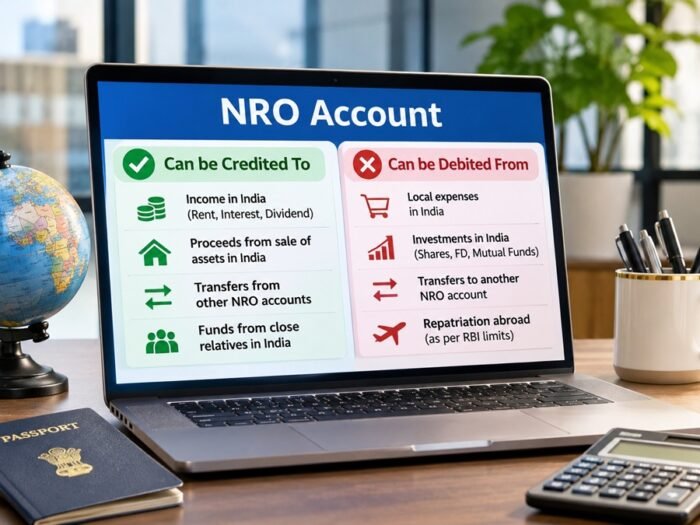



Non-resident Indians (NRIs) often need to manage income earned in India alongside their financial commitments overseas. Understanding which transactions are permitted through a non-resident ordinary (NRO) account helps them receive domestic income, pay expenses and transfer eligible funds according to applicable regulations. Knowing the rules for credits, debits and outward remittances can also help account holders maintain accurate financial records.
What is an NRO account?
An NRO account allows NRIs to hold and manage income earned in India, such as rental income, dividends, pension payments and other eligible receipts. It can be maintained as a savings, current, fixed deposit or recurring deposit account, subject to the bank’s offerings and applicable regulations.
Unlike a non-resident external (NRE) account, which is primarily intended for eligible foreign earnings brought into India, an NRO account is commonly used for domestic income and expenses.
What can be credited to an NRO account?
The Reserve Bank of India (RBI) permits eligible credits to an NRO account under the applicable foreign exchange regulations. These may include:
- Income earned in India: Rental income, pension payments, dividends and interest from eligible Indian investments
- Sale proceeds: Proceeds from eligible assets or investments in India, subject to applicable regulations and documentation
- Transfers from other NRO accounts: Permitted transfers from another eligible NRO account
- Funds from overseas: Remittances from abroad through permitted banking channels, subject to applicable rules
- Eligible transfers from NRE accounts: Transfers permitted under the applicable regulations
Account holders should retain supporting documents for significant credits, particularly those arising from property sales, investments or other transactions that may require evidence of the source of funds.
What can be debited from an NRO account?
An NRO account can be used for permitted payments and transfers in India. Common debit transactions include:
- Domestic expenses: Payments for household expenses, utilities, medical costs and other legitimate commitments in India
- Investment-related payments: Eligible payments towards investments in India, subject to applicable rules
- Transfers to other NRO accounts: Transfers between eligible NRO accounts
- Transfers to NRE accounts: Permitted transfers, subject to applicable conditions, documentation and tax compliance
- Overseas remittances: Eligible outward remittances, subject to the prescribed limits and documentation
The permissibility of a transaction depends on its purpose, source of funds and applicable regulatory requirements. Banks may request supporting documents before processing certain transfers.
What documents may be required?
The documents required depend on the transaction and the bank’s verification procedures. Commonly requested records include:
- Bank statements showing the source of funds
- Rental agreements, dividend statements or pension records, where relevant
- Property sale documents or investment records for applicable proceeds
- PAN details and tax payment evidence, where required
- Remittance forms and declarations requested by the bank
For outward remittances, the bank may also require tax-related forms and a certificate from a chartered accountant, depending on the transaction and applicable tax provisions.
How can an NRO account support these transactions?
An NRO account should provide convenient access to domestic banking services while supporting eligible transfers and regulatory compliance.
What should you check before opening an account?
Before you open an NRI account, confirm that the account type matches your income sources and intended transactions. Review the bank’s eligibility requirements, transaction facilities, applicable charges and documentation checklist.
Also, check how interest is calculated and credited to your account, along with the terms and conditions that apply. Understanding these details can help you choose an account that suits your financial goals.
Conclusion
Understanding permitted credits and debits helps NRIs manage Indian income, pay domestic expenses and transfer eligible funds overseas. Reviewing regulatory conditions, maintaining supporting records and selecting an appropriate account can make these transactions more straightforward.
- What types of income can be credited to an NRO account?
An NRO account can receive eligible income earned in India, including rental income, dividends, pension payments and interest from Indian investments. Other permitted credits may include inward remittances and transfers from other NRO accounts, subject to applicable regulations.
- Can money be transferred from an NRO account to an overseas bank account?
Yes. Eligible funds can be remitted overseas, subject to applicable tax requirements, documentation and repatriation rules. Current income and other eligible balances may be subject to different conditions.
- Is there a limit on transferring funds abroad from an NRO account?
Eligible balances other than current income can generally be repatriated up to USD 1 million per financial year, subject to applicable conditions and documentation. Current income, such as rent, dividends and interest, is subject to separate rules and should not automatically be treated as part of this limit.
- What documents may be required for transactions through an NRO account?
Depending on the transaction, a bank may request account statements, proof of the source of funds, tax-related documents and supporting records for the payment or remittance. Additional forms or declarations may be required for outward transfers.
- Can I open an NRI account online to manage income earned in India?
Some banks provide digital facilities for eligible non-resident applicants, subject to identity verification, KYC requirements and the bank’s procedures. Before applying, check the documentation required and whether the available account facilities suit your income sources and intended transactions.