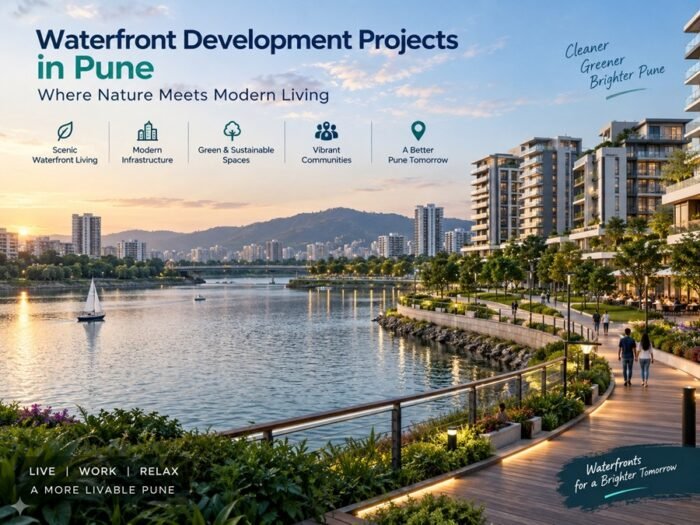



Pune’s skyline is getting a new focal point, and it’s not a building. It’s the river. For decades, the Mula and Mutha rivers ran through the city mostly ignored, boxed in by slums, garbage, and broken embankments. That’s changing fast, and it’s turning into one of the biggest urban transformation stories in western India right now.
Expert Tip / Practical Advice
Local Tip: If you’re planning to visit the riverfront or scout property nearby, don’t just check the official completion date and assume everything is open. Right now, only a small segment of Phase 1 (about 1.5 km out of the 3.7 km stretch from Sangamwadi to Bund Garden) is actually accessible to the public. Call ahead or check PMC’s local updates before you plan a visit, and if you’re eyeing riverfront-facing property, ask the builder exactly which phase your unit overlooks. “Riverfront view” in a brochure can sometimes mean a phase that’s still years away.
What Is the Pune Waterfront Development Project?
The Pune waterfront development project is a large-scale urban rejuvenation plan by the Pune Municipal Corporation to redevelop the banks of the Mula and Mutha rivers into walkable public spaces. It covers close to 44 km of riverfront and comes with a price tag between ₹4,727 crore and ₹5,500 crore, making it one of the costliest civic projects Pune has ever undertaken.
If you’ve been searching for updates on this project, here’s the short version: construction started in 2023, the first public stretch opened in early 2026, and the full plan will roll out across multiple phases over the next few years.
Quick Answer
Waterfront development projects in Pune are currently led by the Mula-Mutha Riverfront Development, a ₹4,727–5,500 crore initiative by the Pune Municipal Corporation covering nearly 44 km along the Mula and Mutha rivers. The first public stretch, from Sangamwadi to Bund Garden, opened in February 2026, with walkways, plazas, and green spaces, while the remaining phases are still under construction.
Mula-Mutha Riverfront Development: Quick Overview
Officially called the Mula-Mutha Riverfront Development, this isn’t a fresh idea. Talk of engineering Pune’s rivers goes back over a hundred years, with the first proposal dating to 1918. What’s different this time is the scope.
Here’s what the project actually includes:
- Paved walkways and cycling tracks along both riverbanks
- Public plazas, seating areas, and green landscaped zones
- Ghats and steps leading down to the water
- Boundary walls and embankments to control flooding
- Basic amenities like toilets, eateries, and parking near key access points
- New land created through controlled reclamation along the riverbed, meant for public infrastructure rather than private construction
The project isn’t limited to one river. It spans three distinct stretches:
| River Section | Length |
|---|---|
| Mula River | 22.2 km |
| Mutha River | 10.4 km |
| Mula-Mutha combined stretch | 11.8 km |
| Total | ~44 km |
That’s a lot of ground to cover, which is why the whole thing is being executed in phases rather than one single launch.
Who Is Building It: PMC’s Role and Vision
The Pune Municipal Corporation is the developer and the driving force behind this entire project, and that matters because it means the riverfront is public infrastructure, not a private real estate development. PMC isn’t just laying walkways here. Its goals for the project run wider than that:
- Clean up and rejuvenate rivers that had become dumping grounds for decades
- Create flood-resilient embankments after Pune’s repeated monsoon flooding scares
- Give the city a genuine public recreation space, something Pune has always been short on compared to its population size
- Boost the ecological health of the Mula-Mutha river system, not just its appearance
Think of it as PMC trying to do what Ahmedabad did with the Sabarmati Riverfront years ago, adapted to Pune’s own geography and civic priorities. The vision is simple on paper: turn a neglected river into the kind of public space people actually want to spend time at. Whether execution matches that vision is something we’ll get into later in this guide, especially around the land reclamation debate that’s picked up steam in 2026.
Pune Riverfront Project: Key Facts at a Glance
Here’s every number you’re likely searching for, in one place.
| Detail | Information |
|---|---|
| Official Name | Mula-Mutha Riverfront Development |
| Developer | Pune Municipal Corporation (PMC) |
| Groundbreaking | 2023 |
| Total Cost | ₹4,727–5,500 Crore |
| Total Length | ~44 km |
| Phase 1 Stretch | Sangamwadi to Bund Garden (3.7 km) |
| Phase 1 Status | Nearing completion, ~90% done |
| Public Access | Partial opening from February 15, 2026 |
| Land Reclamation | ~1,544 acres along riverbed and banks |
| Key Benefiting Areas | Koregaon Park, Kalyani Nagar |
Project Timeline: From Groundbreaking to 2026 Opening
Construction on the Pune riverfront project began in 2023, and PMC opened the first public stretch to residents in February 2026, with the remaining phases expected to follow over the next few years. The project is being executed in three broad stages, and none of them are happening on the same clock.
Phase 1: Sangamwadi to Bund Garden (3.7 km)
This is the stretch everyone’s talking about right now.
- Total length: 3.7 km
- Work completion: around 90% as of early 2026
- Public opening: started February 15, 2026, but only a 1.5 km segment was made accessible at launch
- What’s there: walking paths, landscaped sections, and initial public amenities
Phase 2 and Phase 3: What’s Coming Next
PMC hasn’t released a firm public date for full completion of Phase 2 and Phase 3, but based on current construction pace, these stretches will extend the riverfront experience further along both the Mula and Mutha rivers. Expect these phases to bring in more plazas, ghats, and connecting bridges as they progress.
Current Construction Status
Here’s the honest picture as of 2026:
- Phase 1 is nearly done, with a small portion already open to the public
- Phase 2 and 3 are still under active construction
- Full project completion is targeted for 2026, though large public infrastructure projects in India often see this stretch further
If you’re planning a visit or checking on property near a specific stretch, don’t assume the entire 44 km is walkable yet. It isn’t.
Where Is the Pune Riverfront Located? (Coverage Area)
The Pune riverfront project runs along three river stretches, the Mula, the Mutha, and the combined Mula-Mutha, cutting through some of the city’s most recognisable neighbourhoods.
Mula River Stretch (22.2 km)
This is the longest section of the project, running through areas on the western and northern side of the city. It’s also where a lot of upcoming residential development is concentrated, since this stretch has more room for embankment work and green space.
Mutha River Stretch (10.4 km)
The Mutha stretch cuts through more central, established parts of Pune. Expect this section to see heavier footfall once complete, simply because it’s closer to older residential pockets and commercial hubs.
Mula-Mutha Combined Stretch (11.8 km)
This is where the two rivers meet, and it includes the Sangamwadi to Bund Garden stretch, which is exactly where Phase 1 is happening. Sangamwadi literally means “confluence point,” so it makes sense PMC chose this section to launch first. It’s central, visible, and symbolic.
What Can You Do at the New Pune Riverfront?
Right now, you can walk, cycle, and relax along the open 1.5 km segment near Sangamwadi and Bund Garden, with more facilities opening as construction wraps up. Once fully complete, the riverfront is designed to function as a proper public recreation zone, not just a scenic backdrop.
Walking and Cycling Tracks
Dedicated paved tracks run along the riverbank, separated from vehicle traffic. These are built for daily use, not just weekend visits, so expect to see joggers, cyclists, and evening walkers becoming a regular sight here.
Public Plazas, Ghats, and Green Spaces
- Open plazas for gathering and events
- Ghats and steps leading down toward the water
- Landscaped green patches with seating
- Planned eateries and small retail spots near access points
Entry Timings and Visitor Guidelines
Official timings for the fully public sections hadn’t been broadly confirmed at the time of Phase 1’s partial opening in February 2026. If you’re planning a visit, check PMC’s official riverfront page or local news updates closer to your visit date, since access points and timings are likely to expand as more sections open.
Impact on Pune Real Estate: Which Areas Benefit Most
Riverfront-adjacent localities in Pune, especially Koregaon Park and Kalyani Nagar, are seeing renewed real estate interest as the project progresses, with property consultants noting steady price appreciation in these pockets. This isn’t unique to Pune. Cities with successful waterfront redevelopment almost always see nearby property values move first.
Koregaon Park and Kalyani Nagar: Premium Hotspots
Koregaon Park was already Pune’s most prestigious address before the riverfront project, and this development is adding another layer to that reputation.
- Property rates in Koregaon Park have touched ₹22,000+ per sq. ft. for premium projects
- The locality has maintained steady 5-6% year-on-year price growth
- Riverfront completion, combined with improving Metro connectivity, is being cited as a direct contributor to the area’s renewed appeal
- Land scarcity in KP means new supply is limited, which keeps pushing demand toward existing and upcoming riverside projects
Kalyani Nagar is following a similar pattern, benefiting from its direct river frontage and proximity to established commercial zones.
How Riverfront Access Is Changing Property Valuations
Here’s the pattern showing up across most waterfront cities, and Pune is no exception:
- Homes and offices with a direct or near-direct river view tend to command a price premium over similar units further inland
- Walkability and green space access are increasingly factored into buyer decisions, not just square footage
- Developers are actively marketing “riverfront-facing” or “riverfront-proximity” as a selling point, sometimes before the actual facing stretch is complete
Should You Invest Near the Pune Riverfront?
If you’re considering a purchase, treat this as general market information rather than a guarantee of returns; property decisions should account for your own financial situation and, ideally, professional advice.
A few practical things worth checking before you commit:
- Confirm which specific project phase your chosen property actually overlooks, since “riverfront view” can sometimes refer to a stretch still years from completion
- Check MahaRERA registration for any project you’re considering
- Compare recent price trends in the specific micro-market, not just the broader locality
- Factor in ongoing construction disruption if you’re buying in a stretch still under active work
Environmental and Civic Concerns Around the Project
The Pune riverfront project has real environmental trade-offs, the most significant being the reclamation of roughly 1,544 acres of riverbed and bank land, which has raised concerns among environmental groups and residents. It’s worth understanding both sides here rather than treating the project as purely a win.
Land Reclamation and Ecological Impact
Under the river conservation and beautification scheme, PMC plans to build embankments and carry out landfilling along the river, creating new land for walkways, ghats, plazas, and other public infrastructure. Critics point out that large-scale reclamation of this kind can:
- Narrow the river’s natural flow path
- Disturb existing riverbank ecosystems
- Increase construction load along stretches that were previously untouched
This isn’t a uniquely Pune problem. Ahmedabad’s Sabarmati project faced almost identical criticism, with reports noting the river channel there was narrowed from an average width of 382 metres down to 275 metres during construction.
Flood Resilience: Does the Project Actually Reduce Flood Risk?
PMC’s stated goal is to improve flood resilience through better embankments and controlled river training. In theory, this should help during heavy monsoon years. In practice, the outcome depends heavily on execution quality and whether the narrowed river channel can still handle peak monsoon discharge without backing up into surrounding areas. This is a genuine open question until Pune sees a few full monsoon cycles post-completion.
Citizen and Expert Reactions
Reactions on the ground have been mixed:
- Many residents are excited about finally having accessible green public space along the river
- Environmental experts and some citizen groups remain cautious about the scale of reclamation and its long-term ecological cost
- Real estate stakeholders are largely positive, given the visible uptick in interest around riverside localities
How Pune’s Riverfront Compares to Other Indian Waterfront Projects
Pune’s riverfront is often compared to Ahmedabad’s Sabarmati Riverfront, and while the two share a similar vision, they differ quite a bit in scale, cost, and approach.
Sabarmati Riverfront (Ahmedabad) vs Pune Riverfront
| Aspect | Sabarmati Riverfront | Pune Riverfront |
|---|---|---|
| Groundbreaking | 2005 | 2023 |
| Public Opening | Since August 2012, phase-wise | February 2026, phase-wise |
| Estimated Cost | ~₹1,400 crore (as of 2019) | ₹4,727–5,500 crore |
| River Type | Monsoon-fed, needed Narmada canal water for flow | Mula-Mutha, natural perennial-ish flow |
| Land Reclamation | ~190-200 hectares (roughly 500 acres) | ~1,544 acres |
| Key Criticism | Channel narrowing, resettlement of over 12,000 families | Scale of land reclamation, ecological impact |
What Pune Is Doing Differently
A few things stand out when you compare the two:
- Pune’s reclamation footprint is significantly larger relative to its river length, which is exactly why local environmental concerns have been louder and earlier this time around
- Sabarmati relied on diverted Narmada canal water to maintain a “riverfront” look, since the Sabarmati itself runs dry for parts of the year; Pune’s rivers don’t face the same issue
- Pune’s project cost is more than three times Sabarmati’s original budget, reflecting both inflation and a larger scope
- Sabarmati took over a decade to reach meaningful public completion after groundbreaking; Pune is aiming for a much faster phase-wise rollout, though only time will confirm if that holds
Frequently Asked Questions
Q1. Is the Pune riverfront open to the public yet?
Partially, yes. PMC opened a 1.5 km segment of the first phase (Sangamwadi to Bund Garden) to the public starting February 15, 2026. The full 3.7 km Phase 1 stretch is close to complete, but the remaining two phases are still under construction.
Q2. How much does the Pune riverfront project cost?
Estimates for the Mula-Mutha Riverfront Development range between ₹4,727 crore and ₹5,500 crore, depending on the source and how the scope is calculated. It’s funded and executed by the Pune Municipal Corporation, making it one of the city’s biggest-ever civic investments.
Q3. Which areas in Pune will benefit most from the riverfront project?
Localities directly along the river stand to gain the most, especially Koregaon Park and Kalyani Nagar. These are already premium addresses, and easier access to a landscaped, walkable riverfront is expected to add further appeal to residential and commercial properties there.
Q4. Is the Pune riverfront project environmentally safe?
It’s debated. The project includes flood-resilience measures and river rejuvenation goals, which are genuine positives. But it also involves reclaiming close to 1,544 acres of riverbed and bank land for construction, which environmental groups and residents have raised concerns about.
Conclusion: What This Means for Pune’s Future
Pune’s riverfront project is one of those rare civic developments that’s going to reshape how people actually experience the city, not just how it looks on a map. A walkable, green stretch along the Mula and Mutha rivers gives Pune something it’s genuinely lacked: accessible public space at this scale.
That said, this isn’t a story without friction. The land reclamation numbers are real, the ecological trade-offs are real, and the pace of Phase 2 and 3 will tell us a lot about whether PMC can deliver on the full 44 km vision or whether Pune ends up with a partially finished promise, the way some large Indian infrastructure projects do. For now, the early signs, a functioning public stretch, rising interest in riverside real estate, and a clear phased plan, suggest this project has a real shot at becoming what Sabarmati became for Ahmedabad. Whether it gets there faster or with fewer compromises is the part worth watching over the next couple of years.
This coverage of waterfront development projects in Pune is brought to you by APZO Media, your trusted source for real-time news and insights on India’s evolving cities.