



Getting a call about “Tallyman Axis Bank” and not sure whether to panic? You are not alone. Thousands of Axis Bank customers search tallyman axis every month, usually right after a missed EMI or an overdue credit card bill triggers a phone call they were not expecting.
Here is the short version before we go deep: Tallyman is not a scam, not a separate company chasing you, and not something Axis Bank built to intimidate customers. It is a piece of collections software the bank has been using for over a decade. Once you understand what it actually does, most of the fear around it disappears.
This guide covers where the name comes from, why the calls happen, what your rights are under RBI rules, and exactly what to do next.
What Is Tallyman Axis Bank? (The Real Origin, Not Guesswork)
Most articles online describe axis tallyman as “a system Axis Bank uses for collections” without saying where it came from. That vague explanation is part of why the calls feel unsettling. So let’s clear it up properly.
Tallyman is a debt collection and recovery software product built by Experian, the global credit information company you probably already know from CIBIL-linked services. Axis Bank licensed Experian’s Tallyman software back in 2013 to manage its debt collection and recovery operations across India, as confirmed in Experian’s own corporate announcement at the time.
In simple terms, when your EMI or credit card bill goes unpaid, your account details get logged into this Experian-built software. The software then organizes overdue accounts, decides which ones need a call, an SMS, or a field visit, and routes that task to a recovery agent. It is the same category of tool banks use for fraud checks or loan approvals, just applied to collections instead.
So the next time you hear “this call is regarding your Tallyman account,” what that actually means is: this call is regarding your overdue payment, tracked through Axis Bank’s collections software.
Why Are You Getting Tallyman Axis Bank Calls?
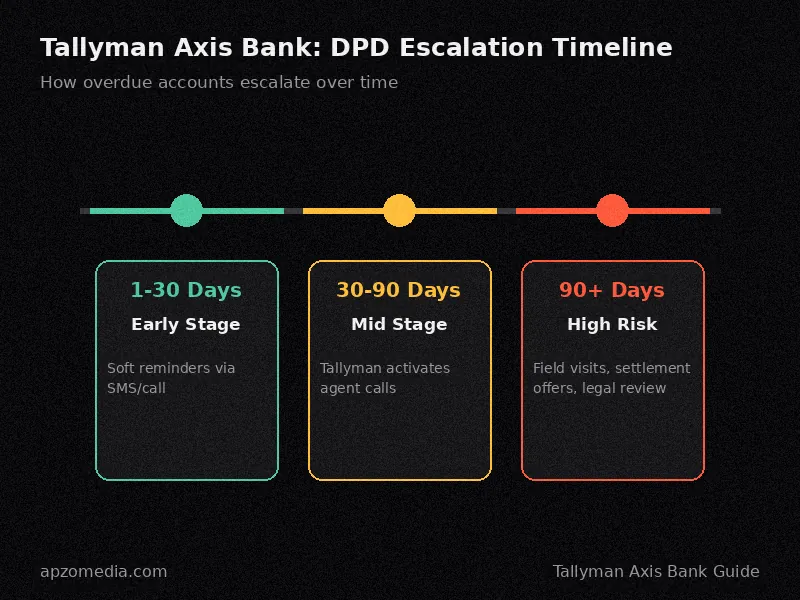
Calls do not go out randomly. The tallyman axis collection process flags an account only when something specific triggers it. Here is what usually causes it.
Missed EMI payment. If you have a personal loan, home loan, or car loan and an installment does not go through on the due date, the account gets flagged almost immediately. Even one missed EMI on a home loan of say 35 lakhs can trigger a reminder call within a few days.
Credit card dues left unpaid. This is the most common trigger. If you paid the minimum amount due on your credit card bill but not the full outstanding, or missed the payment entirely, the system picks it up in the next billing cycle.
Payment made but not reflected. This happens more often than people expect. Say you paid your EMI through UPI but the bank’s system had a delay in updating it. You might still get a call even though you already paid, simply because the software has not caught up yet.
Long-pending dues across cycles. If dues have been unpaid for several months, the account moves into a higher-risk category and contact frequency increases.
| Loan or Card Type | Typical Trigger | Usual DPD Stage |
|---|---|---|
| Credit card | Minimum due unpaid | 1 to 30 days |
| Personal loan | Missed EMI | 1 to 30 days |
| Home loan | Missed EMI | 1 to 30 days, escalates faster due to loan size |
| Auto loan | Missed EMI | 1 to 30 days |
DPD stands for Days Past Due. It is simply how many days it has been since your payment was due.
Is Tallyman Axis Bank Safe or a Scam?
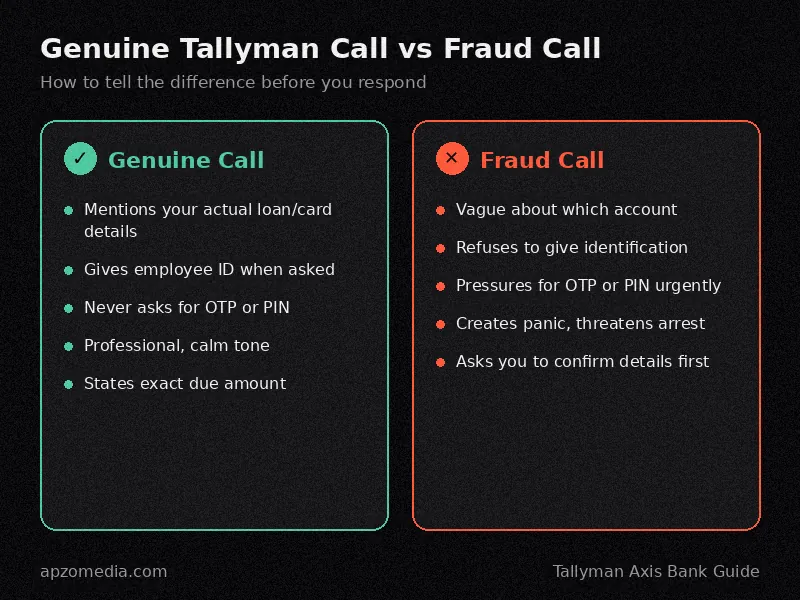
No, axis bank tallyman is not a scam. It is part of Axis Bank’s official recovery infrastructure, running on Experian’s licensed software as explained above, and it operates within the RBI’s Fair Practices Code for lenders. That said, the term “Tallyman” has become well known enough that scammers sometimes use it to sound legitimate. This is where you need to be careful.
Here is how to tell the difference.
| Genuine Axis Bank Call | Likely Fraud Call |
|---|---|
| Mentions your actual loan account or card details | Vague about which account, asks you to confirm details first |
| Caller gives an employee ID and branch or agency name when asked | Refuses or dodges when asked for identification |
| Never asks for OTP, PIN, or net banking password | Pressures you to share OTP or PIN urgently |
| Professional tone, references actual due amount | Creates panic, threatens arrest or legal action immediately |
If you want to verify a call is genuine, hang up and call Axis Bank’s official customer care number yourself, or check your outstanding dues directly through the app. Never call back a number the caller gave you.
How the Axis Bank Recovery Process Works, Step-by-Step
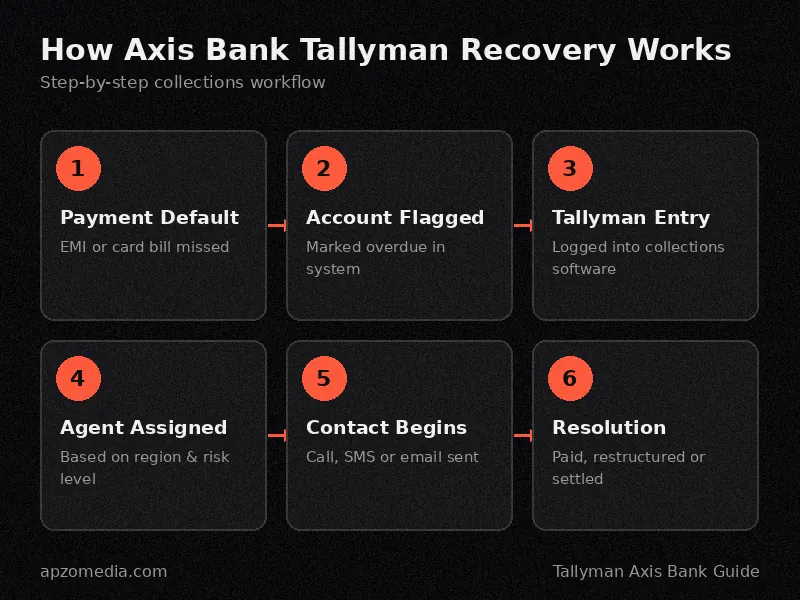
Understanding this workflow helps you know exactly where your account stands and what happens next.
Step 1: Payment default occurs. You miss an EMI or credit card payment.
Step 2: Account gets flagged as overdue. The bank’s system classifies your account into a DPD bucket based on how many days have passed.
Step 3: Entry into the Tallyman system. Your account details move into the collections software for tracking.
Step 4: Recovery agent assignment. An agent gets assigned based on your region, the risk level of the account, and your repayment history.
Step 5: Contact begins. You start receiving calls, SMS reminders, or emails.
Step 6: Resolution. You either pay the dues, request restructuring, or in some cases, discuss a settlement.
For unsecured products like personal loans and credit cards, this debt collection process stays mostly limited to calls and reminders in the early stages. For secured loans like home and auto loans, the bank has stronger legal tools available if dues remain unpaid for a long time, which we cover below.
Your Rights Under RBI’s Fair Practices Code
This is the part most guides on this topic skip entirely, and it is genuinely useful to know.
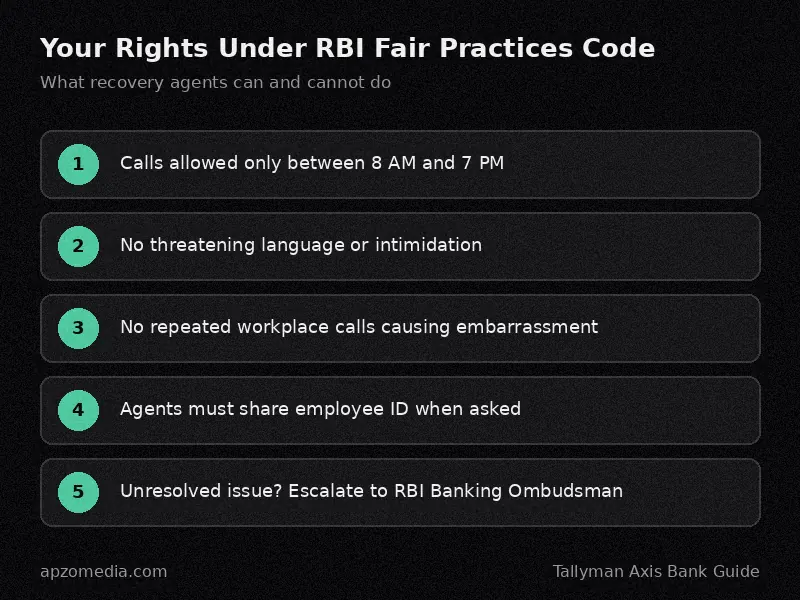
The Reserve Bank of India requires all banks, including Axis Bank, to follow a Fair Practices Code when it comes to loan recovery. This means:
- Recovery calls can only be made between 8 AM and 7 PM.
- Agents cannot use threatening language, abusive behavior, or intimidation tactics.
- You cannot be contacted repeatedly at your workplace in a way that causes embarrassment or harassment.
- Recovery agents must identify themselves clearly, including their employee ID, when asked.
If a call crosses these lines, you have a real path to complain, not just a theoretical one.
Step 1: Contact Axis Bank’s Grievance Redressal Officer directly. Every bank is required to have one, and Axis Bank publishes this contact information on its official website under customer care or grievance redressal.
Step 2: If the issue is not resolved within 30 days, or you are unhappy with the resolution, you can escalate to the RBI Banking Ombudsman. This is a free, RBI-run complaint resolution service specifically for banking grievances like harassment during recovery calls.
Knowing this process turns a stressful situation into a manageable one. You are not powerless here.
How to Check Your Outstanding Dues
Before responding to any call, it is worth checking your actual account status yourself. Here is how.
Through the Axis Mobile app:
- Open the app and log in with your credentials.
- Go to the Loans or Cards section depending on what you are checking.
- Select the specific account to view outstanding balance, due date, and payment history.
Through net banking:
- Log in to Axis Bank internet banking.
- Navigate to Accounts, then select Loans or Credit Cards.
- Check the statement or outstanding summary for the exact pending amount.
Through customer care: Call Axis Bank’s official customer care number listed on their website and provide your registered mobile number or account details for verification.
Doing this takes five minutes and immediately tells you whether a call you received is accurate, outdated, or possibly fraudulent.
What Happens If You Ignore Tallyman Calls?
Ignoring the calls does not make the underlying issue go away. It usually makes things more complicated.
Late payment penalties get added according to your loan or card terms, increasing what you owe.
Your CIBIL score takes a hit. Missed payments get reported to credit bureaus, and this can affect your ability to get approved for future loans or credit cards, sometimes for years.
Recovery contact increases in frequency and intensity, including field visits in cases where dues remain unpaid for extended periods.
For secured loans specifically, home loans and auto loans work differently from unsecured debt. If dues on a home loan remain unpaid for a long stretch, the bank can eventually invoke provisions under the SARFAESI Act, which allows lenders to take possession of the mortgaged property without going through lengthy court proceedings first. This is a serious consequence that applies specifically to secured loans and is worth knowing if you have a home or auto loan with Axis Bank.
This is exactly why responding early, even just to explain a temporary financial difficulty, tends to work out better than silence.
How to Handle a Tallyman Axis Bank Call the Right Way
Verify first. Ask for the caller’s employee ID and the branch or agency they are calling from.
Cross-check your account. Use the app or net banking to confirm the outstanding amount and due date match what the caller is saying.
Never share sensitive information. No genuine Axis Bank recovery call will ever ask for your OTP, ATM PIN, or net banking password. If someone asks for these, end the call immediately.
Respond based on your situation. If the dues are genuine and you can pay, do it through official banking channels and keep the transaction receipt. If you are facing a temporary financial crunch, ask about restructuring options. Axis Bank, like most lenders, generally prefers working out a repayment plan over letting an account go into deeper default.
Tallyman Axis Bank vs Other Bank Recovery Systems
Axis Bank is not unique in using specialized collections software. Most major Indian banks run similar systems, just under different names or vendors.
HDFC Bank and ICICI Bank both use their own internal collections and recovery platforms combined with third-party recovery agencies for high-risk accounts. SBI, given its scale, relies heavily on both in-house recovery teams and empaneled agencies, especially for secured loans.
The underlying process across banks looks similar: flag the overdue account, assign a recovery resource, initiate contact, escalate if needed. What differs is the specific software and the exact escalation timelines, which each bank sets internally. So if you have loans across multiple banks, expect a broadly similar experience, just with different names attached to the calls you receive.
Frequently Asked Questions
Is Axis Bank Tallyman real? Yes. It refers to Experian’s Tallyman debt collection software, which Axis Bank has licensed and used since 2013 to manage overdue loan and credit card accounts.
Can Tallyman calls affect my CIBIL score? The calls themselves do not directly affect your score. However, the missed payments that triggered the calls do get reported to credit bureaus and can lower your CIBIL score.
Can I negotiate my dues directly with Axis Bank? Yes. You can request loan restructuring, revised EMI plans, or in some cases a settlement, especially if you are facing genuine financial hardship. It is best to raise this proactively rather than waiting for escalation.
Is there a Tallyman app for customers? No. Tallyman is an internal tool used by bank staff and recovery agents. There is no customer-facing version, and any app claiming to be an official “Tallyman customer app” should be treated with suspicion.
Who do I contact if a recovery call feels fraudulent? Hang up and call Axis Bank’s official customer care number to verify. If the call turns out to be genuine but involved harassment or rule violations, file a complaint with Axis Bank’s Grievance Redressal Officer, then escalate to the RBI Banking Ombudsman if unresolved.
Still Unsure About a Tallyman Axis Bank Call?
Check your outstanding dues on the Axis app or net banking first. If everything checks out, clear the amount or ask about restructuring before it escalates. If something feels off about the call itself, verify it directly with Axis Bank’s customer care before sharing any information.
Conclusion
Tallyman Axis Bank is simply the name of the collections software running quietly behind the scenes whenever a payment falls overdue. It is not a threat by itself. What matters is how you respond to it: verify the call, check your actual dues, know your rights under RBI’s Fair Practices Code, and act early rather than letting things escalate.
Most collections situations are far more manageable than they feel in the moment, as long as you understand the process instead of just reacting to a phone call.
For more practical banking and finance explainers like this one, Apzo Media breaks down complex financial systems into guides you can actually use. Explore our CIBIL score guide or credit card bill payment guide for more on protecting your credit health.
Disclaimer: This article is for general informational and educational purposes only. Apzo Media is an independent publisher and is not affiliated with, endorsed by, or officially connected to Axis Bank, Experian, or any of their subsidiaries. “Tallyman” is a registered trademark of Experian, referenced here only to explain its use within Axis Bank’s collections process.
The information provided is based on publicly available sources, including Experian’s official press release and RBI guidelines, and reflects our understanding at the time of publishing. Banking policies, recovery procedures, and RBI regulations may change over time, so we recommend verifying current details directly with Axis Bank or the official RBI website before making any financial decisions.
This article does not constitute legal, financial, or professional advice. If you are dealing with loan default, debt recovery, or a dispute with Axis Bank, please consult Axis Bank’s official customer care, a qualified financial advisor, or a legal professional for guidance specific to your situation.