


Getting auto insurance quotes is the fastest way to find out what you’ll actually pay to insure your car, and it costs you nothing but a few minutes. Most drivers overpay simply because they never compare more than one quote. This guide breaks down exactly how car insurance pricing works, how to get quotes without the runaround, and how to use them to actually lower your bill.
Expert Tip: When I compare car insurance quotes, I always request them within the same 24-hour window. Rates shift daily based on the insurer’s own claims data, so a quote you got on Monday and another from Wednesday aren’t a fair comparison, even from the same company. Pull all your quotes back-to-back, on the same day, so you’re actually comparing prices and not just comparing timing.
What Is Auto Insurance and Why Do You Need It?
Auto insurance is a contract between you and an insurance company where you pay a premium, and in return, the insurer covers certain costs if you’re in an accident, your car is stolen, or it’s damaged. Almost every US state requires some form of car insurance to legally drive.
Think of it like this: you’re not just paying for peace of mind. You’re paying so a $4,000 fender-bender doesn’t turn into a $4,000 hole in your savings account.
What Auto Insurance Covers
There are a few core coverage types, and most policies bundle several of them together. If you want a deeper look at how each one protects you day to day, see our guide on personal auto insurance and its top benefits.
- Liability coverage – pays for injuries or property damage you cause to someone else
- Collision coverage – pays to repair or replace your car after an accident, regardless of fault
- Comprehensive coverage – covers non-crash damage like theft, fire, vandalism, or hitting a deer
- Uninsured/underinsured motorist coverage – protects you if the other driver has no insurance or not enough
- Personal injury protection (PIP) – covers medical bills for you and your passengers, no matter who caused the crash
Is Car Insurance Legally Required in Your State?
Yes, in nearly every state, but the minimum amount required is different everywhere. For example, California requires at least $15,000 in bodily injury liability per person, while Florida only requires PIP and property damage liability, no bodily injury minimum at all. New Hampshire is the one state that doesn’t legally require insurance, though most lenders will still require it if you’re financing a car.
Always check your specific state’s Department of Insurance website before assuming your coverage meets the legal minimum. It changes more often than people expect.
Auto Insurance Quote vs. Rate vs. Premium: What’s the Difference?
A quote is an estimate, a rate is the pricing behind that estimate, and a premium is the actual amount you pay once your policy is active. People use these terms interchangeably, but they’re not the same thing.
Here’s how they actually differ:
| Term | What It Means | When You See It |
|---|---|---|
| Quote | An estimated price based on the info you provide | Before you buy, during comparison shopping |
| Rate | The underlying pricing formula insurers use (per mile, per coverage type, etc.) | Used internally to calculate your quote |
| Premium | The final, confirmed price you pay for your policy | After you accept and the policy is issued |
Your premium can end up higher or lower than your original quote once the insurer verifies your driving record, credit-based insurance score, or vehicle history. That’s normal. It’s why comparing multiple car insurance quotes matters more than locking in the first number you see.
How to Get Auto Insurance Quotes: Step by Step
Getting a car insurance quote takes about 10 to 15 minutes if you have your information ready, and you can do it entirely online without talking to anyone. Here’s the actual process.
Information You’ll Need Before Requesting a Quote
Have this ready before you start, and the process moves a lot faster:
- Driver’s license number and date of birth for every driver on the policy
- Vehicle Identification Number (VIN) or year, make, and model
- Current mileage and how the car is used (commuting, business, pleasure)
- Address where the car is parked overnight
- Driving history, including any accidents or tickets in the last 3-5 years
- Your current insurance provider and policy details, if you have one
Online vs. Agent vs. Comparison-Site Quotes
You’ve got three real options for getting a quote, and each one fits a different type of shopper:
- Direct insurer websites (GEICO, Progressive, State Farm): fastest for a single quote, good if you already know who you want
- Independent agents: helpful if your situation is complicated (multiple cars, a teen driver, a DUI on record) since they can shop several carriers for you
- Comparison sites (like The Zebra or Insurify): best if you want several quotes side by side without filling out the same form five times
How Long Does It Take to Get a Car Insurance Quote?
Most online quotes come back instantly, within 60 seconds of submitting your info. If you’re going through an agent or need specialty coverage (high-risk driver, classic car, commercial vehicle), it can take a few hours to a full business day since a human has to review your file.
What Affects Your Car Insurance Quote?
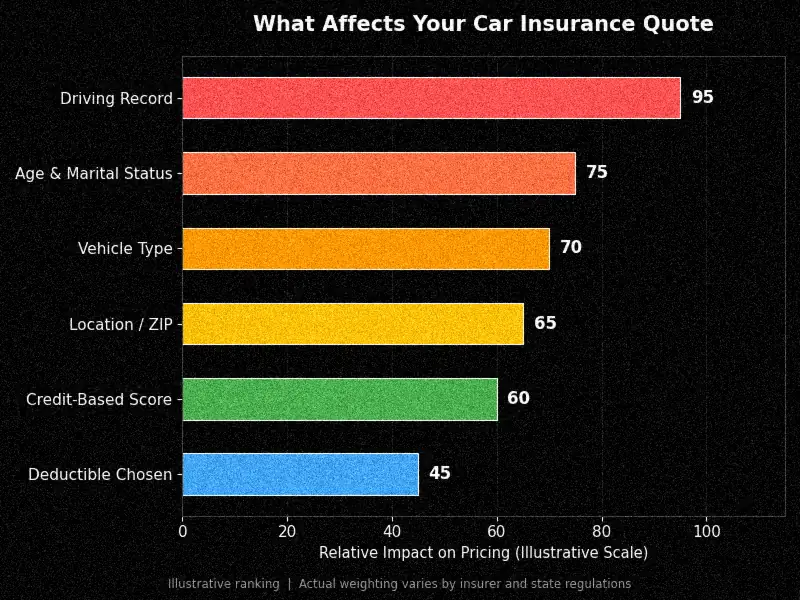
Your quote isn’t random. Insurers run your information through a pricing model that weighs several factors, and small changes in any one of them can shift your price by hundreds of dollars a year.
Driving Record and History
This is the single biggest factor. A speeding ticket can raise your rate for three years. A DUI can raise it for five to ten years, depending on the state. One at-fault accident typically adds 40-50% to your premium at renewal.
Age, Gender, and Marital Status
Drivers under 25 pay significantly more, since younger drivers statistically file more claims. Married drivers often get slightly lower rates than single drivers of the same age, and in most states, rates level out by your mid-30s regardless of gender.
Vehicle Make, Model, and Year
A Honda Civic and a BMW M3 with the same driver profile will not get the same quote. Insurers price based on repair costs, theft rates, and safety ratings. Sports cars and luxury vehicles cost more to insure. Vehicles with strong safety ratings, like the Subaru Outback, often qualify for lower comprehensive and collision rates.
Location and ZIP Code
Where you park your car matters as much as how you drive it. Dense urban ZIP codes with higher accident and theft rates cost more to insure than rural areas. Living in a state prone to hail, flooding, or hurricanes (Florida, Louisiana, Texas) also pushes comprehensive coverage costs up.
Credit-Based Insurance Score
In most states (not California, Hawaii, or Massachusetts, where it’s banned), insurers use a credit-based insurance score as part of pricing. It’s not your regular credit score, but it’s built from similar data. Drivers with poor credit history can pay noticeably more, even with a clean driving record.
Coverage Level and Deductible Chosen
A higher deductible means a lower monthly premium, since you’re agreeing to pay more out of pocket before insurance kicks in. Going from a $500 to a $1,000 deductible can lower your premium by roughly 10-15%, but only choose this if you actually have that cash available if something happens.
Average Auto Insurance Costs
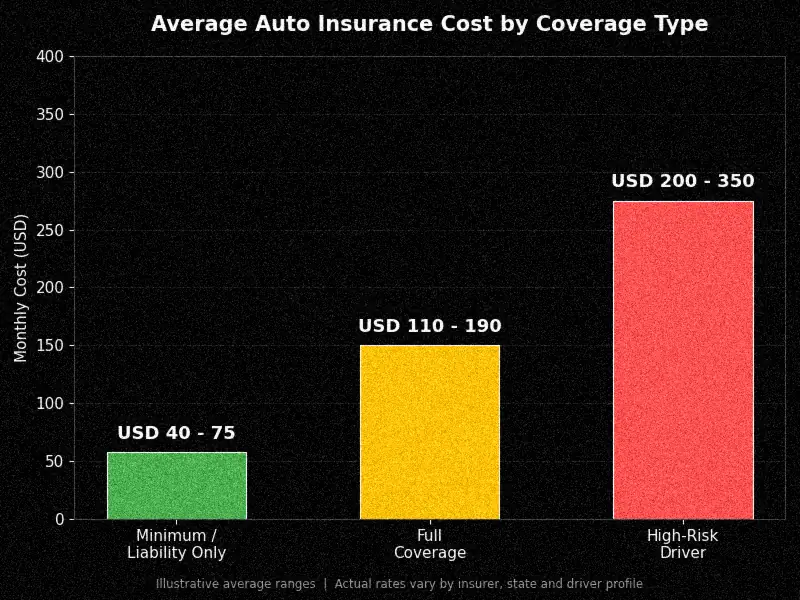
Real numbers vary a lot by state, driver profile, and insurer, but here’s a general breakdown to set expectations before you start comparing car insurance quotes.
| Coverage Type | What It Includes | Typical Monthly Range |
|---|---|---|
| Minimum/Liability Only | State-required minimum, no damage to your own car | $40 – $75 |
| Full Coverage | Liability + collision + comprehensive | $110 – $190 |
| High-Risk Driver | Coverage after a DUI, major violation, or multiple claims | $200 – $350+ |
Average Cost by Age Group
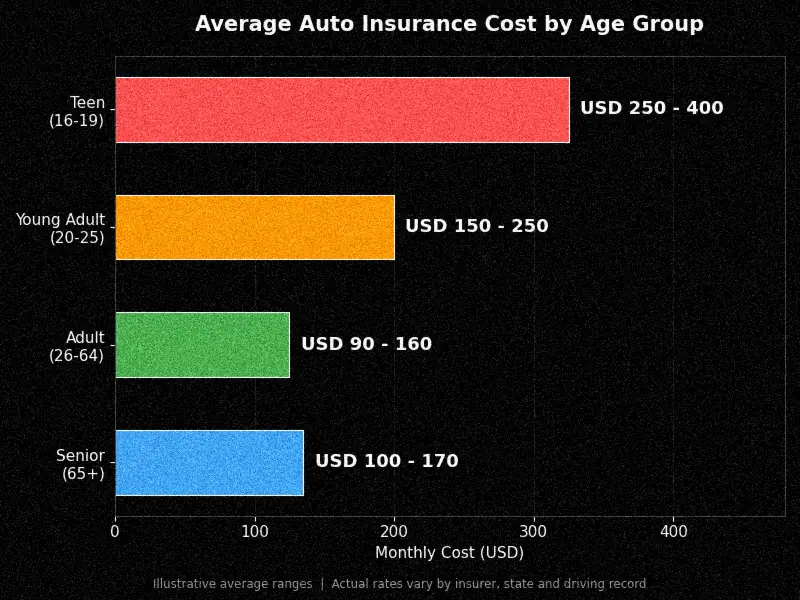
- Teen drivers (16-19): often $250-$400/month if added to a parent’s policy, more if insured separately
- Young adults (20-25): $150-$250/month
- Adults (26-64): $90-$160/month
- Seniors (65+): $100-$170/month, can rise again after 70 in some states
Average Cost by State
States with no-fault laws, high uninsured driver rates, or frequent severe weather tend to run higher. Michigan, Florida, and Louisiana consistently rank among the most expensive states for auto insurance, while states like Maine, Ohio, and Vermont tend to rank among the cheapest.
These numbers are illustrative averages. Always confirm current pricing with your state’s insurance department or a licensed agent, since rates shift with market conditions.
Key Takeaways: Comparing Multiple Auto Insurance Quotes
Before you dive into the comparison process, here’s a quick-scan view of what shopping around actually gets you, and where it can go wrong if you’re not careful.
| Details | |
|---|---|
| Pros | Can save $500-$1,000+ a year by switching insurers |
| Reveals discounts your current insurer never applied | |
| Helps you spot if you’re carrying coverage you don’t need | |
| Takes 10-15 minutes per quote, all doable online | |
| Cons | Easy to compare mismatched coverage limits by mistake |
| Some comparison sites sell your info to multiple agents, leading to spam calls | |
| Switching mid-policy can trigger a short cancellation fee with some insurers | |
| Cheapest quote isn’t always the best claims experience |
How to Compare Auto Insurance Quotes the Right Way
Comparing quotes only works if you’re comparing the same coverage across every insurer. A cheap quote with lower coverage limits isn’t actually a better deal, it’s a different product.
Comparing Apples to Apples: Matching Coverage Limits
Before comparing prices, make sure every quote has:
- The same liability limits (e.g., 100/300/100)
- The same deductible for collision and comprehensive
- The same optional coverages (roadside assistance, rental reimbursement, gap insurance)
If one quote is $40 cheaper a month but has half the liability coverage, you’re not saving money, you’re just taking on more risk.
Red Flags in a Suspiciously Cheap Quote
Watch for these before you commit:
- No option to speak with a licensed agent if you have questions
- Coverage limits that default to your state’s bare minimum without asking
- Pressure to buy immediately with no time to compare
- Poor customer reviews around claims handling, even if the price looks great
A quote that’s dramatically cheaper than every other one usually means something’s missing, not that you found a hidden deal.
Questions to Ask Before You Buy
- What’s my deductible for collision versus comprehensive?
- Are rental car and roadside assistance included or extra?
- How does the company handle claims after an accident?
- Will my rate go up after one at-fault accident, and by how much?
- Are there discounts I qualify for that aren’t already applied?
How to Lower Your Auto Insurance Quote
You don’t have to accept the first number you get. There are practical ways to bring your quote down without cutting coverage you actually need.
Discounts You Might Be Missing
Most insurers offer these, but they don’t always apply them automatically:
- Safe driver discount (no accidents/tickets in 3-5 years)
- Good student discount for drivers under 25 with a B average or higher
- Low mileage discount if you drive under 7,500 miles a year
- Defensive driving course completion discount
- Paperless billing and autopay discounts
- Anti-theft device or dash cam discount
Ask your insurer directly, “what discounts am I not currently getting?” It’s a simple question that often turns up savings agents don’t volunteer.
Bundling Auto with Home/Renters Insurance
Bundling your car insurance with home or renters insurance through the same company typically saves 10-25% on both policies. If you already have renters or homeowners coverage, this is usually the single easiest discount to unlock.
When and How Often to Re-Shop Your Policy
Re-shop your auto insurance quotes once a year, or any time one of these happens:
- You move to a new address
- You pay off your car loan
- Your driving record improves (violations roll off after 3-5 years)
- You add or remove a driver from the policy
- Your insurer raises your premium at renewal without a clear reason
Loyalty doesn’t usually pay off with insurance. Studies from comparison platforms consistently show that drivers who switch after comparing quotes save more than those who auto-renew year after year. For a closer look at why this habit matters beyond just car insurance, check out why you should review your insurance policy regularly.
Common Mistakes When Getting Car Insurance Quotes
- Only getting one quote. Rates for the exact same driver and car can differ by hundreds of dollars between insurers.
- Underestimating annual mileage. This can actually lower your quote if you drive less than you think.
- Skipping the fine print on deductibles. A low premium with a $2,000 deductible might cost you more if you ever file a claim.
- Not mentioning safety features. Anti-lock brakes, backup cameras, and anti-theft systems can qualify you for discounts you’d otherwise miss.
- Letting coverage lapse between policies. Even a short gap in coverage can raise your future rates, since insurers see it as a risk signal.
Frequently Asked Questions
Is it bad to get multiple car insurance quotes?
No. Getting multiple quotes doesn’t hurt your driving record or count against you with insurers. It’s the standard, recommended way to shop for coverage.
Does checking car insurance quotes affect your credit score?
Most online quotes use a soft credit pull, which doesn’t affect your score. If you move forward and apply for a policy, some insurers may run a soft inquiry specifically for insurance scoring, which is different from a hard credit check used for loans.
How accurate are online auto insurance quotes?
They’re generally close, but not final. Your actual premium can shift once the insurer verifies your driving record, vehicle history, and credit-based insurance score after you apply.
Why did my auto insurance quote change from what I saw online?
This usually happens because a promotional discount expired, your driving record was verified and didn’t match what you entered, or the insurer’s rates were updated since you first checked. It’s worth asking the agent directly what changed.
What’s the difference between insurance for a car and insurance for automobiles in general?
There’s no real difference. “Insurance for a car,” “insurance of car,” and “auto insurance” all refer to the same product, personal auto insurance covering a private vehicle. The wording just varies by region and how people search for it.
Can I get car insurance quotes without owning a car yet?
Yes. Most insurers let you get a quote before you buy, using the VIN of the car you’re planning to purchase or a similar make and model, so you know your insurance cost before you sign for the vehicle.
How often should I compare car insurance quotes?
At least once a year, ideally around your renewal date, since rates and available discounts change even if nothing about your driving has.
How much is a drivers insurance quote for a new driver?
New drivers typically see quotes between $250 and $400 a month if added to a parent’s policy, or $300-$500+ if insured separately. Rates drop as the driver builds a clean record, usually reassessed every six months to a year.
Is car insurance by car type more expensive for SUVs or sedans?
It depends on the specific model, not just the body type. SUVs with strong safety ratings can cost less to insure than sports sedans, since insurers price based on repair costs, theft rates, and crash-test performance, not just vehicle category.
Can I insure a car I don’t legally own yet?
Yes. You can get a quote using the VIN before purchase, but you can’t activate a policy until you’re the registered owner or lienholder listed on the title, since insurers require proof of insurable interest in the vehicle.
Do insurance car quotes expire?
Most quotes are valid for 30 days. After that, insurers usually re-run the numbers since rates, discounts, and your driving record can all shift, even slightly, within that window.
Final Thoughts: Getting the Right Auto Insurance Quote for You
The cheapest quote and the best quote aren’t always the same thing. What actually matters is getting coverage that fits your car, your driving habits, and your budget, then comparing that same coverage across at least three insurers before you buy.
Set a reminder to re-shop your policy every year. Rates change, your driving record improves, and new discounts show up that your current insurer won’t tell you about unless you ask. A few minutes of comparing quotes now can genuinely save you hundreds of dollars over the life of your policy.