



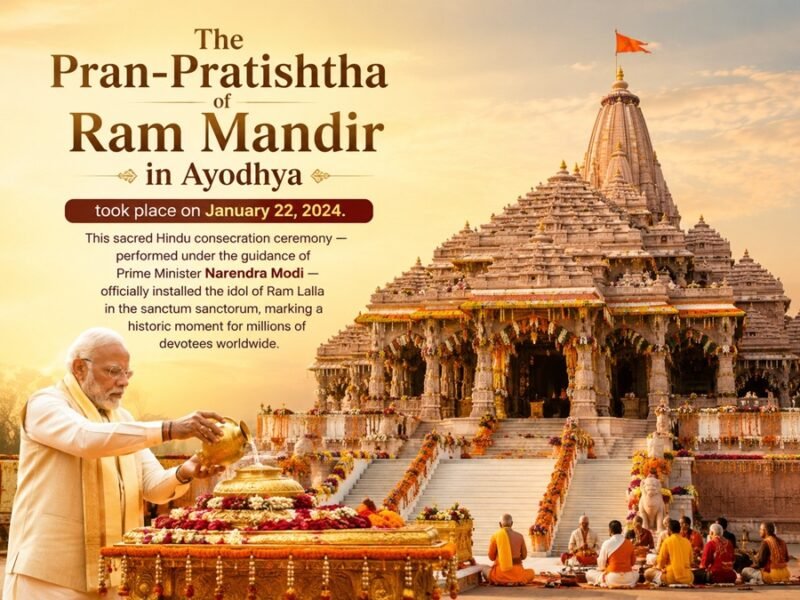
January 22, 2024 was not just another date on the calendar.
Across India, people woke up before sunrise. Temples lit up with diyas. Bhajans played from every street corner. Families sat around televisions with folded hands. And in Ayodhya — a city that has held its breath for centuries — the moment that generations of devotees had prayed for finally arrived.
The Pran-Pratishtha of Ram Mandir in Ayodhya took place on this day. In simple words, this was the sacred consecration ceremony where the idol of Ram Lalla — Lord Ram in his five-year-old, child form — was officially installed in the sanctum sanctorum of the newly built Shri Ram Janmabhoomi Mandir. From that moment, Ram Lalla was no longer just a deity under a makeshift tent. He had come home.
Around 7,000 VVIPs attended the ceremony in person, including saints, religious leaders, and tribal representatives from across the country. Doordarshan broadcast the event live. Millions more watched from diaspora communities in Mauritius, Fiji, the United States, the United Kingdom, and Southeast Asia. For the Hindu world, this was not a local religious function. It was something far bigger.
Prime Minister Narendra Modi, who served as the chief Yajman (patron) of the ceremony, said it best: “January 22, 2024 is not just a date, but the beginning of a new era.”
This article covers everything you want to know — from what Pran-Pratishtha actually means, to the history of Ayodhya, the rituals of the ceremony, the stunning architecture of the temple, and how you can plan your own visit.
Quick Facts Table
| Detail | Information |
|---|---|
| Event | Pran-Pratishtha of Ram Lalla |
| Date | January 22, 2024 |
| Hindu Calendar Date | Paush Shukla Dwadashi (Kurma Dwadashi) |
| Location | Ayodhya, Uttar Pradesh, India |
| Temple Name | Shri Ram Janmabhoomi Mandir |
| Chief Officiant | PM Narendra Modi (as Yajman) |
| Head Priest | Acharya Lakshmikant Dixit |
| Idol | Ram Lalla (Lord Ram as 5-year-old child) |
| Idol Sculptor | Arun Yogi |
| Architect | Chandrakant Sompura & family |
| Architectural Style | Nagara (Maru-Gurjara) |
| Temple Height | 161 feet (49 metres) |
| Temple Length | 360 feet (110 metres) |
| Temple Width | 235 feet (72 metres) |
| Number of Pillars | 392 |
| Number of Doors | 44 |
| Floors | 3 (each floor 20 feet tall) |
| Groundbreaking (Bhoomi Pujan) | August 5, 2020 |
| Guests Attended | ~7,000 VVIPs |
| Anniversary Name | Pratishtha Dwadashi |
What is Pran-Pratishtha? Let’s Understand It Simply
Most people have heard the term, but not everyone knows what it actually means.
Pran-Pratishtha comes from two Sanskrit words — Prana (life force) and Pratishtha (installation). Put them together and it means “infusing life into a deity’s idol.” Through this ritual, what starts as a beautifully sculpted piece of stone becomes a living divine presence — a home where God actually resides.
Think of it this way. Before Pran-Pratishtha, an idol is like a house that is built but not yet lived in. After the ceremony, God moves in. From that point, the temple becomes alive, and every prayer offered there reaches the deity directly.
According to the ancient Hindu texts — especially the Agama Shastra, which are the classical guides for temple worship — a properly consecrated idol must be worshipped every single day without fail. Ram Lalla at the Ayodhya temple wakes up each morning to the Mangala Aarti, receives a ritual bath (Abhishek), is offered food (Bhog), dressed in fresh clothes, and rests at night. This is not symbolic. It is a living, daily spiritual practice.
The Pran-Pratishtha itself involves many layers of ritual spread over several days. Priests sow seeds as a symbol of auspiciousness (Ankurarpanam), worship the nine celestial bodies (Navagraha Puja), perform sacred fire rituals with Vedic chants (Havan), install water pots at sacred spots (Kalasha Sthapana), and finally perform the most important act — the Netra Unmilan, or “opening of the deity’s eyes.” This is the moment when the divine life force enters the idol and the consecration is complete.
All of these rituals at Ayodhya were performed by 121 Vedic Acharyas (trained priests) over seven days, under the leadership of Acharya Lakshmikant Dixit from Kashi — one of the most respected Sanskrit scholars of our time.
Ram Mandir in Ayodhya: The History You Need to Know
Ayodhya — More Than Just a City
Ayodhya sits on the banks of the sacred Saryu River in Uttar Pradesh. But calling it “just a city” would be doing it a great disservice.
Ayodhya is one of the Sapta Puri — the seven holiest cities in Hinduism. Ancient texts like the Ramayana, the Mahabharata, and various Puranas all speak of it as the capital of the Kosala Kingdom and, most importantly, as the birthplace of Lord Ram. Even Buddhist and Jain texts reference Ayodhya — which tells you how deep its historical roots really are.
For Hindus across the world, Ayodhya carries a very specific identity. It is Ram Janmabhoomi — the sacred land where Ram was born. That one fact has shaped the city’s identity for thousands of years.
Who is Lord Ram — And Why Does He Matter So Much?
Lord Ram is the seventh avatar of Lord Vishnu and one of the most beloved figures in all of Hinduism. His other name — Maryada Purushottam — tells you exactly who he is: the ideal human being. He honoured his father’s word even when it cost him his throne. He stood by truth even in the most difficult circumstances. He governed his kingdom with deep care for every citizen, including the humblest among them.
The Ramayana, written by the sage Valmiki, tells his entire story — from his birth in Ayodhya to his 14-year exile in the forest, his battle against the demon king Ravana, the rescue of Sita, and his triumphant return home. This story has shaped the culture, values, and art of India and much of Southeast Asia for over two thousand years.
When you understand this, you understand why the Pran-Pratishtha of Ram Mandir in Ayodhya carried such emotional weight for so many people.
The Long Journey to This Moment
The history of the Ram Janmabhoomi site is long and complex. Ancient tradition holds that a grand temple once stood at the exact spot where Ram was born. Historical records from the 16th century indicate that the Babri Masjid was built at this location in 1528 CE during the Mughal era. From the 19th century onward, the site became the subject of repeated legal battles and disputes over religious ownership.
In 1949, idols of Ram Lalla appeared inside the mosque, intensifying the controversy. The site was unlocked for Hindu worship in 1986 by court order. Then in 1992, the mosque structure was controversially demolished, triggering a new round of legal and social upheaval that would last nearly three more decades.
The turning point came on November 9, 2019, when the Supreme Court of India delivered a unanimous landmark verdict. The court awarded the full 2.77-acre site to the Shri Ram Janmabhoomi Teerth Kshetra Trust for temple construction. It was a verdict that ended a legal saga stretching back over a century.
Construction began with the Bhoomi Pujan (groundbreaking ceremony) on August 5, 2020, performed by Prime Minister Narendra Modi. And just three and a half years later — on January 22, 2024 — Ram Lalla was consecrated in his permanent, magnificent home.
The Pran-Pratishtha Ceremony: What Actually Happened
Seven Days of Sacred Preparation
The Ayodhya Ram Mandir Pran Pratishtha was not a single-day event. The temple trust and priestly council decided to begin the sacred process seven days before the main ceremony. Starting January 16, 2024, a full week of rituals unfolded — each day building toward the final, historic moment.
| Date | What Happened |
|---|---|
| January 16 | Pre-consecration Vedic rituals begin; Ramotsav celebrations start across all 826 local bodies of Uttar Pradesh |
| January 17 | A grand procession carries the Ram Lalla idol to Ayodhya; devotees carry Saryu water in sacred Mangal Kalash |
| January 18 | Ganesh-Ambika Puja, Varun Puja, Matrika Puja, Brahmin Varan, and Vastu Puja are performed |
| January 19 | Sacred fire kindled; Navagraha installation; Havan performed with Vedic chanting |
| January 20 | The innermost chamber is cleansed with sacred Saryu waters; Vaastu rituals and Annadhivas performed |
| January 21 | The idol receives a sacred bath using 125 urns of water; Shayadhivas — the idol is ceremonially put to rest for the night |
| January 22 | Morning Puja followed by the grand Pran-Pratishtha ceremony |
The Big Day — January 22, 2024
On the morning of January 22, Vedic chanting filled the air inside the temple complex as 121 priests performed their assigned rituals in perfect coordination. Acharya Lakshmikant Dixit from Kashi led the entire priestly team.
At the sanctum sanctorum, Prime Minister Narendra Modi performed the key ceremonial rites as the Yajman — the person on whose behalf the sacred ceremony is conducted. The most profound moment was the Netra Unmilan, when the eyes of Ram Lalla’s idol were symbolically opened. At that instant, Ram Lalla was no longer just stone. He was alive in the sacred sense — present, divine, ready to receive his devotees.
The idol itself is a masterpiece. Sculptor Arun Yogi created it to depict Lord Ram as a five-year-old child, full of innocence and divine grace. Ram Lalla sits on a throne made with approximately 9.5 kilograms of silver — befitting a king and a god at once.
Representatives from virtually every Hindu sect, monastic order, and spiritual tradition in India attended the ceremony — along with tribal community representatives, making it a gathering that truly reflected the breadth of India’s spiritual landscape.
Why the Ceremony Followed the Hindu Calendar
One interesting detail many people miss: the Pran-Pratishtha happened on Paush Shukla Dwadashi as per the Hindu lunar calendar — also known as Kurma Dwadashi. This is the 12th day of the waxing moon in the month of Paush.
The temple trust decided that all future anniversaries would be celebrated on this date per the Panchang (Hindu almanac), not on January 22 of the English calendar. In 2025, Paush Shukla Dwadashi fell on January 11 — and the first anniversary celebrations, called Pratishtha Dwadashi, were held on that day. This is a good reminder that at its heart, this is a living religious tradition, not just a historical event.
Why This Moment Was Truly Historic
The Cultural Weight of the Event
The Pran-Pratishtha was not just a religious moment. It was a civilizational one. The Uttar Pradesh government earmarked ₹100 crore for Ramotsav — a series of religious and cultural programs that ran across 826 local bodies in the state, with Bhajan Sandhya programs, folk performances, Ram Katha discourses, and more.
Artists, musicians, sculptors, and classical performers from every corner of India participated. The event felt less like a government function and more like the entire country pausing to celebrate something deeply its own.
What It Meant for Devotees
For many Hindu families, this moment carried the same emotional intensity as the fulfillment of a lifelong vow. Grandparents who had prayed for this for decades sat next to grandchildren who watched it on their phones. Temples across India performed simultaneous aartis. Community halls in Mauritius, Trinidad, and Singapore filled up with people who wanted to watch together, not alone.
The feeling was simple but profound: Ram had come home. And people who had heard that phrase all their lives had finally seen it happen in their own lifetime.
Global Attention
The event trended worldwide on social media. Diaspora communities organized community viewings from London to Los Angeles. The live stream on Doordarshan’s YouTube channel attracted viewership from dozens of countries. Whatever one’s personal perspective, the scale of collective emotion around the Ayodhya Ram Mandir Pran Pratishtha was genuinely unprecedented in modern India.
The Architecture of Ram Mandir: Built to Last a Thousand Years
How the Temple Looks and Feels
Walk up to the Ram Mandir and the first thing that hits you is the sheer scale. The temple stands 161 feet tall — as high as a 14-storey building. It stretches 360 feet in length and 235 feet in width, spread across 2.77 acres within a larger 70-acre complex. Three floors rise one above the other, with each floor standing 20 feet tall.
The design belongs to the Nagara style of temple architecture — specifically the Maru-Gurjara tradition, which is classical to North and Western India. You recognise Nagara style by its curved, mountain-like spires (shikharas) that seem to reach upward toward the sky, and by the intricate carvings that cover nearly every surface.
The main entrance faces east and you reach it by climbing 32 steps through the Singh Dwar — the Lion Gate. From the entrance, you walk through five grand halls (mandapas) before reaching the sanctum sanctorum where Ram Lalla resides. These five halls — the Nritya Mandap, Rang Mandap, Sabha Mandap, Prarthana Mandap, and Kirtan Mandap — each serve a specific ritual and devotional purpose.
Who Built It and How
The temple’s design comes from the celebrated Sompura family of temple architects — Chandrakant Sompura, along with his sons Nikhil and Ashish. Chandrakant Sompura first sketched the plans back in 1983, over four decades before the temple was finally built. The Sompura family has designed more than 100 temples across the world, but this is their most celebrated commission.
Here is something that makes the Ram Mandir stand apart from almost any modern construction: the entire temple uses no iron. Traditional Indian building techniques drive every part of its structure. Sandstone from the Bansi Pahadpur quarries in Rajasthan — the same pink stone used in India’s finest classical temples — forms the body of the building. Engineers from CBRI Roorkee and IIT Madras verified the soil and structural design, working alongside construction partner L&T. The temple is built to endure for one thousand years.
392 pillars and 44 doors cover the interior, each one intricately sculpted with images of Hindu deities, Yakshas (celestial beings), and divine motifs. The first floor houses the Shri Ram Darbar — where Ram sits alongside Sita, Lakshman, and Hanuman in a full royal court. Four corner temples on the campus are dedicated to Surya, Devi, Ganesh, and Shiva.
The Spiritual Significance of Lord Ram and This Temple
Ram Is Larger Than Any One Temple
Lord Ram’s devotion stretches far beyond the borders of India. In Thailand, the royal Chakri dynasty traditionally uses the title Rama — the current monarch being Rama X. The Ramayana influences classical dance, puppetry, and storytelling traditions in Indonesia, Cambodia, Laos, and Myanmar. Temples dedicated to Ram exist in Mauritius, Trinidad, Guyana, and wherever the Indian diaspora has settled.
When the Ram Mandir was consecrated, it was not just India watching. It was a global community of people for whom the Ramayana is not ancient literature but a living guide to how to live.
What the Temple Represents
The Ram Mandir is a symbol of something that goes beyond architecture or religion. It tells the story of a faith that held on — through centuries of uncertainty, through legal battles, through generations of waiting — and eventually found its way to this moment.
For devotees, the temple says: dharma prevails. Truth, in the end, endures.
For future generations, the temple carries a different kind of message: India’s civilizational thread is unbroken. The craftsmanship of Indian artisans, the depth of Sanskrit scholarship, and the devotion of millions of ordinary people can come together to create something that will stand for a thousand years.
And at the centre of all of this — simply — is a five-year-old child sitting on a silver throne, waiting for you to come and visit.
Ayodhya After the Ram Mandir Inauguration
A City Transformed
Before January 22, 2024, Ayodhya received a few million pilgrims each year. After the Pran-Pratishtha, that number surged dramatically. Ayodhya now ranks among India’s most-visited pilgrimage destinations, and the city’s infrastructure has changed to match this new reality.
The Maharshi Valmiki International Airport opened to handle the surge of visitors, with flights now operating from Delhi, Mumbai, Lucknow, and other major cities. The railway station has been redeveloped. New roads connect the city to major expressways. Hotels, dharamshalas, and pilgrim rest facilities have expanded across the city.
The Saryu River Aarti — held each evening on the banks of the Saryu — is being developed on the lines of the famous Ganga Aarti in Kashi (Varanasi), giving Ayodhya yet another attraction for the devotion-seeking traveller.
Economy and Community
The temple has become a catalyst for Ayodhya’s wider growth. Thousands of new jobs have opened up in hospitality, transportation, retail, and tourism. Local artisans who make Ram-themed crafts, flower vendors who supply the temple, food stalls that serve pilgrims, and guides who lead visitors through the city’s many sacred sites — all of them have seen their livelihoods transform.
Apollo Hospital is developing a healthcare facility near the Yatri Seva Kendra inside the temple complex. A new 500-seat auditorium and guesthouse are also under construction within the campus. Ayodhya, in short, is becoming a complete pilgrimage city — one that can welcome millions of visitors with the infrastructure they need.
Interesting Facts About Ram Mandir That Most People Don’t Know
The Ram Mandir has several layers of detail that go well beyond what most coverage mentions.
Chandrakant Sompura, the chief architect, first drew the temple’s plans in 1983 — more than 40 years before the structure was built. In those early days, he famously used his own footsteps as the unit of measurement because formal surveying tools were not available at the disputed site. The design went through multiple revisions over the decades, and even after the Supreme Court verdict in 2019, the scale was expanded nearly double the original plan to accommodate more devotees.
No iron was used anywhere in the structure — a conscious architectural decision that reflects both spiritual tradition and extraordinary engineering confidence. The Bansi Pahadpur sandstone from Rajasthan, chosen for both its beauty and its durability, is the same material used in centuries-old temples that still stand strong today.
Ram Lalla was worshipped under a makeshift temporary structure at the disputed site for several decades before the grand temple was built. Despite those modest circumstances, millions made the journey to Ayodhya just to catch a glimpse of the idol. Now, the same deity sits in one of India’s grandest temples.
The anniversary of the Pran-Pratishtha follows the Hindu lunar calendar, not the English date of January 22. Every year, the celebration (called Pratishtha Dwadashi) falls on Paush Shukla Dwadashi — which in 2025 was January 11.
In June 2025, a second major Pran-Pratishtha took place at the Ram Mandir — this time for the Ram Darbar on the first floor of the temple, where Ram is flanked by Sita, Lakshman, and Hanuman. This ceremony was performed by 101 Vedic Acharyas over three days, showing that the spiritual life of the temple continues to grow.
Soil and water from sacred rivers across India were used in the original consecration rituals — a gesture that made the ceremony a symbolic gathering of the entire country’s spiritual geography into one place.
How to Visit Ram Mandir in Ayodhya
Getting There
Shri Ram Janmabhoomi Mandir sits at Ram Janmabhoomi Path, Ayodhya, Uttar Pradesh — 224123. The coordinates are 26°47′44″N, 82°11′39″E.
You can reach Ayodhya by air via the Maharshi Valmiki International Airport, with direct flights from Delhi, Mumbai, and Lucknow. By train, Ayodhya Junction and Ayodhya Cantt stations connect the city to the national rail network — both stations have improved significantly after the temple inauguration. By road, Ayodhya lies about 130 km from Lucknow, 160 km from Prayagraj, and 200 km from Varanasi, all well-connected by national highways.
Planning Your Darshan
The temple opens early in the morning (around 5:00 AM) and closes at night. Aarti timings follow a fixed schedule that shifts slightly with the seasons, so check the official temple trust website before you travel. You can book Aarti passes online in advance — strongly recommended during festivals and peak season. Remove footwear before entering the premises, dress modestly, and follow the directions of temple staff and signage inside.
The best times to visit are October through March, when the weather in Ayodhya is pleasant and comfortable. Ram Navami (usually March or April) is the biggest festival — the city celebrates Lord Ram’s birthday with grandeur and warmth. Diwali in Ayodhya is a spectacle unlike anywhere else in India, when millions of diyas light up the banks of the Saryu in celebration of Ram’s return to Ayodhya all those centuries ago.
People Also Ask
What is the meaning of Pran-Pratishtha?
Pran-Pratishtha is a sacred Hindu ritual that infuses divine life force into a deity’s idol. Through Vedic chanting, sacred baths, fire rituals, and the symbolic opening of the deity’s eyes, a sculpted image becomes a living spiritual presence — a home where the divine actually resides.
When was the Ram Mandir Pran-Pratishtha held?
The Pran-Pratishtha of Ram Lalla at the Ram Mandir in Ayodhya was held on January 22, 2024 — which corresponds to Paush Shukla Dwadashi (Kurma Dwadashi) as per the Hindu lunar calendar. The week-long pre-consecration rituals began on January 16, 2024.
Why is Ayodhya important in Hinduism?
Ayodhya is the birthplace of Lord Ram and one of the Sapta Puri — the seven holiest cities in Hinduism. The Ramayana, Mahabharata, and numerous Puranas all describe Ayodhya as the capital of the Kosala Kingdom and Ram’s sacred home. The city has been a centre of devotion for over two thousand years.
Who is Ram Lalla?
Ram Lalla means “child Ram” — Lord Ram in his innocent, five-year-old form. The consecrated idol at the Ram Mandir was sculpted by Arun Yogi and depicts this tender, childlike aspect of the deity. Ram Lalla sits on a throne made with approximately 9.5 kilograms of silver.
Can tourists visit Ram Mandir?
Yes — Ram Mandir welcomes all visitors regardless of religion. You can reach Ayodhya by air, rail, or road. Book Aarti passes online in advance. Dress modestly, remove footwear before entering, and follow the temple’s guidelines during your visit.
Who performed the Pran-Pratishtha rituals?
Acharya Lakshmikant Dixit from Kashi led a team of 121 Vedic Acharyas. Prime Minister Narendra Modi performed the key rites as the chief Yajman (patron).
Who designed the Ram Mandir?
Chandrakant Sompura, assisted by his sons Nikhil and Ashish, designed the temple in the classical Nagara (Maru-Gurjara) style. The Sompura family has designed over 100 temples worldwide.
FAQs
1. What is Ram Janmabhoomi?
Ram Janmabhoomi means “the birthplace of Lord Ram.” It refers to the specific site in Ayodhya that Hindu tradition holds as the exact location of Ram’s birth. The Shri Ram Janmabhoomi Mandir has been constructed at this sacred spot.
2. What role did the Supreme Court play in the Ram Mandir?
The Supreme Court of India delivered a unanimous landmark verdict on November 9, 2019, awarding the disputed 2.77-acre land in Ayodhya to the Shri Ram Janmabhoomi Teerth Kshetra Trust for the construction of a Hindu temple. The verdict ended a legal dispute that stretched back over a century.
3. When was the Bhoomi Pujan (groundbreaking) of Ram Mandir?
The Bhoomi Pujan took place on August 5, 2020. Prime Minister Narendra Modi performed the rituals, officially beginning construction of the temple.
4. How tall is the Ram Mandir?
The Ram Mandir stands 161 feet (49 metres) tall — the height of roughly a 14-storey building. It is a three-storied structure with each floor measuring 20 feet.
5. Is the Ram Mandir open to non-Hindus?
Yes. The temple complex welcomes all visitors. There is no restriction based on religion, though all guests must respect the temple’s customs — modest clothing, removing footwear, and following the guidelines of temple staff.
6. What is Pratishtha Dwadashi?
Pratishtha Dwadashi is the annual anniversary of the Pran-Pratishtha of Ram Lalla, observed on Paush Shukla Dwadashi as per the Hindu lunar calendar. In 2025, this fell on January 11, and the temple trust held three days of celebrations on this occasion.
7. Why does the Ram Mandir use no iron?
The decision to avoid iron reflects both ancient Hindu temple-building traditions and a long-term architectural philosophy. The temple is built to endure for a thousand years using Rajasthani sandstone and traditional Indian construction techniques that have proven their durability over centuries.
8. How many people attended the Pran-Pratishtha ceremony?
Approximately 7,000 VVIPs attended the ceremony in person, including saints, religious leaders, tribal representatives, and public figures. Millions more watched the live broadcast on Doordarshan and YouTube.
9. Where does Ram Lalla reside in the temple?
Ram Lalla resides in the Garbha Griha (sanctum sanctorum) on the ground floor. The first floor houses the Shri Ram Darbar — consecrated in a separate Pran-Pratishtha ceremony held in June 2025.
10. What is the significance of worshipping Ram in child form?
Worshipping Ram as a child (Ram Lalla) expresses a deeply personal, parental form of devotion. The devotee approaches God not with awe or fear, but with the warmth and love a parent feels for a child. This is one of the most intimate expressions of Bhakti (devotion) in the Hindu tradition.
11. Can I book Aarti passes online?
Yes. Aarti passes for the Shri Ram Janmabhoomi temple are available for online booking through the official trust portal. Booking in advance is strongly recommended, especially around Ram Navami, Diwali, and Pratishtha Dwadashi.
12. What was the Ram Darbar Pran-Pratishtha in June 2025?
In June 2025, the first floor of the Ram Mandir received its own Pran-Pratishtha ceremony for the Ram Darbar — where Ram sits alongside Sita, Lakshman, and Hanuman. The three-day ritual was performed by 101 Vedic Acharyas under the leadership of Pandit Jaiprakash from Kashi, culminating on June 5, 2025.
Conclusion: Why January 22, 2024 Will Always Matter
The Pran-Pratishtha of Ram Mandir in Ayodhya was many things at once.
It was a religious ceremony — ancient, precise, and deeply meaningful. It was a cultural moment — India’s artisans, scholars, priests, and devotees came together to create something extraordinary. It was a historical turning point — the end of a legal journey that lasted over a century. And for millions of ordinary people, it was deeply personal — a moment they had heard about from their grandparents, prayed for all their lives, and finally witnessed with their own eyes.
The temple will stand for a thousand years. Every day within it, priests will wake Ram Lalla with the Mangala Aarti, offer him food, dress him in fresh clothes, and sing bhajans in his presence. Pilgrims will climb those 32 steps, walk through the Singh Dwar, and finally stand before a five-year-old child seated on a silver throne — and feel something that is difficult to put into words.
That is the legacy of the Ayodhya Ram Mandir Pran Pratishtha. It is not just a moment in history. It is a living, breathing, daily reality — a thread of devotion that will continue long after all of us are gone.
Jai Shri Ram.
Must Read: Shri Hanuman Dham, Kiratpur: Complete Visitor Guide, History, Timings, Location & Travel Tips