



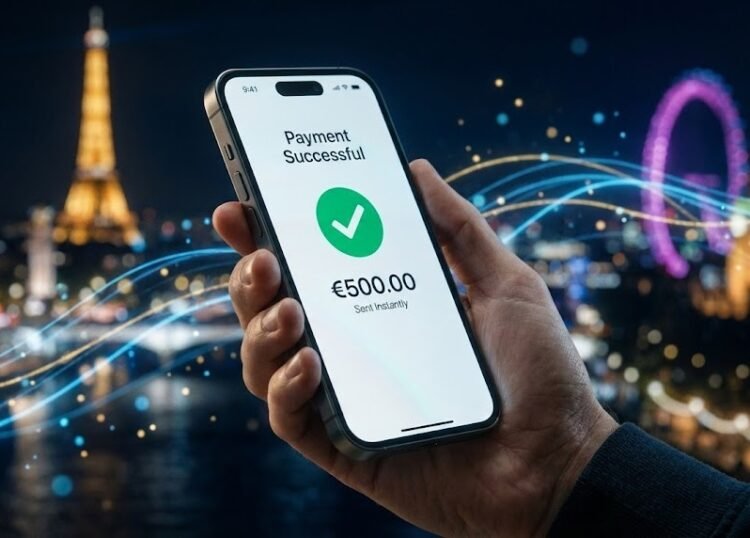
It’s Friday night in Paris, imagine that. All you’ve done is split a dinner bill with friends, maybe, or else you run a small business in Berlin and are waiting on the client to settle an invoice so that you can buy inventory for the weekend. In the old banking world, that money would disappear into a black hole of “processing” before popping up again Tuesday morning.
That world is ending. Fast money transfers in Europe are no longer a dream for fintech geeks — they’re en route to becoming a legal right. Thanks to sweeping new E.U. regulations, the age of “3-5 business days” is being replaced by a “10-second rule” that operates 24/7, 365 days a year.
What Exactly Are Instant Payments?
An instant payment, when all is said and done, is a SEPA (Single Euro Payments Area) credit transfer that completes in less than 10 seconds. Unlike traditional transfers, which only take place during “banking hours,” instant payments don’t care if it’s Christmas Day or 3 a.m. on a Sunday.
New Gold Standard: The “10-Second Rule”
At the end of 2025 and in 2026, European law requires that:
- Speed: Once the “send” button is hit, money should arrive in the recipient’s account within 10 seconds.
- Non-stop – The service must ensure operation 24 hours per day, seven days a week, 365 days per year.
- Price: Banks are not allowed to charge a higher fee for an instant payment compared with a standard credit transfer. If the regular transfer is free, the instant one has to be.
Why 2026 Will Be Europe’s Turning Point
The technology has been around since 2017, but adoption was sporadic. Some banks charged €10 per transaction; others did not offer it at all. Because of regulation, and the game-changer is the Instant Payments Regulation (IPR).
Verification of Payee (VoP)
The “fat finger” error — sending money to the wrong IBAN — was among the biggest obstacles to instant transfers. By October 2025, the entire banks in the Eurozone have to offer a ”Verification of Payee” service. This is so your name can be checked as soon as you hit send, to see whether the name provided matches the name of the account. This is a huge win for fraud prevention.
Mandatory Compliance for All Banks
By the beginning of 2026, most European banks should have migrated to provide both sending and receiving capabilities. We are transitioning from a fragmented landscape to one single European payment network at the speed of local systems found in Brazil or India.
The Big Winners: Companies and Consumers Businesses are the chief beneficiaries of the corporate tax cut, which has enabled them to keep more of their profits.
But the migration to real-time money movement is about more than convenience, it’s about liquidity. The European Commission estimates that almost €200 billion is trapped in “transit” at any given time in the EU. Instant payments unlock that capital.
For Consumers:
- Emergency Transfers: Send funds to distressed family members instantly in other countries.
- Offline Payments: A possible solution to the big cards networks (Visa/Mastercard), perhaps using QR codes and paying directly from your bank app.
- Marketplace Safety: If you are purchasing a second-hand car, do ensure the seller actually gets the money before handing him or her over your car.
For Businesses:
- Faster Cash Flow: No more waiting days for payment. It also enables small businesses to make real-time payments to suppliers and collect money from customers.
- Reduced Fees: account-to-account (A2A) payments can be priced much more cost-effective for merchants than traditional card processing.
- Lower Risk: After the 10 seconds, no one can claim the money but you. There’s no possibility of the payment later being “undone” because there are insufficient funds at the end of the week.
FAQs:
Are instant payments safe?
Yes. They may, in fact, be safer than traditional donations. Banks are now required to alert you if the name of your recipient does not correspond with that on their IBAN, thereby slashing “Authorized Push Payment” (APP) fraud.
Can you do an Instant Payment to a non-Euro country?
These direct debits currently mainly cover euro payments in the SEPA area. But banks from non-Euro EU countries (think Poland or Sweden) will also be covered gradually with a bit longer timeframes for implementation.
Do you limit how much I can send?
Despite, SEPA Instant previously having a €100,000 limit. But the 2025/26 rulebooks look set to abolish these scheme-wide limits, allowing banks and card providers to instead impose their own limits based on security and customer characteristics.
The Bottom Line
The “instant payments in europe” is here. By 2026, the friction of waiting for money to move anywhere in Europe will feel as outdated as waiting for a paper letter to wind its way through the mail. For a business, this would be the time to audit your payment stacks. For consumers, it’s time to demand more from your bank.