



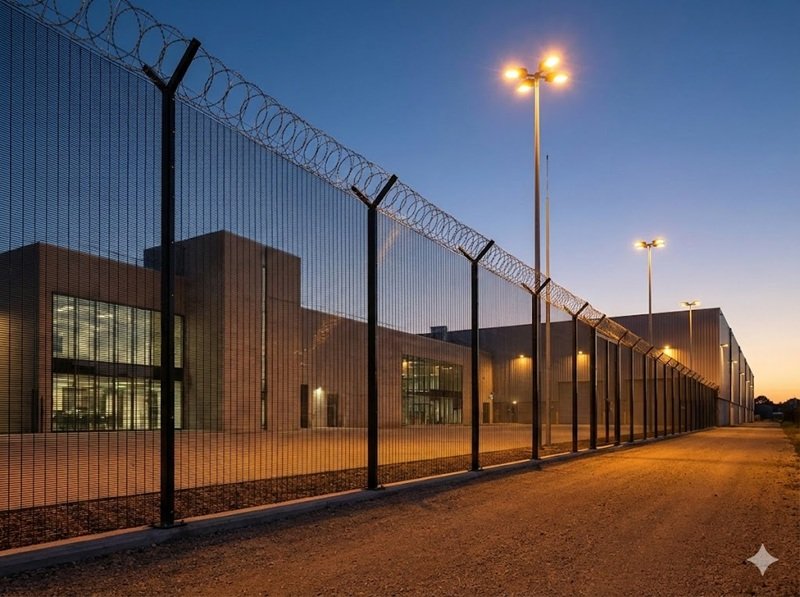
You lock your front door. You might even have a camera doorbell watching the porch. But if an intruder is already standing on your welcome mat, your security plan has missed a step.
Real security doesn’t start at the front door; it starts at the property line.
Think of your property like a castle. The alarm system is the guard inside the throne room, but the perimeter fence? That’s the moat. Without it, you’re inviting trouble to walk right up to the building. Whether you manage a commercial facility, a data center, or a private estate, quality fencing isn’t just about marking territory—it’s the backbone of a proactive defense strategy.
Let’s be honest: a rusty chain-link fence falling over in the wind isn’t stopping anyone. It’s barely a suggestion. To truly protect your assets, you need a physical barrier that works as hard as your alarm system.
### Key Takeaways
Deterrence is Key: The visual impact of a high-quality fence stops crimes of opportunity before they happen.
The 3 D’s: Fencing supports the core principles of physical security: Deter, Detect, and Delay.
Integration: Modern fences aren’t standalone; they are the mounting rack for sensors, lighting, and cameras.
ROI: Investing in perimeter hardening often lowers insurance premiums and reduces theft losses.
The Psychology of the “Hard Target”
Criminals are, generally speaking, path-of-least-resistance types. They are looking for the “soft target”—the warehouse with the open gate or the house with overgrown hedges and no barriers.
When you install high-quality perimeter fencing, you are engaging in psychological warfare. You are signaling that this property is managed, watched, and hardened.
This is the concept of CPTED (Crime Prevention Through Environmental Design). A 10-foot anti-climb fence tells a potential intruder that getting in is going to be difficult, and getting out with stolen goods will be even harder. Most bad actors will look at that setup, do the mental math, and move on to an easier target.
The 5-Second Rule: Delaying the Threat
Let’s say a determined intruder decides to try anyway. This is where the physical reality of the fence kicks in. In the security industry, we talk about delay time.
Every second an intruder spends trying to cut, climb, or bypass your fence is a second that:
Your surveillance cameras have to capture their face.
Your motion sensors have to trigger an alarm.
Security personnel or police have to respond.
If your perimeter is wide open, the delay time is zero. They are at your window instantly. A high-security fence—like a welded wire mesh or palisade—can add minutes to that timeline. In a break-in scenario, minutes are an eternity.
Comparing Common Perimeter Barriers
Not all fences are created equal. Here is how they stack up when it comes to stopping a threat.
| Fence Type | Visual Deterrence | Delay Time | Best Application |
| Standard Chain Link | Low | Low (Easy to cut/climb) | Residential boundaries, dog parks. |
| Anti-Climb Mesh (358) | High | High (Fingers can’t fit) | Data centers, prisons, utilities. |
| Palisade / Steel Picket | High | Medium/High | Commercial lots, industrial parks. |
| Electric Fencing | Extreme | Extreme (Active shock) | High-risk storage, car lots. |
The “Smart Fence”: Integrating Technology
Gone are the days when a fence was just steel in the ground. In 2024 and beyond, your perimeter is a smart grid.
A quality fence acts as the physical infrastructure for your electronic security. You can run fiber-optic cables through the mesh that detect vibrations. If someone tries to cut the fence or climb it, the fence itself “feels” it and alerts your security team to the exact GPS coordinate of the breach.
Furthermore, perimeter lighting and cameras need mounting points. By securing the perimeter, you push your surveillance zone out to the edge of the property. This means you detect threats before they damage your building, not after.
Regulatory Compliance and Liability
Here is the boring (but expensive) stuff you need to know. Depending on your industry, perimeter security might not be optional.
Insurance: Many commercial insurance policies require a fenced perimeter to cover outdoor assets (like fleet vehicles or raw materials). No fence? No payout.
Safety Standards: If you have hazardous equipment, a pool, or high-voltage transformers, you have a legal duty to prevent accidental access. If a neighborhood kid wanders onto your unfenced lot and gets hurt, the liability lawsuit could be catastrophic.
A quality fence keeps the bad guys out and the innocent people safe. It defines the liability line clearly.
How to Choose the Right Solution
Don’t just buy the cheapest roll of wire you can find at the hardware store. Consider the threat profile of your location.
Assess the Threat: Are you worried about vandalism, professional theft, or wildlife? Vandalism needs visual deterrence; professional theft needs anti-cut capabilities.
Check Local Zoning: In the US, local municipalities have strict height and material restrictions. Don’t install razor wire in a retail zone unless you want a fine.
Think About Maintenance: Wood rots. Cheap steel rusts. Powder-coated aluminum or galvanized steel might cost 20% more upfront but will last 15 years longer without needing a paint job.
Frequently Asked Questions (FAQ)
Does a fence actually prevent burglary?
Yes. Studies consistently show that visible physical barriers are top deterrents for burglars. Most break-ins are crimes of opportunity; a fence removes the “opportunity” factor by making access difficult and risky.
What is the most secure type of fencing?
For commercial use, 358 Mesh (Prison Mesh) or Palisade fencing are top tier. They are incredibly difficult to climb because there are no footholds, and they are hard to cut with standard tools. For maximum security, these are often topped with razor wire or electric pulse systems.
Can I use electric fencing on my commercial property?
In most US states, yes, but with caveats. You typically need clear signage warning of the shock, and the fence often needs to be behind a non-electric outer barrier to prevent accidental contact by the public. Always check local ordinances first.
How tall should a security fence be?
The industry standard for security is a minimum of 6 feet, but 8 feet is preferred for industrial sites. Anything lower than 6 feet is easily vaulted by an athletic adult and serves mostly as a psychological boundary rather than a physical one.
Conclusion
Your perimeter is the first thing people see and your first line of defense. A weak, dilapidated fence tells criminals that you don’t care about security. A strong, well-maintained barrier tells them to keep moving.
Don’t wait for a breach to upgrade your boundaries. Secure your assets, lower your liability, and get peace of mind by investing in quality fencing today.
Ready to harden your perimeter?
Contact our security specialists for a free site assessment. We’ll help you design a fencing solution that balances aesthetics, budget, and impenetrable defense.