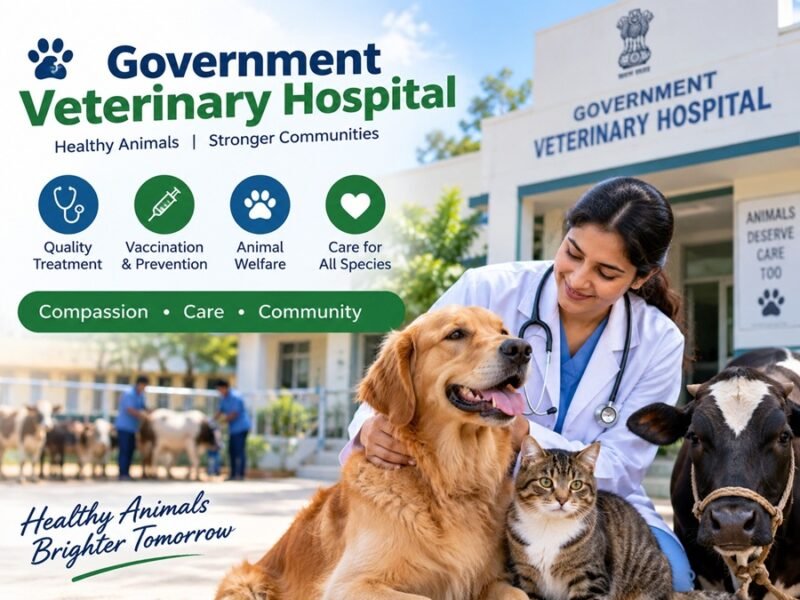



If you’ve ever rushed a sick street dog or your family’s cow to the nearest government veterinary hospital, you already know the drill: a long queue, a harried doctor, and hopefully, a free vaccine or checkup by the end of it. For millions of pet owners and farmers across India, these hospitals are the first and often only line of animal healthcare available to them.
And the network is bigger than most people realise. As per the Basic Animal Husbandry Statistics (BAHS) 2024 report, India currently has 13,173 veterinary hospitals, 30,184 veterinary dispensaries, and 24,532 veterinary aid centres across the country. Yet the on-ground experience doesn’t always match the scale — a 2023 ground report by ThePrint on Delhi’s government veterinary hospitals found hygiene and staffing issues serious enough that animal rights activists filed a PIL over it.
This guide breaks down exactly what a government veterinary hospital offers, what it costs, how to find one, and what to expect — so you’re prepared before you walk in.
What Is a Government Veterinary Hospital?
A government veterinary hospital is a state-run animal healthcare facility that provides treatment, vaccination, and basic surgery for livestock and pets, usually at little to no cost. It’s part of a three-tier system — hospitals, dispensaries, and aid centres — run by each state’s Animal Husbandry Department.
Veterinary hospital vs dispensary vs aid centre
These three terms get used loosely, but they’re not the same:
| Facility Type | What It Offers | Typical Location |
|---|---|---|
| Veterinary Hospital | Full treatment, vaccination, minor/major surgery, diagnostics | District or block level |
| Veterinary Dispensary | Treatment, vaccination, artificial insemination | Block/tehsil level |
| Veterinary Aid Centre | Basic first aid, vaccination camps | Village level |
Who runs them
- Animal Husbandry is a state subject in India, so individual state governments set up and run these hospitals.
- The central government supports this through schemes like ESVHD-MVU (Establishment and Strengthening of Veterinary Hospitals & Dispensaries – Mobile Veterinary Units), which funds mobile veterinary units for doorstep service, especially in rural areas.
Services Offered at Government Veterinary Hospitals
Direct answer: Government veterinary hospitals mainly offer vaccination, artificial insemination for livestock, basic treatment, and minor surgery. Pet-specific care (for dogs and cats) is available at select urban hospitals, but coverage varies a lot by state and city.
Core services you’ll typically find
- Vaccination and immunization (rabies, FMD, etc.)
- Artificial insemination (AI) for cattle and livestock breeding
- General health checkups and basic treatment
- Minor surgical procedures
- Deworming and parasite control
- Emergency first aid (at select hospitals)
Livestock-focused vs pet-focused hospitals
- Rural/district hospitals are usually built around livestock — cows, buffaloes, goats, poultry — since that’s tied to farmer livelihoods.
- Urban government hospitals (especially in metro cities) increasingly handle dogs and cats too, but not all of them are equipped for advanced pet care like dental work or major surgery.
- Always call ahead or check the hospital’s listed services before assuming they’ll treat your specific animal.
Is Treatment Really Free? (Cost Breakdown)
Consultation and many vaccines at government veterinary hospitals are usually free or heavily subsidized, but you may still have to pay separately for certain medicines, lab tests, or advanced procedures — this varies by state and hospital.
What’s typically free
- Doctor consultation
- Common vaccinations (especially during govt drives/camps)
- Basic first aid
What you might still pay for
- Prescribed medicines (some hospitals ask you to buy from outside pharmacies)
- Lab tests and diagnostics
- Advanced surgery or specialist procedures
Government vs private vet hospital — cost comparison
| Factor | Government Vet Hospital | Private Vet Clinic |
|---|---|---|
| Consultation fee | Free or nominal | ₹300–₹800+ |
| Vaccination | Often free | ₹200–₹600 per dose |
| Overnight stay | Rarely available | Around ₹1,000/night (varies by city) |
| Wait time | Can be long | Usually shorter |
| Availability | Limited timings | Often 24×7 or extended hours |
This cost gap is exactly why many pet owners feel stuck — as one Delhi-based animal welfare volunteer put it in a ThePrint report, private overnight care can cost far more than what most people can afford for a pet emergency, which is why government hospitals matter so much despite their gaps.
How to Find and Visit a Government Veterinary Hospital Near You
You can find your nearest government veterinary hospital through your state’s Animal Husbandry Department website, the district administration portal (like district.nic.in pages), or the Open Government Data (OGD) platform, which lists hospitals district-wise.
Where to search
- State Animal Husbandry Department websites — most states list hospitals, dispensaries, and contact numbers.
- District portals (e.g., [districtname].nic.in) — many districts publish local veterinary hospital addresses directly.
- data.gov.in — the Open Government Data platform hosts a district-wise list of veterinary hospitals across India.
- Toll-free helplines — some states run dedicated numbers (for example, Haryana’s 24×7 veterinary helpline, 1962) for emergency livestock care and ambulance services.
Timings to keep in mind
- Most government vet hospitals operate during standard government office hours (roughly 9 AM–5 PM, with a lunch break).
- True 24×7 emergency care is rare and usually limited to select city hospitals or helpline-based mobile units.
- Always confirm timings by phone before visiting, especially for non-emergency visits.
Real Experience: What to Expect During Your Visit
Expect a functional but often crowded setup — free or low-cost basic care, but also longer waits and, at some hospitals, staff shortages that can affect how quickly you’re seen, especially during emergencies.
A real example
A 2023 ThePrint ground report on Delhi’s government veterinary hospitals documented visits where facilities showed poor hygiene and limited staff, prompting a Public Interest Litigation (PIL) from animal welfare activists demanding improvements from the Delhi government and the Animal Welfare Board of India. This isn’t true everywhere — many district and rural hospitals function well — but it’s a realistic picture of what urban pet owners sometimes encounter, and it’s worth going in with the right expectations.
Common issues people report
- Long queues, especially on vaccination camp days
- Limited staff, especially during lunch hours or emergencies
- Being asked to buy medicines from outside pharmacies
- Inconsistent availability of specialist doctors
Tips to get better service
- Carry your pet’s/livestock’s previous medical records, if any
- Visit early morning to avoid the rush
- Call ahead to confirm the doctor and required tests are available
- For genuine emergencies, ask specifically about emergency protocol — don’t assume it’s the same as a private ER
Government Veterinary Hospital vs Private Vet Clinic — Which to Choose?
Choose a government veterinary hospital for routine, budget-friendly care like vaccination and general checkups. Choose a private clinic for emergencies, advanced diagnostics, or when time and consistent availability matter more than cost.
When government makes sense
- Routine vaccinations and health checkups
- Livestock-related services (AI, deworming, camps)
- Budget is a major constraint
When private makes more sense
- Medical emergencies requiring immediate attention
- Specialized treatment (dental, advanced surgery, oncology)
- You need guaranteed availability and shorter wait times
Quick comparison
| Situation | Better Option |
|---|---|
| Annual vaccination | Government |
| Livestock breeding (AI) | Government |
| Sudden high fever/emergency | Private (or govt hospital with emergency care) |
| Budget-tight routine care | Government |
| Advanced surgery | Private |
FAQs
Is treatment free at a government veterinary hospital?
Consultation and many vaccines are usually free or low-cost, but medicines and tests may cost extra depending on the hospital and state.
What are the timings of a government veterinary hospital?
Most operate during standard government hours (around 9 AM–5 PM), though a few urban hospitals and helpline-based mobile units offer extended or emergency support.
Do government veterinary hospitals treat pets like dogs and cats, or only livestock?
It depends on location. Rural and district hospitals are typically livestock-focused, while many urban government hospitals also treat pets, though services vary.
How do I find the nearest government veterinary hospital?
Check your state’s Animal Husbandry Department website, your district’s official portal, or the district-wise hospital list on data.gov.in.
How can I complain about poor service at a government veterinary hospital?
You can raise a complaint with the state Animal Husbandry Department, or in some states, escalate it to the Animal Welfare Board of India if the issue involves neglect or hygiene violations.
What documents are needed to get treatment?
Usually none for a first visit, though carrying previous medical records (if any) helps the doctor treat your animal faster.