


You can have a freshly printed degree in mechanical engineering and still be completely lost on your first day at a modern automotive startup.
The internal combustion engine is being pushed out, replaced by chemistry and computer code. The problem is, a lot of university curriculums were built for the old playbook.
Hiring managers are hitting a wall. Finding a graduate who can balance an equation is easy; finding one who knows what to do when a 400-volt battery pack starts overheating is a different story. The industry is starving for engineers who can do more than the math—they need troubleshooters who can plug a laptop into a charging station and figure out exactly why it refuses to talk to the car.
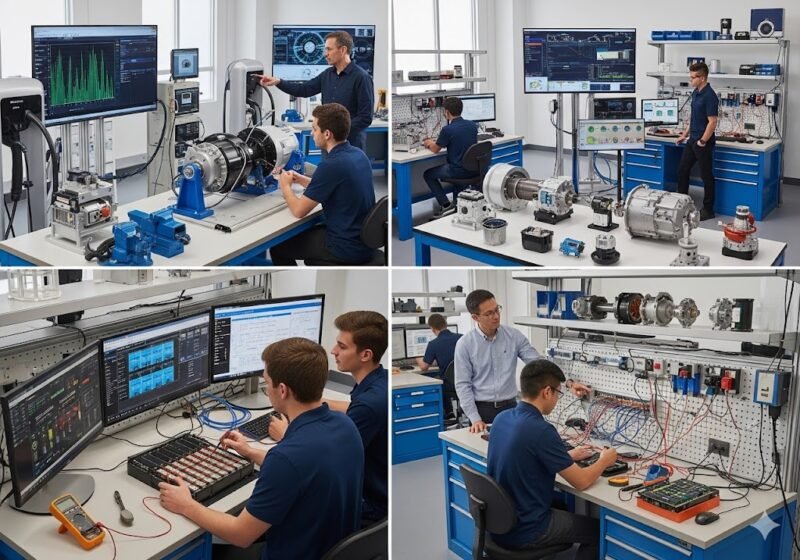
To fix this, the best engineering schools are moving away from pure lecture halls. They are building dedicated, hands-on spaces—a modern electric vehicle laboratory—where students can actually touch the hardware.
Here are the four critical areas where students are getting their hands dirty to become hireable.
1. Battery Physics and the Reality of Regeneration
In a textbook, a battery is a stable source of power. In the real world, it is a volatile chemical box that hates extreme cold and unpredictable drivers.
Students in these labs spend a lot of time breaking things. They don’t just charge a battery; they stress it. They run “drive cycles” that copy the stop-and-go chaos of city traffic to see how the battery’s health drops over time. They learn quickly that a battery working fine at 70°F might fail completely at 15°F.
The hardest thing to learn here is regenerative braking.
Regen isn’t just free energy. When a driver lifts their foot off the pedal, the motor turns into a massive generator. It shoots a huge spike of current back into the battery. If you don’t manage that spike right, you destroy the cells. Students have to write the rules that decide how much energy the battery can swallow at that exact second, balancing range against safety.
2. The Inverter and Motor Control
An electric motor is actually pretty simple hardware. It’s mostly magnets and copper wire. If you just hook a battery up to it, nothing useful happens. The real engineering happens in the inverter—the box that sits between them.
This is where students learn Power Electronics. They take the flat Direct Current (DC) from the battery and chop it up into Alternating Current (AC) waves to spin the wheels.
In the lab, students deal with Field-Oriented Control (FOC). This is complex math that controls the magnetic fields inside the motor. They use dyno benches to create fake resistance—like driving up a steep hill or pulling a heavy trailer. Then, they tune the software. They find out that if their timing is off by a fraction of a millisecond, the motor creates “torque ripple”—a vibration you can feel in the driver’s seat. Their job is to smooth that out without wasting power.
3. The Grid Handshake and Charging Protocols
There is a misconception that charging is passive. In reality, it is a high-speed communication protocol. The car and the charger engage in a strict “handshake” to agree on voltage and amperage limits before the high-voltage contactors ever close. Students in these labs get under the hood of that protocol. They analyze the signal logic to troubleshoot failed sessions—figuring out if a charge was rejected because of a software timeout or a faulty physical lock. This sets the stage for learning Vehicle-to-Grid (V2G) technology, where the complexity doubles as cars become mobile power plants for the grid.
4. Safety Logic and “Fault Injection”
A gas car is a machine; an EV is a robot. If the software crashes, the car stops. Or worse, the battery catches fire.
This makes software testing the most critical skill to learn. In these labs, students practice “fault injection.” This is exactly what it sounds like. They deliberately trick the system into thinking something is broken.
They might cut a sensor wire or simulate a sudden voltage drop. Then, they watch how their code reacts. Does the system cut the high-voltage power instantly? Does it warn the driver? Does it turn on the cooling pumps?
This teaches students that safety isn’t an accident. It is a set of logical rules they have to write, test, and verify. It moves them from thinking “I hope this works” to knowing “this will fail safely if something goes wrong.”
Why This Matters
The shift to electric cars has created a hiring crisis. Companies are desperate for engineers who don’t need six months of training to understand how an inverter works or how to read a data log.
When universities invest in a proper electric vehicle laboratory, they are bridging that gap. They are producing graduates who have already seen the problems, fixed the code, and handled the hardware. In a tough job market, that experience is the difference between getting an interview and getting an offer.