


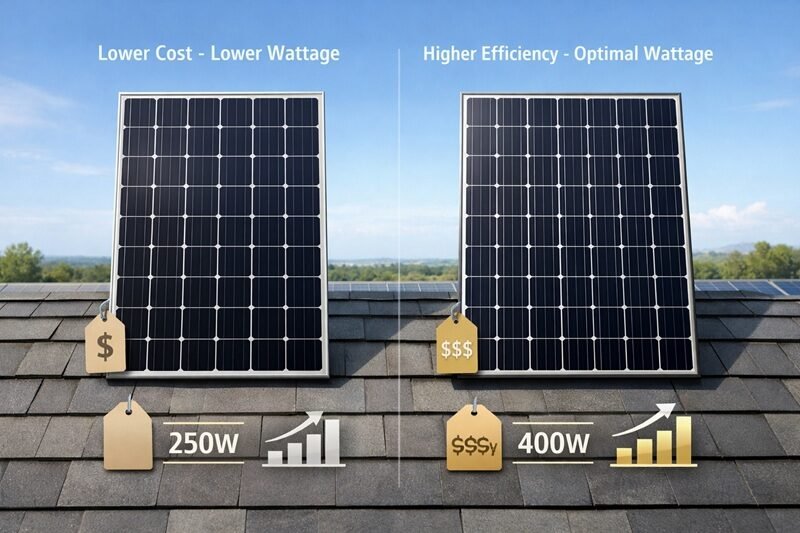
At some point in the solar journey, everyone hits the same wall. You start comparing panels, scrolling through specs, asking people around, and suddenly one question refuses to leave your head. Why does this panel cost more when the wattage looks almost the same. One panel says 400 W. Another says 450 W. The price gap feels bigger than it should be. Sales conversations only add to the confusion. More watts sounds better. A higher price must mean higher performance. Or does it?
This is where many homeowners overpay. Not because solar is expensive, but because power output numbers are often misunderstood. Solar panel pricing is not just about wattage. It never has been. Understanding the relationship between solar panel price and actual power output helps you choose smarter. Let us understand that!
Why Higher Wattage Does Not Automatically Mean Better Value
Wattage is the most visible number on a solar panel, but also the most misunderstood. A panel’s watt rating is measured under laboratory conditions where there is bright sun, ideal temperature, perfect angle, and real rooftops rarely offer those conditions. In everyday use:
- Panels rarely operate at peak wattage all day
- Temperature, dust, shade, and orientation affect output
- Two panels with different watt ratings can perform very similarly over a year
That means a higher-watt panel does not always deliver proportionally higher energy in real life, yet it often costs more. This gap between rated power and actual output is where overpaying begins.
What Actually Determines Solar Panel Price
Solar panel prices are influenced by several factors, not just wattage. Key factors that affect price are:
- Cell technology used
- Panel efficiency
- Build quality and materials
- Temperature performance
- Degradation rate over time
- Warranty coverage
Two panels with similar watt ratings can differ greatly in how they age, how they handle heat, and how consistently they produce power over the years. That difference shows up in pricing.
Power Output Is About Energy Over Time, Not One Number
Most homeowners focus on wattage because it feels concrete. But solar value comes from the energy generated over the years. Power output is better understood as:
- Units generated per day
- Units generated per year
- Stability of output across seasons
A slightly lower watt panel with better efficiency and lower degradation may produce more total energy over 20 years than a higher watt panel that degrades faster. That is why annual output matters more than peak rating.
Understanding Efficiency
Efficiency simply means how well a panel converts sunlight into electricity. Higher efficiency panels:
- Produce more power from the same roof area
- Perform better in a limited space
- Often costs more
But here is the catch: If you have enough roof space, ultra-high efficiency may not be necessary. Paying extra for efficiency only makes sense when space is limited. This is where many people overspend without real benefit.
Temperature Matters More Than Most People Think
Solar panels lose efficiency as the temperature rises. This is especially relevant in Indian conditions. Some panels handle heat better than others. This is reflected in their temperature coefficient. A panel with good heat performance:
- Loses less output during hot afternoons
- Delivers more stable daily generation
- Performs better over the year
Two panels with the same watt rating can behave very differently in summer. The one that handles heat better often costs more, but also delivers more usable energy.
When Paying More Actually Makes Sense
There are situations where a higher-priced panel is the right choice.
- Limited roof space
- High electricity consumption
- Harsh temperature conditions
- Long-term ownership plans
In such cases, better efficiency, stronger build quality, and slower degradation justify the higher solar panel price. But if space is available and consumption is moderate, mid-range panels often deliver better value.
Common Mistakes That Lead To Overpaying
Many people overspend not because they choose solar, but because they choose unknowingly. Some common mistakes include:
- Comparing panels only by wattage
- Ignoring heat performance
- Paying extra for efficiency without space limitations
- Focusing on short-term numbers instead of long-term output
- Assuming a higher solar panel price guarantees higher savings
Solar works best when chosen calmly, not emotionally.
How To Match Panel Choice With Real Needs
Before choosing a panel, ask simple questions.
- How much roof space do I actually have?
- What is my average monthly electricity usage?
- Do I plan to stay in this home long-term?
- Is the summer heat extreme in my area?
Clear answers to these questions make panel selection easier. They also prevent unnecessary upgrades that add cost but not value.
Conclusion
The value of a solar panel is not decided on day one. It shows up slowly, over years of consistent generation. Panels that balance solar panel price, performance, and durability often deliver better returns than those that simply look impressive on paper. Thoughtful choices reduce unnecessary spending and help solar remain a reliable part of your home, not a constant point of doubt.