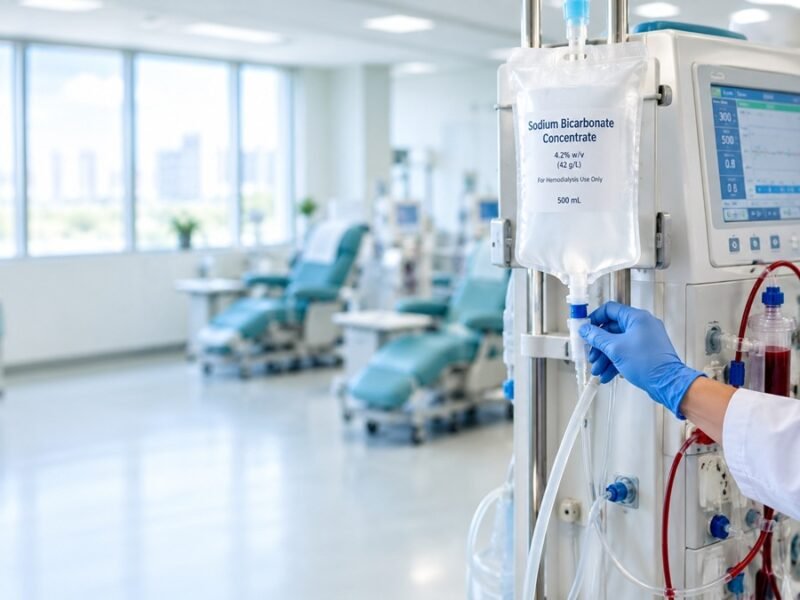



Sodium bicarbonate bags are sealed, single-use bags of dry, pharmaceutical-grade sodium bicarbonate powder that clip onto a haemodialysis machine. The machine pulls purified water through the bag, makes a saturated bicarbonate solution on the spot, and mixes it with acid concentrate to create the patient’s dialysate.
They replaced heavy liquid bicarbonate jugs in many dialysis units because they are lighter, take less storage space and carry a lower risk of bacterial growth. The most common sizes are 650 g and 900 g, and the best-known example is the Fresenius bibag used on 4008 and 5008 series machines.
Most pages ranking for this term are short product brochures. In this Pro Business Cop guide, we go further: how long each bag size really lasts, which acid concentrate it needs, how to store it in a hot climate, what to check before you buy, and what to do when something goes wrong mid-session.
Quick note on the keyword. “Sodium bicarbonate bags” can mean three different products, so make sure you are reading the right guide:
| What people mean | What it is | Who uses it |
|---|---|---|
| Dialysis bicarbonate bags | Dry NaHCO3 powder in a bag that connects to a dialysis machine | Dialysis centres, home haemodialysis |
| IV sodium bicarbonate bags | Sterile liquid solution (for example 8.4% or 150 mEq in 1,000 mL) given into a vein | Hospitals, ICUs, under a doctor’s order |
| Bulk or industrial bags | 25 kg to 50 kg sacks of food-grade or technical-grade baking soda | Food, feed, labs, water treatment |
This article focuses on the first type: dialysis bicarbonate bags.
How does a dialysis bicarbonate bag work?
The bag works as an on-line mixing chamber: water goes in, a saturated bicarbonate solution comes out, and the machine does the rest. You never weigh powder or mix a tank by hand.
Here is what happens during a typical session:
- The nurse or technician hangs the bag on the machine’s bicarbonate holder, with its two nozzles (water in, solution out) locked into the connector.
- The machine fills the bag with purified water from the RO plant.
- The powder dissolves until the water is saturated with sodium bicarbonate.
- The machine draws off this saturated solution and proportions it with acid concentrate (the “A” part) and more purified water.
- The final dialysate reaches the dialyser at the prescribed sodium and bicarbonate levels, and conductivity sensors confirm the mix all through the session.
Because the bag only ever holds dry powder until the moment of use, there is no standing liquid sitting in a warehouse for weeks. That single design choice explains most of the benefits you will read about below.
Bag or cartridge? Both do the same job. A bag (like the Fresenius bibag) is soft and flexible, while a cartridge (like the Baxter BiCart or B. Braun Sol-Cart B) is a rigid polypropylene container. Your machine decides which one you can use, not personal preference.
Bicarbonate bag vs cartridge vs liquid jug vs central supply
For most single-machine setups, a dry bag or cartridge beats a liquid jug on hygiene, weight and storage. Central bicarbonate supply can be cheaper per session in very large units, but only if the loop is cleaned and tested on a strict schedule.
| Format | Real-world example | Typical sizes | Main strength | Main trade-off |
|---|---|---|---|---|
| Dry powder bag | Fresenius bibag and compatible Indian-made bags | 650 g, 900 g | Light, flexible, little plastic | Fits only machines with a bag connector |
| Dry powder cartridge | Baxter BiCart, B. Braun Sol-Cart B, NikkiCart | 650 g to 1,250 g | Wide size range, long shelf life (Sol-Cart B lists 36 months) | Rigid plastic waste; machine-specific holder |
| Liquid bicarbonate jug (8.4%) | Ready-mixed “B” concentrate in 5 L to 10 L canisters | 5 L to 10 L | Works on almost any 3-stream machine | Heavy, bulky, highest contamination risk once opened |
| Central bicarbonate supply | Mixed in a tank, piped to every station | Bulk | Lowest cost per litre at scale | Loop must be disinfected and monitored, or bacteria build up |
A real-world way to think about it: a 15-station unit running three shifts uses roughly 45 bicarbonate units a day. With 5 L jugs, that is over 225 kg of liquid to receive, store and lift every single day. With 900 g bags, it is about 40 kg of powder. Fresenius says its bags give up to five times the treatments per box compared with one case of its liquid bicarbonate.
How long does a 650 g or 900 g bicarbonate bag last?
A 650 g bag lasts at least 6 hours and a 900 g bag at least 8 hours at a dialysate flow of 500 mL/min and a bicarbonate setting of 32 mEq/L, according to the Fresenius bibag Instructions for Use. Push the flow rate or the bicarbonate prescription higher, and the bag runs out sooner.
Baxter publishes similar numbers for its 650 g BiCart: about 6 hours at 500 mL/min, but only 4 hours 37 minutes at 700 mL/min. That gap catches many units out when they switch patients to high-flux or HDF sessions.
Work it out yourself
You can estimate how much powder a session uses with one line of maths. Sodium bicarbonate weighs 84 g per mole, so:
\text{grams used} \approx Q_d\,(\text{L/min}) \times t\,(\text{min}) \times \text{HCO}_3\,(\text{mmol/L}) \times 0.084Then add about 20% for priming, rinse and the powder left behind in the bag. Here is what that looks like for common prescriptions, at roughly 35 mmol/L of bicarbonate drawn from the bag:
| Dialysate flow | Session length | Powder used (approx.) | With 20% buffer | Bag to choose |
|---|---|---|---|---|
| 500 mL/min | 4 h | 355 g | 425 g | 650 g |
| 500 mL/min | 5 h | 440 g | 530 g | 650 g |
| 500 mL/min | 6 h | 530 g | 635 g | 650 g (tight) |
| 700 mL/min | 4 h | 495 g | 595 g | 650 g |
| 800 mL/min | 4 h | 565 g | 675 g | 900 g |
| 700 mL/min | 5 h | 615 g | 740 g | 900 g |
| 500 mL/min | 8 h (nocturnal) | 705 g | 845 g | 900 g |
These figures are planning estimates, not a prescription. Always confirm against your machine’s manual and the bag maker’s runtime table.
Practical tip from the floor: if your unit runs mostly 4-hour sessions at 500 mL/min, stocking only 900 g bags wastes around 400 to 500 g of powder per session. Keep 650 g as your default and hold 900 g for long, high-flow or nocturnal patients.
Which acid concentrate works with a bicarbonate bag?
A bicarbonate bag only gives a safe dialysate when it is paired with an acid concentrate made for the same mixing ratio. The Fresenius bibag, for example, is approved only for 45X acid concentrates, with the machine set to mix 1 part acid with 44 parts bicarbonate and water.
35X vs 45X in plain words
The number tells you how many total parts of dialysate one part of acid concentrate makes.
- 45X (1+44): 1 part acid to 44 parts bicarbonate solution and water. This is the standard for Fresenius machines and most bibag-type bags.
- 35X (1+34): 1 part acid to 34 parts bicarbonate solution and water. Used on some other machine brands, including Gambro (now Baxter) systems. Check your machine manual to confirm.
Baxter’s BiCart accepts either, as long as the acid is designed for pure bicarbonate concentrate with a 1:35 or 1:45 ratio. Mixing a 35X acid with a machine set for 45X throws off sodium, potassium and calcium levels, and the IFU warns that misuse may cause patient injury or death.
Pre-session safety checklist
- Acid concentrate ratio (35X or 45X) matches the machine setting and the bag maker’s instructions
- Bag is sealed, undamaged and within its expiry date
- Bag size suits today’s flow rate and session length (see the table above)
- Conductivity reading is within the machine’s target range before connecting the patient
- pH or conductivity checked with an independent meter, if your machine’s manual requires it
- Bag date and time of connection noted on the treatment sheet
Print this list and tape it near the stock shelf. It takes 30 seconds and catches most mix-up errors before they reach a patient.
Is dry bicarbonate safer than liquid bicarbonate?
Yes, dry powder carries a much lower contamination risk than liquid bicarbonate, because bacteria need water to grow and the powder stays dry until treatment starts. It does not make the bag germ-proof, though, and that is where many supplier pages overstate things.
Why liquid bicarbonate is a problem
Bicarbonate solution is a good home for bacteria. In a well-known CDC-linked study, unfiltered liquid bicarbonate concentrate had median levels of 479,000 CFU/mL of bacteria and 39,800 pg/mL of endotoxin. Those numbers are far above the ultrapure dialysis fluid limits of under 0.1 CFU/mL and under 0.03 EU/mL.
Even big brands get caught out. In 2015, Health Canada published a safety letter after one bottle of NaturaLyte liquid bicarbonate exceeded Fresenius’ internal limit of 100 CFU/mL. The advice included using opened liquid bicarbonate within 24 hours.
The 24-hour rule still applies to bags
Once water enters a bag, the clock starts. The Fresenius IFU says the bibag must be used within 24 hours of connecting to the dialysis machine because bacterial growth can occur.
What this means on the ward:
- Never “save” a half-used bag for the next shift or the next patient.
- Do not pre-connect bags hours before a session to save time.
- Treat the bag as part of the fluid pathway: your routine dialysate cultures and endotoxin tests still matter.
- Keep the machine’s dialysate ultrafilter (such as the DIASAFE filter on Fresenius machines) in date.
So the honest claim is this: dry bags reduce contamination risk. Proper handling, good water and filters do the rest.
How should you store sodium bicarbonate bags?
Store bicarbonate bags sealed, dry and between 5°C and 30°C, away from direct sunlight, and never in a fridge. These are the conditions printed in the Fresenius bibag IFU, and most other makers use a similar range.
That 30°C upper limit matters a lot in India, the Gulf and Southeast Asia. A tin-roofed storeroom in May can easily cross 40°C in the afternoon, and a closed delivery truck can run hotter still.
What heat and humidity actually do
- Above 60°C, sodium bicarbonate starts to break down into sodium carbonate and CO2, according to Solvay’s shelf-life statement. That changes the chemistry of what reaches the patient.
- Humidity makes powder clump. Solvay notes that caking does not change the chemical nature of sodium bicarbonate, but hard lumps can dissolve slowly and cause conductivity alarms early in a session.
- Cold is not ideal either. Baxter recommends keeping BiCart cartridges at 20 to 25°C for 3 to 4 hours before use for best performance. A bag straight off a cold winter truck in North India may not dissolve evenly.
Shelf life
Dry bicarbonate keeps far longer than liquid. Baxter describes BiCart as having double the shelf life of liquid bicarbonate concentrate, and B. Braun lists a 36-month total shelf life for Sol-Cart B. Always go by the expiry date printed on your batch, not a general rule.
Simple storeroom routine: store cartons off the floor on pallets, keep a cheap digital thermometer and hygrometer on the shelf, and use stock on a first-expiry, first-out basis.
How to use a bicarbonate bag, step by step
Using a bicarbonate bag takes under a minute: open the holder, hang the bag, close the door, and let the machine fill it. The steps below follow the Fresenius bibag IFU; always check your own machine’s manual too.
Setting up
- Check the bag for tears, an open seal or an expired date. Do not use a damaged or open bag.
- Remove the plastic seal under the water and bicarbonate nozzles.
- Lift the handle to open the bag holder door.
- Hang the bag by its connector nozzles, with the white handle facing outward.
- Close the door until it clicks shut.
- Follow the machine prompts to fill the bag and prepare the dialysate.
- Wait for conductivity to settle in range before connecting the patient.
At the end of the session
- Use the machine’s “Empty bibag” function, or drain the bag into a suitable sink.
- Lift the door handle and remove the bag.
- Throw away the bag and any leftover powder as per your unit’s waste policy. Never reuse it.
If you see slight discoloration in the powder once water touches it, do not panic. Fresenius states this comes from the raw material and does not affect safety or efficacy.
Troubleshooting common problems
The official IFUs mostly say “see the machine manual” for problems. Here is what usually causes the issues dialysis teams report most often:
| Problem | Likely cause | What to try |
|---|---|---|
| Conductivity alarm right after setup | Bag not seated properly, or acid concentrate ratio does not match machine setting | Re-seat the bag, confirm 35X or 45X acid, recheck conductivity |
| Conductivity drifts low late in the session | Bag running out of powder | Swap to a fresh bag; move this patient to a 900 g bag next time |
| Bag collapses or air alarm | Poor connection or air trapped at the nozzles | Close and reopen the door so the nozzles lock fully |
| Leak or drip at the connector | Damaged nozzle or bag | Replace the bag at once and clean the spill |
| Slow to reach target conductivity | Caked powder from humid storage, or a very cold bag | Store bags dry; let cold stock reach room temperature first |
If an alarm does not clear after these checks, stop and follow your machine’s alarm procedure. Do not bypass a conductivity alarm.
Why water quality matters as much as the bag
A bicarbonate bag is only as clean as the water that flows through it. Makers approve their bags for use only with water that meets ANSI/AAMI RD62, Ph. Eur. or ISO 13959 dialysis water standards.
Think of it this way. Over a 4-hour session at 500 mL/min, about 120 litres of RO water go into the dialysate, including the water that dissolves the bicarbonate powder. If the RO plant, storage tank or loop is contaminated, a premium bag cannot fix that.
Keep these basics on your monthly calendar:
- Culture and endotoxin tests on product water and dialysate at the frequency your guidelines set
- RO membrane and pre-filter changes on schedule, not when output drops
- Chlorine and chloramine checks before every shift if your feed water is municipal supply
- Loop disinfection logs that a visiting inspector can actually read
When dialysate cultures come back high, units often blame the concentrate first. In practice, the water system is the more common culprit, so test both before you switch suppliers.
How to choose a sodium bicarbonate bag supplier
Buy only from a supplier who can show a valid medical device licence, a pharmacopoeia-grade certificate for each batch, and proof that the bag fits your exact machine model. Price comes after those three.
Regulatory basics in India
In India, the CDSCO classifies haemodialysis concentrate as a Risk Class C medical device under the Medical Devices Rules, 2017. Class C devices need a manufacturing licence issued by the central licensing authority (Form MD-9) or an import licence (Form MD-15). In the United States, federal law restricts sale of products like bibag to a physician or on a physician’s order.
The Pro Business Cop buyer’s checklist
Ask every supplier for these before you sign a rate contract:
| What to ask for | Why it matters | Red flag |
|---|---|---|
| CDSCO licence number (MD-9 or MD-15) | Confirms the product is legal to sell as a Class C device | “Licence applied for” or a state Class A or B licence |
| Grade: USP, Ph. Eur. or IP | Sets purity limits for heavy metals and other impurities | Only “food grade” or “technical grade” on the label |
| Certificate of analysis per lot | Proves each batch was tested, including bioburden and endotoxin | One generic certificate for every batch |
| Machine compatibility statement | The connector must lock fully on your 4008, 5008 or other model | “Fits most machines” with no model list |
| Fill weight and tolerance | You need the full 650 g or 900 g to finish long sessions | No stated tolerance |
| Shelf life and storage label | Shows the product is stable for your stock cycle | Missing or hand-written expiry dates |
| Instructions for Use | Required for safe use and audits | No IFU, or an IFU copied from another brand |
| Complaint and recall process | You need a named contact when a batch fails | No traceable batch number on the bag |
Real example of a weak listing: several supplier pages for bicarbonate bags in India list only pack sizes and broad claims like “no spillage” or “prevents microbial growth”, with no licence number or test data on the page. That does not mean the product is poor, but it does mean you must ask for the paperwork directly.
Trial before you switch
Run a 2 to 4 week trial on a few machines before switching the whole unit. Track conductivity alarms, bags that run out early, leaks and any change in dialysate culture results. Compare those numbers with your current supplier, not just the invoice price.
Are bicarbonate bags cheaper and greener than liquid jugs?
Bags usually win on total cost and waste, even when the price per unit looks higher, because you stop paying to ship, store, lift and dispose of water. The real comparison is cost per completed session, not cost per bag.
How to work out your true cost per session
Add these up for each format over one month, then divide by the number of sessions:
- Purchase price of the bicarbonate product
- Freight (liquid jugs are mostly water, so you pay to move weight that adds nothing)
- Storage space, valued at what that room could otherwise be used for
- Staff time to receive, carry and change containers
- Waste disposal by weight or by bag
- Product thrown away: half-used jugs past 24 hours, or oversized bags on short sessions
Run this sum and you may find that choosing the right bag size saves more than changing brands. A unit using 900 g bags for every 4-hour session can often cut bicarbonate spend just by moving short sessions to 650 g bags.
The environmental side, with numbers
- Less weight on the road. A 650 g bag replaces a 5 L jug that weighs over 5 kg, so each delivery carries roughly an eighth of the mass for the same number of sessions.
- Less plastic. A soft bag uses far less plastic than a rigid canister. Fresenius says its flexible bag is recyclable and may reduce waste costs.
- Recyclable cartridges, with a condition. Baxter says BiCart cartridges can be recycled if rinsed clean and your facility’s programme accepts polypropylene #5.
Dialysis is resource-heavy, and “green dialysis” is now an active research area. Switching from jugs to dry bags is one of the easiest wins a unit can make without touching clinical care.
What patients and caregivers should know
If you are on haemodialysis, the bicarbonate bag is the part of your treatment that helps correct the acid build-up your kidneys can no longer clear. Your nephrologist sets how much bicarbonate you get, and the machine delivers it through the bag.
A few things worth knowing:
- It affects your sodium too. Sodium bicarbonate supplies part of the sodium in your dialysate, so your prescription balances both together.
- Side effects during dialysis are usually not caused by the bag itself. Labels list hypotension, nausea, headache and cramps as possible reactions to dialysis fluid. Tell your nurse if these happen, as your prescription may need adjusting.
- Home haemodialysis users benefit most from dry bags. Carrying 650 g bags is far easier than hauling 5 L jugs, and storage at home takes a small shelf instead of a corner of a room.
- It is not the same as a baking soda supplement. Do not take sodium bicarbonate tablets or powder at home unless your doctor has prescribed them.
You are entitled to ask your unit which bicarbonate product they use and how they test their water. A good unit will be happy to explain.
Frequently asked questions
What is a sodium bicarbonate bag in dialysis?
It is a single-use bag of dry, pharmaceutical-grade sodium bicarbonate that connects to a haemodialysis machine. The machine dissolves the powder with purified water and mixes it with acid concentrate to make the dialysate, so staff never handle liquid bicarbonate jugs.
How many hours does a 900 g bicarbonate bag last?
A 900 g bag lasts at least 8 hours at 500 mL/min with a 32 mEq/L bicarbonate setting, based on Fresenius bibag data. Higher flow rates or bicarbonate prescriptions shorten that time, so check the maker’s runtime table for your settings.
Can a bicarbonate bag be reused?
No. Each bag is single-use and must be discarded with any leftover powder after the treatment. Once water enters the bag, bacteria can start to grow, which is why makers require use within 24 hours of connection.
What is the difference between a bicarbonate bag and a bicarbonate cartridge?
Both hold dry sodium bicarbonate and work the same way. A bag is soft and flexible (for example, Fresenius bibag), while a cartridge is a rigid polypropylene container (for example, Baxter BiCart or B. Braun Sol-Cart B). Your machine’s holder decides which one you can use.
Which dialysis machines use bicarbonate bags?
Bag-type products are mainly used on Fresenius machines fitted with a bibag connector, such as the 4008 and 5008 series and, in the US, the 2008T. Cartridge-type products fit machines from Baxter (Gambro), B. Braun, Nikkiso and others with a cartridge holder.
Why does my bicarbonate bag need 45X acid concentrate?
The machine is set to mix 1 part acid with 44 parts bicarbonate solution and water. Using an acid made for a different ratio, such as 35X, gives the wrong sodium, potassium and calcium levels in the dialysate, which can harm the patient.
How should bicarbonate bags be stored in hot weather?
Keep them sealed, dry and between 5°C and 30°C, out of direct sun and off the floor. In hot regions, avoid tin-roofed stores and closed vehicles, and use a thermometer on the shelf to check that the limit is not exceeded.
Is a dialysis bicarbonate bag the same as an IV sodium bicarbonate bag?
No. A dialysis bag holds dry powder used outside the body to make dialysate. An IV bag holds a sterile liquid solution, such as 8.4% sodium bicarbonate, given directly into a vein in hospital under a doctor’s order.
What licence is needed to sell dialysis concentrate in India?
Haemodialysis concentrate is a Class C medical device under CDSCO rules. Manufacturers need a licence on Form MD-9 from the central licensing authority, and importers need an import licence on Form MD-15.
The bottom line
Sodium bicarbonate bags are the simplest, cleanest way to supply bicarbonate for most haemodialysis machines, as long as you match the bag size to the session, pair it with the correct acid concentrate and store it below 30°C. The bag is only one link in the chain: water quality, the 24-hour rule and a licensed supplier matter just as much.
If you are reviewing your unit’s consumables, start with three quick wins: map each patient’s flow and session length to a 650 g or 900 g bag, print the pre-session checklist, and ask your current supplier for their licence and batch certificates. At Pro Business Cop, we believe clear, practical information like this helps dialysis teams and buyers make safer decisions, faster.
This article is for general information and does not replace your machine manual, the product’s Instructions for Use or your nephrologist’s advice.