


It happened in the span of a single fiscal quarter.
If you walked into your local pharmacy or coffee chain in October, you likely waited in line behind a person who was chatting with a cashier. There was friction. There was a misunderstanding about a coupon. There was a joke about the weather.
Walk into that same store today, in mid-December, and the friction is gone. But so is the cashier.
We spent years debating the ethics of automation. We worried about robots taking factory jobs or self-driving trucks taking over the highways. We braced ourselves for a loud, clanking industrial revolution.
Instead, the biggest shift in modern labor history arrived on a tablet screen, wearing a smile that looks entirely human but doesn’t actually exist.
Nobody was prepared for how fast the “front of house” would disappear. And perhaps more unsettlingly, nobody was prepared for how quickly we would accept it.
The Speed of the Switch
For years, self-checkout was a clunky alternative. It screamed “unexpected item in bagging area.” It was frustrating. It required you to do the work.
That dynamic collapsed over the last three months.
Major retailers, facing a cocktail of labor shortages and breakthrough efficiency in large language models, didn’t just upgrade their kiosks. They replaced the interface entirely.
The new screens don’t ask you to push buttons. They just listen.
They understand your mumbled order. They know you want oat milk before you finish the sentence because they remember your face from last Tuesday. They offer empathy when they’re out of stock. They make small talk that is terrifyingly good.
This isn’t the “press 1 for English” frustration of 2023. This is seamless. And that frictionless experience is exactly why the transition happened at warp speed.
We didn’t fight for human interaction because the machine finally became easier to talk to than the person.
The Vanishing “Third Place”
Sociologists talk about “third places”—the spots between work and home where community happens. The barber shop, the corner store, the diner.
These interactions are usually trivial. You don’t know the barista’s life story. But you know they look tired today. You exchange a nod. It’s a micro-dose of shared humanity.
We are currently watching the systematic evaporation of these micro-interactions.
When you interact with the new AI concierge at the grocery store, you are getting efficiency. You are getting accuracy. But you are not getting recognition. The machine mimics recognition, but it cannot witness you.
We are effectively editing the “boring parts” out of our daily social lives. But it turns out those boring parts—waiting while someone fumbles with a register, exchanging a grimace with a stranger—were the glue holding a lot of our social patience together.
Without them, our days are becoming a series of highly efficient, solitary transactions.
Why We Didn’t See It Coming
We were looking the wrong way.
We were watching the robotics companies, waiting for androids to stock shelves. We thought automation was a hardware problem.
It turns out it was a software problem. The physical bodies of workers weren’t the bottleneck; their minds and voices were what cost money.
Once the AI models dropped below the price of federal minimum wage per hour of operation—a crossover event that quietly occurred earlier this year—the boardrooms didn’t hesitate. The rollout wasn’t tested in small markets for years. It was deployed via cloud updates overnight.
Suddenly, the “Help Wanted” signs vanished, not because the jobs were filled, but because the positions were deleted.
The Silence of Convenience
The strangest part of this past month hasn’t been the outrage. It’s been the lack of it.
There have been no widespread boycotts. There are no picket lines in the drive-thru lane.
Why? because we are tired.
The average consumer is exhausted. When given the choice between an awkward interaction with an overworked teenager or a smooth, instant interaction with a cheerful avatar, the consumer chooses the avatar.
We are complicit in this shift because it feels good. It feels easy.
We trade the social contract for the path of least resistance. It is a transaction we make dozens of times a day, often without looking up from our phones.
What We Lose When We Gain Time
The economic ramifications are massive and will be debated by economists for the next decade. But the psychological shift is immediate.
We are entering an era where human interaction is becoming a premium product.
Talking to a human being is rapidly becoming a luxury service. You will see it in high-end hotels and expensive restaurants, where “real staff” will be touted as an amenity.
For everyone else, the public sphere is becoming a private experience. You move through the world in a bubble, interacting only with algorithms designed to smooth your path and upsell your purchase.
The world didn’t end. The economy didn’t collapse. The stores are still open, and the coffee is still hot.
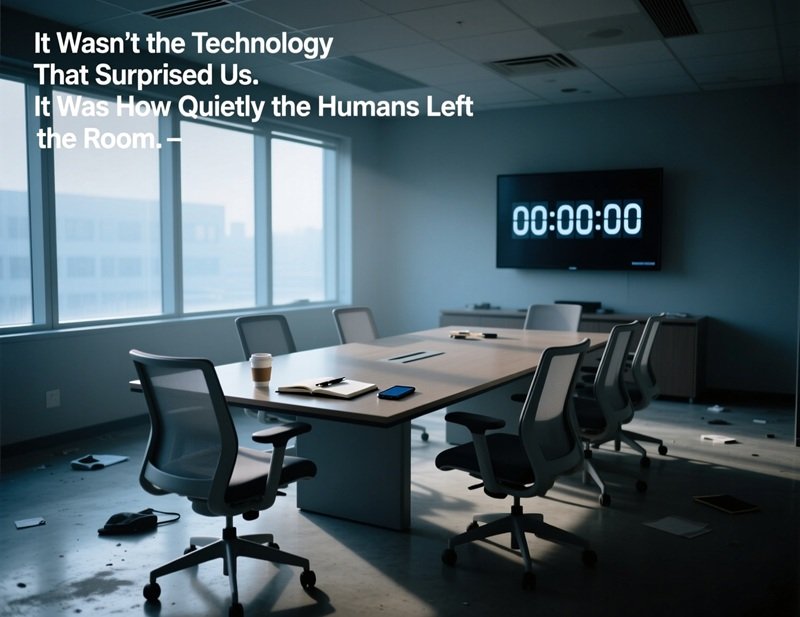
It’s just quieter now.
And as we scroll through our feeds, enjoying the time we saved by not talking to the person at the counter, we have to ask ourselves if that silence is really what we wanted.