



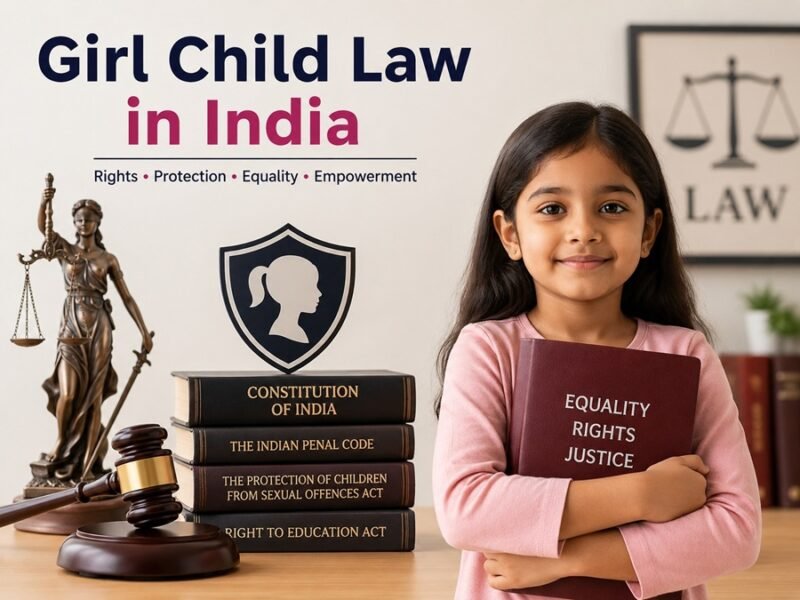
India has built a strong legal framework to protect the girl child — from birth to adulthood. But most families still don’t know what these laws actually cover, or how to use them if something goes wrong.
This guide breaks down the girl child rights and laws in India in simple language, so you know exactly what protection exists and where to go if it’s violated.
Why Girl Child Laws Matter in India
Girls in India often face discrimination before they’re even born — through sex-selective practices, unequal access to education, early marriage, or unsafe environments. The Indian government has responded with a set of laws covering:
- Birth and survival (protection from sex-selective abortion)
- Education
- Protection from abuse and exploitation
- Marriage age and consent
- Property and inheritance
- Workplace and maternity protection
Here’s a clear breakdown of each one.
1. Right to Life and Protection Before Birth — PC-PNDT Act, 1994
The Pre-Conception and Pre-Natal Diagnostic Techniques (PC-PNDT) Act bans sex determination tests and sex-selective abortion. It was introduced to stop female foeticide and correct India’s declining child sex ratio.
- Doctors or clinics conducting illegal sex-determination tests can face imprisonment up to 3–5 years and heavy fines.
- Reporting is anonymous and can be done via the National/State PC-PNDT helpline.
2. Right to Education — Right of Children to Free and Compulsory Education (RTE) Act, 2009
Every girl child in India between 6 and 14 years has a legal right to free and compulsory education in a neighbourhood school, including children with disabilities.
Key protections under RTE:
- No child can be denied admission due to gender.
- No school can charge capitation fees or hold back-to-school exams for entry.
- 25% reservation for economically weaker sections in private schools.
This right indirectly reduces child marriage and child labour by keeping girls in school longer.
3. Protection from Sexual Abuse — POCSO Act, 2012
The Protection of Children from Sexual Offences (POCSO) Act is the primary law protecting all children, including girls law, from sexual assault, harassment, and exploitation — both online and offline.
What makes POCSO strong:
- It’s gender-neutral in language but has significantly strengthened protection for girl victims.
- A minor’s “consent” is not legally valid — any sexual act with a person under 18 is an offence.
- Cases are non-bailable and cognizable (police can arrest without a warrant).
- Special POCSO courts are required to complete trials within a set time frame and record the child’s statement in a child-friendly manner.
If you suspect abuse, you can report it via the Childline helpline: 1098 (toll-free, 24×7).
4. Right Against Child Marriage — Prohibition of Child Marriage Act, 2006
This law fixes the minimum legal age of marriage at 18 for girls and 21 for boys.
Important points:
- Anyone who conducts, promotes, or permits a child marriage can face up to 2 years’ imprisonment or a fine up to ₹1 lakh, or both.
- A child marriage is not automatically void — but the minor can approach the court to have it annulled.
- District-level Child Marriage Prohibition Officers are appointed to prevent such marriages.
- Following the Supreme Court’s 2017 ruling in Independent Thought v. Union of India, sexual intercourse with a wife under 18 is legally treated as rape under criminal law, regardless of marital status.
A 2021 Bill proposing to raise the marriage age for women to 21 was introduced in Parliament but has not yet been passed into law.
5. Right to Property and Inheritance — Hindu Succession (Amendment) Act, 2005
Before 2005, daughters had limited rights to ancestral property. This amendment gave daughters equal coparcenary rights with sons in Hindu Undivided Family (HUF) property.
- Daughters now have an equal share by birth, not just as a gift or favour.
- This applies retrospectively, meaning it counts even for daughters born before 2005 (subject to certain court rulings and conditions).
6. Right Against Child Labour — Child Labour (Prohibition and Regulation) Act, 1986/2016
This law bans employment of children under 14 in any occupation, and prohibits adolescents (14–18 years) from working in hazardous industries.
- Girls are especially vulnerable to domestic child labour and trafficking, which this Act, alongside the Juvenile Justice Act, aims to prevent.
- Violations can lead to imprisonment of 6 months to 2 years and fines for employers.
7. Protection Under the Juvenile Justice (Care and Protection of Children) Act, 2015
This Act protects children in difficult circumstances — including trafficking, abandonment, and abuse — and ensures rehabilitation, not punishment, for child victims and offenders alike.
- Sets up Child Welfare Committees (CWCs) in every district.
- Girls rescued from trafficking or exploitation are placed under state care and rehabilitation, not treated as criminals.
8. Right to a Safe Workplace (For Adolescent and Working Women) — POSH Act, 2013
While primarily for adult women, the Sexual Harassment of Women at Workplace (Prevention, Prohibition and Redressal) Act, 2013 protects girls above 18 who enter the workforce, apprenticeships, or internships from harassment.
- Every organisation with 10+ employees must have an Internal Complaints Committee (ICC).
- Complaints must be resolved within 90 days.
Quick Reference Table
| Law | Year | Protects Against |
|---|---|---|
| PC-PNDT Act | 1994 | Sex-selective abortion |
| RTE Act | 2009 | Denial of education |
| POCSO Act | 2012 | Sexual abuse and exploitation |
| Prohibition of Child Marriage Act | 2006 | Underage marriage |
| Hindu Succession (Amendment) Act | 2005 | Unequal inheritance |
| Child Labour Act | 1986/2016 | Illegal child employment |
| Juvenile Justice Act | 2015 | Trafficking, abandonment, abuse |
| POSH Act | 2013 | Workplace harassment (18+) |
How to Report a Violation of Girl Child Rights
- Childline India: 1098 (24×7, free, confidential)
- National Commission for Protection of Child Rights (NCPCR): ncpcr.gov.in
- Local Child Welfare Committee (CWC): available in every district
- Nearest Police Station: for POCSO or child marriage cases, an FIR can be filed immediately — these are cognizable offences
FAQs on Girl Child Rights in India
Q1. What is the legal age of marriage for girls in India?
The legal minimum age of marriage for girls in India is 18 years, under the Prohibition of Child Marriage Act, 2006. A proposal to raise it to 21 is still pending in Parliament.
Q2. Is child marriage automatically cancelled (void) in India?
No. A child marriage is voidable, not automatically void — meaning the minor party must approach a court to have it annulled within two years of turning 18.
Q3. Do daughters have equal rights to ancestral property in India?
Yes. Since the Hindu Succession (Amendment) Act, 2005, daughters have equal coparcenary rights with sons in ancestral Hindu Undivided Family property.
Q4. What should I do if a girl child is being abused?
Call Childline at 1098 immediately, or file a complaint at the nearest police station. Cases under the POCSO Act are non-bailable, and police must act without delay.
Q5. Is sex-selective abortion legal in India?
No. It is illegal under the PC-PNDT Act, 1994. Both the person conducting the test and the person seeking it can face legal consequences.
Q6. Does POCSO apply only to girls?
No, POCSO is gender-neutral and protects all children under 18. However, statistically, most reported cases involve girl victims, making it a key law for girl child protection.
Final Thoughts
India’s legal framework for girl child protection is fairly comprehensive on paper — covering birth, education, marriage, safety, and inheritance. The real challenge is awareness and enforcement. Knowing these laws is the first step for parents, teachers, and citizens to actually use them when needed.
This article is for general legal awareness only and does not substitute professional legal advice. For specific cases, consult a lawyer or contact the National Commission for Protection of Child Rights (NCPCR).