


By Satendra Kumar | Last updated: October 30, 2026
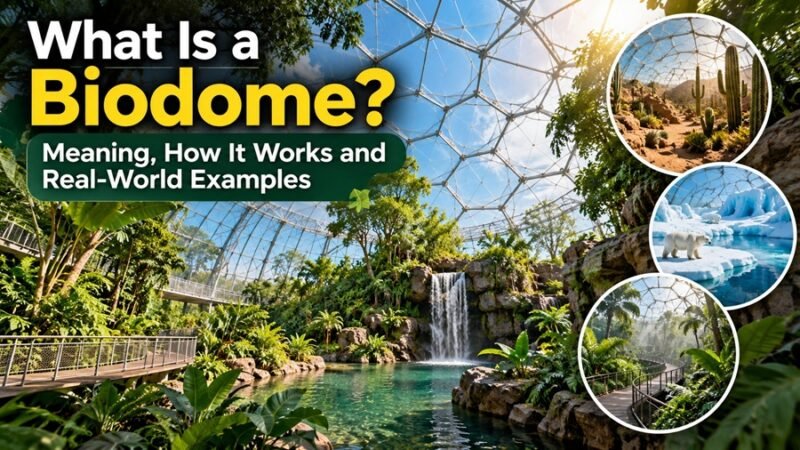
A biodome is an enclosed, climate-controlled structure that recreates one or more natural ecosystems under a single roof. Scientists use biodomes to study how plants, animals, water and air interact. Conservation teams use them to protect species, and space agencies use similar sealed habitats to test how humans could live far from Earth.
You may know the word from the 1996 comedy Biodome, or from photos of glowing glass domes in Singapore and Cornwall. The real thing is more interesting than the movie. This guide explains what a biodome is, how it works, which ones you can actually visit, and what one troubled experiment in the Arizona desert taught scientists about living in a sealed world.
In this guide: definition, how it works, what it is used for, famous examples, biodome vs. greenhouse vs. biosphere, can humans live in one, pros and cons, building a mini version at home, the future, and FAQs.
Biodome Definition: Quick Answer
A biodome is a human-made, enclosed environment designed to recreate and manage the conditions of one or more natural ecosystems. It may regulate temperature, humidity, light, water and air quality to support plants and, in some facilities, animals. Biodomes are used for research, conservation, education and controlled growing experiments.
Biodome meaning in simple words
Think of a biodome as a small, carefully managed piece of nature under a roof. Inside, people control temperature, humidity, light and water so that a rainforest, a desert or a cold coastline can survive in a place where it would never grow on its own. A tropical rainforest in rainy, cool Cornwall, England, is a perfect example.
Where the word “biodome” comes from
The word joins “bio,” from the Greek bios meaning life, with “dome,” the rounded roof style. Domes became popular for these buildings because they are strong, let in plenty of light and spread air evenly. Not every biodome is a perfect dome, though. Some are long tunnels, some are clusters of bubbles, and one of the most famous is built inside an old sports stadium.
“Biodome” as a common word and as a name
In everyday use, “biodome” describes any enclosed habitat of this kind. But Biodome with a capital B usually means the Montreal Biodome in Canada, a popular indoor zoo and botanical attraction. If you search “biodome” and see ticket prices and opening hours, that is the one Google is showing you.
How Does a Biodome Work?
Every biodome has to solve the same problem: keep living things healthy inside an artificial space. Here is the basic process in five steps.
A shell, made of glass, plastic film or concrete, separates the inside from the outside weather.
Sensors track temperature, humidity, light and carbon dioxide levels.
Heating, cooling, misting and lighting systems adjust automatically when readings drift.
Water is collected, filtered and reused through soil, plants and drains.
Plants, and in some cases animals and soil microbes, balance oxygen and carbon dioxide.
Let us look at the main parts in a bit more detail.
Climate control: temperature, humidity and light
Different ecosystems need very different conditions. A rainforest section needs warmth and heavy humidity all year. A cold-water coastal section needs cool air and chilled pools. In large biodomes, engineers run separate zones with separate controls so a desert and a jungle can sit a short walk apart. Light is handled with a mix of sunlight and lamps, especially in colder countries or in winter months.
Water and soil systems
Water rarely goes to waste in a well-designed biodome. It drips through soil, gets taken up by roots, evaporates from leaves and condenses again, much like a mini water cycle. Many facilities also treat and recycle the water used in pools and misting systems. Soil is not just dirt either. Healthy soil holds bacteria and fungi that break down plant waste and keep nutrients moving.
Air and gas balance
Plants take in carbon dioxide and release oxygen during the day. At night, plants and soil microbes use oxygen. In a huge open room, this swing hardly matters. In a sealed habitat, it can become a serious problem, which is exactly what happened in Biosphere 2, covered below.
Why the dome shape is used
A curved or dome-like roof carries its own weight without heavy supports in the middle, which keeps the floor open for tall trees. It also lets sunlight enter from many angles and helps warm air rise and circulate. American designer Buckminster Fuller popularised the geodesic dome in the mid-20th century, and many modern conservatories borrow from that idea.
Closed system vs. semi-open system
This is a difference most articles skip. A closed system is sealed from the outside, so air and water are recycled inside, and it is mainly used for research. A semi-open system exchanges air with the outside and has regular visitors, staff and deliveries. Almost every biodome you can visit as a tourist is semi-open. Truly sealed habitats are rare and expensive.
What Is a Biodome Used For?
Scientific research
A biodome lets scientists change one variable, such as carbon dioxide or water supply, and watch what happens to a whole ecosystem. That is hard to do in the wild, where weather and wildlife keep changing everything at once. Biosphere 2 in Arizona has been used for studies on rainforest water use, soil and climate for exactly this reason.
Conservation and species protection
Some biodomes house plants and animals that are rare or threatened in nature. They also give researchers a safe place to study breeding, feeding and disease without disturbing wild populations. The Eden Project in Cornwall, for instance, grows crop plants and tropical species from around the world and uses them to show visitors how people depend on plants.
Education and tourism
For most people, this is the main use. A student who has only read about the Amazon can walk through a humid, bird-filled rainforest in under an hour. Biodomes turn textbook ideas like food chains, rainfall and biodiversity into something you can see, smell and feel.
Food production experiments
Research teams use sealed or semi-sealed domes to test how much food can grow in a small space with recycled water. These tests matter on Earth, for example in dry regions and crowded cities, and they matter even more for long space missions.
Space exploration and life-support testing
Astronauts cannot carry unlimited food, water and air to Mars. Scientists therefore study bioregenerative life support, which means using plants and microbes to recycle air, water and waste. Several real programmes are covered in the examples below.
Famous Biodomes Around the World
| Name | Location | Opened | What makes it special |
|---|---|---|---|
| Montreal Biodome | Montreal, Canada | 1992 | Five ecosystems inside a former Olympic cycling stadium |
| Biosphere 2 | Oracle, Arizona, USA | 1991 | Sealed research facility with multiple biomes |
| Eden Project | Cornwall, UK | 2001 | Huge rainforest and Mediterranean biomes in a former clay pit |
| Gardens by the Bay | Singapore | 2012 | Flower Dome and Cloud Forest conservatories |
Montreal Biodome, Canada
The Montreal Biodome sits inside the velodrome built for the 1976 Olympic Games. After the cycling track was no longer needed, the building was converted and opened as a Biodome in 1992. Today it recreates five ecosystems: the Tropical Rainforest, the Laurentian Maple Forest, the Gulf of St. Lawrence, the Labrador Coast and the Sub-Antarctic Islands. It is part of Space for Life, a group of nature museums in Montreal. Interestingly, it is not a geodesic dome at all. It is a concrete sports arena with a curved roof that was cleverly reused.
Biosphere 2, Arizona, USA
Built in the Arizona desert between 1987 and 1991, Biosphere 2 was designed as a sealed miniature Earth, with a rainforest, an ocean with a coral reef, mangrove wetlands, a savanna and a fog desert. The name comes from the idea that Earth itself is Biosphere 1. The University of Arizona now owns and runs the site as a research and visitor centre. It also has large rooms where scientists study things like rainfall and landscape change.
Eden Project, Cornwall, UK
The Eden Project opened in 2001 in a worked-out china clay pit near St Austell. Its two main biomes, the Rainforest Biome and the Mediterranean Biome, are covered in lightweight, transparent plastic panels called ETFE rather than heavy glass. The result is a structure that looks like a group of giant bubbles and gives plants plenty of light. It is a good example of how a biodome can also help restore an industrial landscape.
Gardens by the Bay, Singapore
Gardens by the Bay opened in 2012. Its Flower Dome recreates a cool, dry Mediterranean climate, and its Cloud Forest recreates a misty mountain environment, complete with a tall indoor waterfall. These domes show how a biodome can be built in a hot, humid country and still hold cool-climate plants, thanks to heavy air conditioning and careful design.
Space-related projects: BIOS-3, Lunar Palace 1 and MELiSSA
BIOS-3 was a sealed habitat in Krasnoyarsk, Siberia, built by Soviet scientists. In experiments run mainly in the 1970s and 1980s, small crews lived inside for months and grew wheat and vegetables to recycle air and produce food.
Lunar Palace 1 is a ground-based habitat at Beihang University in Beijing. It hosted a 105-day experiment in 2014, and a later mission, Lunar Palace 365, ended in 2018 after 370 days with crews rotating in and out.
MELiSSA is a European Space Agency programme that has studied for decades how to recycle waste, water and air using microorganisms and plants. Its pilot plant is based at the Universitat Autonoma de Barcelona in Spain.
Biodome vs. Biosphere vs. Biome vs. Greenhouse vs. Terrarium
These five words get mixed up constantly. This table makes the difference clear.
| Term | What it means | Scale | Example |
|---|---|---|---|
| Biodome | A built structure that recreates ecosystems | Building-sized | Montreal Biodome |
| Biosphere | The part of Earth where life exists, or a large sealed research facility | Planet-wide, or very large facility | Earth, Biosphere 2 |
| Biome | A large natural region defined by climate and life | Natural region | Amazon rainforest, Thar Desert |
| Greenhouse | A glass or plastic structure for growing plants | Small to large | A farm greenhouse |
| Terrarium | A small sealed container with plants | Desktop-sized | A bottle garden |
Common mix-ups, explained
Biodome vs. greenhouse: A greenhouse is mainly for growing crops or flowers. A biodome tries to recreate a whole ecosystem, often with animals, water features and several climate zones. A biodome can contain a greenhouse, but a greenhouse is rarely a full biodome.
Biodome vs. biome: A biome is a natural thing, like a rainforest or tundra. A biodome is a human-made structure that copies one or more biomes.
Biodome vs. biosphere: Scientists use “biosphere” for all life on Earth. The word is also borrowed for sealed facilities like Biosphere 2, which is why the two terms overlap in search results.
Can Humans Live Inside a Biodome?
In short, yes for a while, but not comfortably, and not yet for the long term. The best-known test was Biosphere 2.
What the Biosphere 2 experiment tried
In September 1991, eight people, often called biospherians, entered the sealed facility for a planned two-year mission. They grew most of their own food and recycled their air and water. The building even had flexible chambers called “lungs” that let the air expand and contract with temperature, so the structure would not crack under pressure changes.
What went wrong
Oxygen levels inside slowly fell from about 21 percent to around 14 percent, a level that makes people tired and short of breath. Organisers eventually pumped in oxygen from outside, about 16 months into the mission. Researchers later concluded that two things were involved: soil rich in organic matter, where microbes used up oxygen, and the exposed concrete, which absorbed carbon dioxide and so reduced the plants’ ability to rebalance the air. The crew also struggled with limited food and lost weight, and several species, including many insects and small animals, did not survive. Some pests, such as ants, took over.
What scientists learned
The mission was criticised and also praised. It showed that a small closed ecosystem is much harder to balance than it looks. It also taught researchers that building materials, soil choice and even insects can decide whether a habitat works. That knowledge now guides newer life-support projects like Lunar Palace 1.
Advantages and Limitations of Biodomes
Advantages
Control: Researchers can test one change at a time.
Education: Visitors can experience distant ecosystems in one place.
Conservation support: Rare plants and animals get a safe space.
Efficient land use: Food and plants can be grown in small, protected areas.
Limitations
High cost: Building and running them is expensive.
Energy use: Heating, cooling and lighting need large amounts of power.
Fragile balance: One small failure, such as a pump or a pest, can affect the whole system.
Limited scale: A biodome copies nature in miniature. It cannot match a real forest’s size or complexity.
Can You Build a Biodome at Home?
A full biodome is beyond a home project, but you can build small versions that teach the same ideas.
Three beginner-friendly options
Bottle or jar ecosystem: A sealed glass container with soil, small plants such as moss or ferns, and a little water. Place it in bright, indirect light.
Dome greenhouse: A small geodesic or tunnel greenhouse for the balcony or garden, good for seedlings and herbs.
Indoor mini-rainforest corner: A terrarium with a humidity tray or mister for tropical plants.
Basic requirements
Plants need light, air flow, drainage and the right humidity. Too little ventilation causes mould, and too much direct sun can overheat a sealed jar within hours.
Common beginner mistakes
Putting a sealed jar in harsh direct sunlight
Overwatering, which leads to mould and rotting roots
Mixing plants with very different water and light needs
Using garden soil full of insects instead of clean potting mix
The Future of Biodomes
Moon and Mars habitats
Any long mission beyond Earth will need a way to recycle air, water and food. Biodome-style research is one of the main ways scientists are working toward that goal, and the lessons from BIOS-3, Biosphere 2 and Lunar Palace 1 are shaping those designs.
Urban farming and climate-resilient food
On Earth, enclosed growing spaces help cities produce vegetables with less water and fewer pesticides. In India, the glass house at Lalbagh Botanical Garden in Bengaluru, built in the 19th century and modelled on London’s Crystal Palace, shows that the idea of a large glass plant house is not new. Modern versions are simply smarter, with sensors and automatic controls.
Planning to Visit a Biodome?
For the Montreal Biodome, Eden Project, Biosphere 2 and Gardens by the Bay, always check the official website for current ticket prices, timings and any closures. These details change often, and old blog posts get them wrong. A few simple tips that apply almost everywhere:
Wear light layers, because some zones are hot and humid while others are cool.
Go early on weekdays to avoid crowds and get better photos.
Carry a small water bottle and wear comfortable shoes, since you may walk for a couple of hours.
Experience and sourcing note: This article is a research-based explainer, not a report of a personal visit to the facilities described. Before publication, check each facility’s current visitor information and verify historical dates and scientific details against its official website or published research. If the author has personally visited any location, add a specific, truthful observation and original photograph here.
Frequently Asked Questions
What is a biodome in simple words?
A biodome is a large enclosed building that recreates natural habitats like rainforests or deserts. People control its temperature, humidity and light so plants and animals can live there. It is used for research, education and conservation, and for testing how people might live in space.
Who invented the biodome?
No single person invented it. The idea grew from earlier glasshouses and conservatories of the 1800s. Buckminster Fuller made the dome shape famous in the 20th century, and later projects like Biosphere 2 and the Eden Project developed the idea into full ecosystem models.
Is a biodome the same as a greenhouse?
No. A greenhouse is mainly designed to grow plants. A biodome tries to recreate a whole ecosystem and may include animals, water features and several climate zones. A biodome may contain greenhouse-style areas, but its purpose is wider.
What is inside a biodome?
It depends on the biodome. Most contain soil, plants, water systems and climate equipment. Some, like the Montreal Biodome, also hold animals such as birds, fish and mammals. Others, like Biosphere 2, include research labs and living quarters.
Can people live in a biodome?
People have lived in sealed habitats for months, as in Biosphere 2 and Lunar Palace 1. Long-term living is still difficult because air, food and water must be perfectly balanced. Research is ongoing, mostly for future space missions.
How many biodomes are there in the world?
There is no official count. It depends on how you define the term. Dozens of large conservatories, domed gardens and research habitats exist worldwide, and thousands of small dome greenhouses are used by farms and schools.
What is the biggest biodome?
That depends on whether you measure floor area, volume or glass area. The Eden Project’s Rainforest Biome and the domes at Gardens by the Bay are among the best-known large examples. Always check the facility’s official figures before quoting a record.
Is the movie Biodome related to real biodomes?
The 1996 film is a comedy about two men trapped in a sealed habitat. It uses the idea of a biodome as a setting but has no real scientific link. The real research projects discussed above are far more serious and far more useful.
How this guide was prepared
This guide brings together introductory explanations of biodome design, ecosystem management and selected facilities named in the article. For accuracy, readers should consult the relevant facility or research programme for current facts. The article does not claim that the author designed, operated or personally visited a biodome.
Conclusion and Key Takeaways
A biodome is much more than a fancy greenhouse. It is a controlled, human-made ecosystem used to study nature, protect species, teach visitors and prepare for life beyond Earth. The Montreal Biodome, Eden Project and Gardens by the Bay show how engaging these spaces can be, while Biosphere 2 reminds us how delicate a sealed world really is.
A biodome recreates natural ecosystems in a controlled, enclosed space.
Most visitor-friendly biodomes are semi-open, while truly sealed ones are mainly for research.
Biosphere 2’s oxygen problem is one of the best lessons in how hard it is to build a stable closed ecosystem.
Biodome research directly supports future Moon and Mars habitat plans.
Sources to cite and verify before publishing: Space for Life (Montreal Biodome), University of Arizona Biosphere 2, Eden Project, Gardens by the Bay, European Space Agency MELiSSA pages, and published research on BIOS-3 and Lunar Palace 1. Please confirm opening years, dates and figures against these official sources.
About the author: Satendra Kumar is a blogger and digital content publisher and the founder of Apzo Media. He writes accessible online explainers across a range of topics. This article is an informational overview and is not presented as specialist scientific advice.