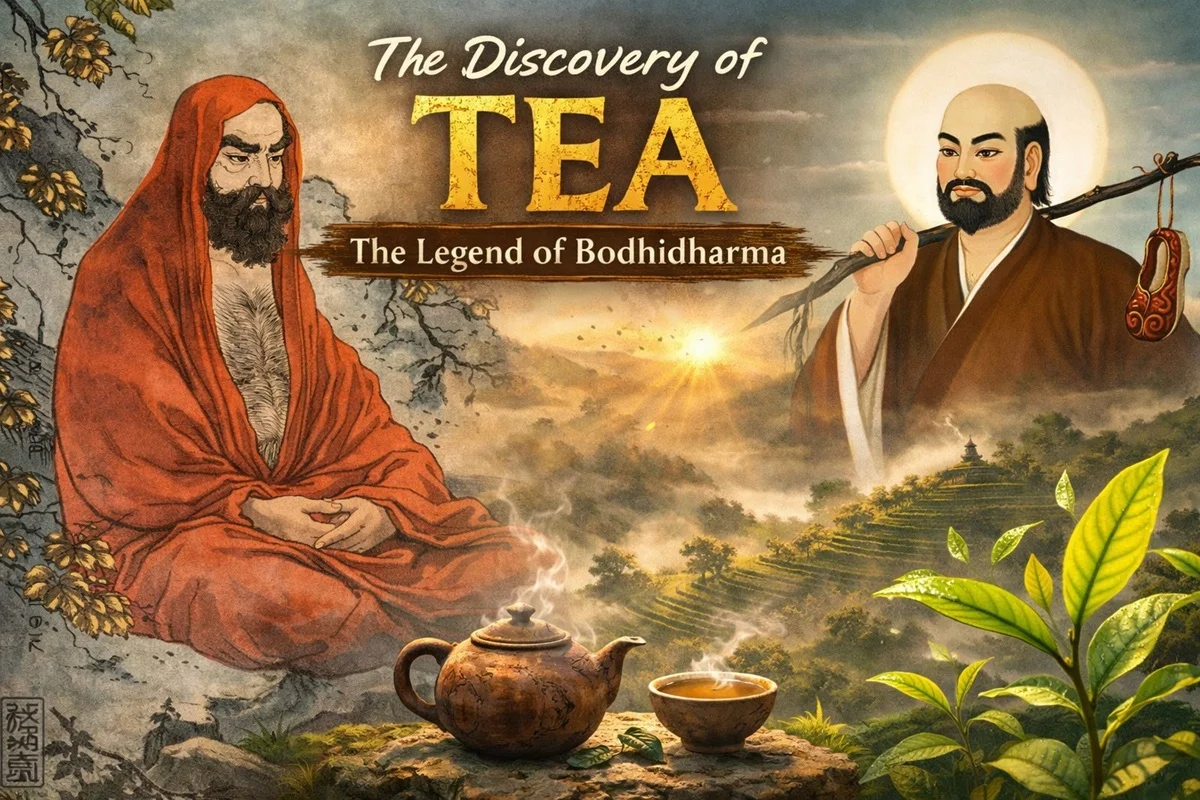



Every morning, millions of Indians wake up to the comforting aroma of chai. But have you ever stopped mid-sip and wondered — how did tea even come to be? While China is widely credited as the birthplace of tea, there is a deeply spiritual and fascinating Indian legend that connects our land to this beloved beverage. It is a story of devotion, sacrifice, and an extraordinary monk named Bodhidharma.
In this article, we uncover the Indian legend regarding the discovery of tea, compare it with historical facts, and explore how tea eventually became the soul of Indian culture.
Who Was Bodhidharma?
Bodhidharma (also known as Daruma in Japan) was a prominent Buddhist monk who lived during the 5th or 6th century AD. He was born into a royal family — believed to be the son of a Pallava king from South India. Renouncing his royal life, he dedicated himself to the path of Buddhism and eventually made a historic journey to China to spread the teachings of Zen Buddhism.
He is widely regarded as the founder of Zen Buddhism and is deeply revered across India, China, and Japan. It is during his years of intense meditation in China that the Indian legend of tea’s discovery is rooted.
The Indian Legend: Bodhidharma and the Discovery of Tea
The legend begins in the mountains of China, where Bodhidharma arrived at the Shaolin Monastery in the Henan province. He made a vow — a vow so extreme that it has been retold for over a thousand years:
He would meditate for nine years without sleep, without moving, until he achieved complete spiritual enlightenment.
For years, Bodhidharma sat in unwavering meditation. But as any human would, he eventually struggled with exhaustion. According to the legend, one day — despite all his efforts — he fell asleep during his meditation. When he woke up, he was so angry and disappointed in himself that he made a drastic decision.
He cut off his own eyelids and threw them to the ground so that they could never close again and never force him into sleep.
And then — something miraculous happened.
From the very spot where his eyelids fell to the earth, a plant began to grow. A plant with broad, green, aromatic leaves. His disciples, curious about this mysterious plant, picked its leaves, boiled them in water, and drank the infusion. The result was extraordinary — the brew instantly banished drowsiness, sharpened the mind, and filled the drinker with calm energy and alertness.
That plant, according to the Indian legend, was the very first tea plant.
Bodhidharma used the leaves to complete his nine-year meditation, and word of this miraculous herb spread rapidly among monks and scholars. And so, tea was born — not as a crop, but as a gift from devotion.
Two Versions of the Same Legend
Like most ancient stories passed down orally across generations, the Bodhidharma legend has two popular versions:
Version 1 — The Eyelids
This is the more dramatic and widely told version. Bodhidharma, furious at having fallen asleep, slices off his own eyelids. Tea plants grow from the ground where they land. His disciples brew the leaves and discover tea’s powerful, alertness-inducing properties.
Version 2 — The Chewed Leaves
A slightly milder version of the story says that Bodhidharma did not cut off his eyelids, but instead — while struggling to stay awake — he began chewing on the wild leaves of a nearby shrub. Almost immediately, he felt a surge of energy, clarity, and focus. These were tea leaves, and this simple act of chewing them marked the accidental discovery of tea.
Both versions carry the same core message: tea is a drink born from human perseverance and a hunger for enlightenment.
What Does the Legend Symbolize?
Whether or not you take this legend literally, its symbolism is powerful and timeless:
- Alertness over laziness: Tea, even in modern science, is proven to boost alertness. The caffeine in tea blocks adenosine receptors in the brain — the very receptors that make you sleepy. Bodhidharma’s legend aligns perfectly with this biological fact.
- Sacrifice for a higher purpose: The cutting of his eyelids represents the extreme sacrifice humans are willing to make in pursuit of knowledge and spiritual growth.
- The connection between nature and healing: The idea that a plant grew from an act of devotion reflects how ancient cultures viewed nature as a living, responsive entity — not just a resource.
- Tea as a tool for mindfulness: Even today, tea is closely associated with calm focus, meditative practices, and mental clarity — a legacy that traces back to this very legend.
Is There Any Historical Truth to This Legend?
The honest answer is — no, this is a myth, not a historical fact. But understanding why it exists tells us a lot about history itself.
Most historians agree that tea was first cultivated in China’s Yunnan province around 2737 BCE — thousands of years before Bodhidharma’s time. The oldest written record linking tea to Emperor Shennong comes from ancient Chinese texts. Bodhidharma, who lived in the 5th–6th century AD, came much later.
Furthermore, India did not begin formal tea cultivation until the 19th century, when the British discovered wild tea plants in Assam in 1823 and began commercial production. In 1839, the first Indian tea company — The Assam Company — was established, and Indian tea began its global journey.
So why does the Indian legend exist at all?
Scholars believe the Bodhidharma legend was a religious allegory — created and spread by Buddhist communities to explain the stimulating effects of tea in spiritual terms. Because tea helped monks stay awake during long meditation sessions, it was natural for them to connect its origin to their greatest spiritual figure. The story was later documented by European naturalists including Engelbert Kaempfer in the 17th century, further cementing its place in popular culture.
Tea’s Real Journey to India
Even though India’s role in tea’s discovery is legendary rather than historical, India’s role in tea’s global rise is very real.
- In 1823, Scottish explorer Robert Bruce discovered wild tea plants growing naturally in Assam, being used by the local Singpho cohort.
- By 1839, the British East India Company established the first formal tea plantation in Assam to reduce dependence on Chinese tea imports.
- India went on to develop world-famous tea regions: Assam (bold and malty), Darjeeling (floral and light — often called the “Champagne of Teas”), and the Nilgiris (smooth and aromatic).
- Today, India is the second largest tea producer in the world, producing over 1.3 billion kilograms of tea annually.
How Tea Became the Heart of Indian Culture
From legend to daily life — tea has become inseparable from the Indian identity. Chai is not just a drink here; it is a ritual, a relationship, a reason to pause.
- Guests are welcomed with a cup of chai — it is the first gesture of Indian hospitality.
- Office breaks, family conversations, roadside friendships — all happen over tea.
- Masala Chai — brewed with ginger, cardamom, cloves, and cinnamon — is uniquely Indian and enjoyed across every state.
- India’s famous cutting chai culture (small, strong half-cups) is a street-side institution in cities like Mumbai and Delhi.
The journey from Bodhidharma’s mountain meditation to a Mumbai tapri (tea stall) is long — but the thread connecting them is the same: tea as a source of energy, community, and comfort.
Final Thoughts
The Indian legend of Bodhidharma and the discovery of tea may not be written in history books as fact — but it lives on in culture, in storytelling, and in the very way we think about this drink. It reminds us that tea is more than leaves and hot water. It is a symbol of focus, devotion, and the human desire to stay awake — not just physically, but mentally and spiritually.
So the next time you take that first sip of your morning chai, remember: somewhere in the mountains of ancient China, a monk from India threw down his eyelids so you could have an alert, beautiful day.
Now that is a legend worth sipping on.
Frequently Asked Questions (FAQs)
Q1. What is the Indian legend regarding the discovery of tea?
The Indian legend says that a Buddhist monk named Bodhidharma, while meditating in China, cut off his eyelids to avoid sleep. Tea plants grew from the spot where his eyelids fell, and the leaves were brewed into a drink that kept his disciples alert and focused.
Q2. Who is Bodhidharma?
Bodhidharma was a South Indian Buddhist monk who lived in the 5th–6th century AD. He is credited with introducing Zen Buddhism to China and is a deeply revered figure across India, China, and Japan.
Q3. Is the Bodhidharma tea legend historically true?
No, it is a myth and religious allegory, not a verified historical event. Historically, tea originated in China’s Yunnan province around 2737 BCE — long before Bodhidharma’s time. India began formal tea cultivation only in the 19th century.
Q4. When did India start producing tea?
India’s formal tea industry began in 1839 with the establishment of The Assam Company, after Robert Bruce discovered wild tea plants in Assam in 1823.
Q5. Which regions in India are famous for tea?
India’s three most famous tea regions are Assam (bold, malty black tea), Darjeeling (light, floral — called the Champagne of Teas), and Nilgiris in South India (smooth, aromatic teas).