
Quick Answer: A car breathalyzer is a breath-alcohol testing device used in or with a vehicle. It comes in two forms: a court-ordered Ignition Interlock Device (IID) that blocks the engine from starting if your BAC is above roughly 0.02–0.025%, and a voluntary personal breathalyzer you use to self-check before driving. A full IID program typically costs $500–$1,500 over 6–12 months. Personal devices range from $15–$150 depending on sensor type (fuel cell vs. semiconductor).
If you’ve searched “car breathalyzer,” you’re probably one of two people: either a court or DMV told you to install one, or you’re a safety-conscious driver who wants a device to self-check before driving. These are two completely different products, and most guides online don’t make that distinction clear from the start.
This guide covers which type applies to your situation, what it actually costs once every fee is added up, how accurate these devices really are, and what to expect the first time you use one.
What Is a Car Breathalyzer?
A car breathalyzer is any device that measures alcohol on your breath before or while you drive. That’s the umbrella term — it covers two very different products.
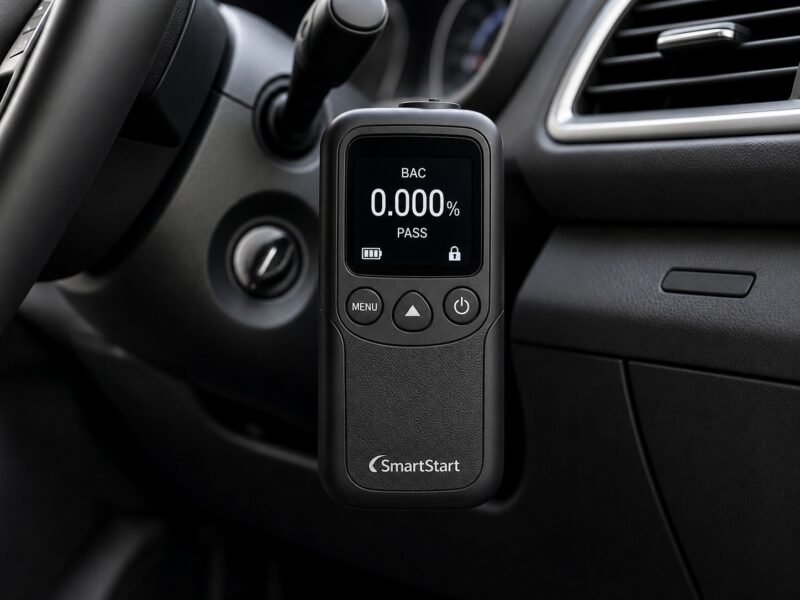
Ignition Interlock Device (IID): A hardware unit wired directly into your car’s ignition system, usually court-ordered after a DUI or DWI. Your car won’t start until you pass a breath test. Some states call it a BAIID (Breath Alcohol Ignition Interlock Device); you’ll also see it marketed as a “breathalyzer for car ignition,” all describing the same court-mandated setup.
Personal breathalyzer: A handheld or keychain device you buy voluntarily to check your own BAC before driving. It has no connection to your ignition system — if you fail a reading, nothing physically stops the car from starting. Many of the smallest models clip onto a keyring, small enough to carry alongside other everyday car accessories.
Quick self-check: If a court, DMV, or employer required the device, skip to the IID sections below. If you’re a parent, fleet manager, or simply want a self-check tool, jump to the personal breathalyzer section.
How Does an Ignition Interlock Device Work?
You press a button to wake the device, then follow a breath pattern — typically blow, inhale, blow again. Each manufacturer’s sequence differs slightly; Intoxalock, for example, asks for a short blow, a short inhale, then a longer final blow. The device measures breath alcohol concentration (BrAC) in real time. If you’re under your state’s limit — usually around 0.02–0.025% — the car starts.
This process is what NHTSA refers to as an alcohol ignition interlock, designed specifically to physically prevent a vehicle from starting when the driver has been drinking. NHTSA-cited research shows these programs measurably reduce repeat DUI offenses while installed.
Once you’re driving, the device requests random rolling retests. You’ll get a warning, then a window — often 5–10 minutes — to safely pull over and retest. If you fail or ignore it, the device won’t cut the engine mid-drive for safety reasons, but it will log the failure, flash your lights, and sound the horn until the car is turned off. That failure gets reported to your monitoring authority.
Can someone else blow for you? Newer devices are built to catch this. Some require a humming pattern along with the blow; others use a camera to photograph the person testing and match it against the ID on file. Circumventing the device typically extends your program length and can add new legal consequences on top of your original charge — it isn’t worth attempting.
Looking ahead, some automakers are developing passive systems that skip the tube entirely. Autoliv, a Swedish safety-equipment manufacturer, has been developing a sensor built into the steering wheel hub that reads breath continuously without active blowing. This is still in development, but it points toward interlock systems built into the vehicle itself.
Who Actually Needs an Ignition Interlock Device?
Most states require an IID after a DUI or DWI conviction — especially for a first offense with a high BAC or any repeat offense. Refusing a breath or blood test during a traffic stop can also trigger the requirement in states with implied consent laws, even without a conviction.
Requirements vary significantly by state:
| State | When It’s Required | Typical Program Length |
|---|---|---|
| California | First DUI in certain counties; mandatory statewide for repeat offenses | 5 months to 1 year |
| Texas | BAC over 0.15 or a second offense within 5 years | 6 months to 1 year |
| Illinois (BAIID) | Most DUI convictions, including many first offenses | 5 months minimum |
| New York | Any DWI conviction — required on any car you drive | 12 months minimum |
| Florida | BAC over 0.15 or repeat offenses | 6 months to 5 years, based on prior record |
Rules vary by county in some states and change over time. Always confirm current requirements with your state’s DMV or a licensed attorney before relying on figures here.
What Does a Car Breathalyzer Actually Cost?
Most vendor sites quote a $70–$150 installation fee and stop there. That’s not the full picture. Here’s what a real IID program costs once everything is added up:
- Installation: $70–$150, one-time
- Monthly lease: $60–$90/month
- Calibration visits: every 30–60 days, sometimes bundled, sometimes an extra $25–$50/visit
- Removal fee: $50–$100 at program end
- Missed-calibration or failed-test penalties: can extend your required program length
Run the math on a 6-month program and you’re realistically looking at $500–$900 total — not the $100 figure often advertised. A 12-month program can run $900–$1,500+ with calibration visits factored in.
Compare that to the cost of the DUI itself: court costs and legal fees alone commonly run into the thousands, and car insurance rates increase by an average of around 61% nationwide after a DUI conviction, typically sticking around for three to five years. Against that backdrop, the interlock cost is a small piece of a much larger financial hit. (If you’re financing your vehicle, a DUI can also affect your loan terms going forward.)
Personal breathalyzers sit on a completely different pricing scale. Basic keychain models with semiconductor sensors run $15–$30. Professional-grade fuel cell devices — using the same sensor technology as police equipment — run $100–$150. That price gap reflects a real accuracy difference, covered next.
Are Personal Car Breathalyzers Actually Accurate?
Sometimes, and sometimes not — the difference almost always comes down to the sensor.
Fuel cell sensors are more accurate and are used in police-grade equipment and devices like the BACtrack S80. Semiconductor sensors are cheaper to manufacture, which is why they show up in $20 keychain devices, but they’re more easily thrown off by outside factors.
A study published in Alcohol: Clinical and Experimental Research found that some budget personal breathalyzers gave incorrect readings compared to police-grade equipment more than half the time — a meaningful gap when someone is using the reading to decide whether they’re safe to drive.
Common causes of a false reading, on either sensor type:
- Mouth alcohol: testing right after your last drink (instead of waiting 15–20 minutes) can spike the reading artificially high
- Mouthwash and breath mints: many contain alcohol and can trigger a false positive for several minutes
- Ketosis: low-carb or keto diets raise acetone levels, which some semiconductor sensors misread as alcohol
- Vaping and secondhand smoke: can interfere with semiconductor sensors specifically
- No recent calibration: any breathalyzer drifts out of accuracy over time without recalibration, typically every 6–12 months
Treat a personal breathalyzer as a data point, not a green light. If your reading is close to the legal limit, or you have any doubt, call a rideshare or a designated driver instead.
Ignition Interlock vs. Personal Breathalyzer: Side by Side
| Feature | Ignition Interlock Device | Personal Breathalyzer |
|---|---|---|
| Purpose | Prevents car from starting if you fail | Lets you self-check before driving |
| Who needs it | Court or DMV ordered, typically after a DUI | Anyone who wants it, fully voluntary |
| Installation | Professional install wired into ignition | None — ready to use out of the box |
| Typical cost | $500–$1,500+ for a full program | $15–$150 depending on sensor type |
| Sensor accuracy | Fuel cell, regulated and calibrated on schedule | Varies — fuel cell or semiconductor |
| Legal weight | Failed test is logged and reported | Personal reference only, not admissible |
| Portability | Fixed to one vehicle | Fits in a pocket or bag, use anywhere |
Choosing the Right Car Breathalyzer for Your Situation
Under a court order? You don’t get to choose whether to install one, but you usually can choose your vendor. Compare install-network size near you, support hours, and whether bi-weekly payment plans are offered instead of one lump sum.
Fleet or company manager? Look for devices with reporting dashboards so you can track compliance across drivers rather than checking units manually — this matters more than raw sensor accuracy at fleet scale.
Parent of a new driver? A simple, durable personal breathalyzer beats anything complicated. Teens are more likely to actually use a device that takes five seconds with no app setup. Keep it in the glovebox, not buried in a bag.
Safety-conscious individual driver? A fuel cell personal breathalyzer with app connectivity (e.g., BACtrack Mobile or similar) gives the most reliable reading and a history log.
Whatever category you fall into, check: sensor type (fuel cell over semiconductor for accuracy), calibration frequency, warranty length, and DOT/NHTSA approval if needed for legal or professional purposes.
What Happens the First Time You Use an Ignition Interlock Device
Your install appointment takes about an hour. A technician wires the device into your ignition and walks you through the exact blow pattern for your specific unit. Practice it a couple of times before leaving the shop.
- Press the button to wake the device and begin the test sequence.
- Follow the blow pattern exactly as demonstrated — usually blow, inhale, blow.
- Wait for the result. If you’re under the limit, the car starts.
- Respond to rolling retests while driving. Find a safe spot to pull over within your window (often 5–10 minutes) — the car will not shut off while moving.
- Contact your monitoring authority if you fail a test. One failed test usually doesn’t restart your program, but a pattern of failures can extend your timeline.
A few habits that help: keep water in the car (a dry mouth can throw off a reading), avoid anything with trace alcohol right before testing (certain sauces, vanilla extract), and know your state’s specific rules for a failed retest in advance.
The Future of Car Breathalyzer Technology
The next generation is moving away from the tube entirely. Passive sensor systems — researched under the DADSS program (Driver Alcohol Detection System for Safety) — aim to read BAC through touch or ambient breath sensors built into the steering wheel or dashboard, with no active blowing required.
It’s still early-stage technology, but it’s worth watching if you’re interested in where vehicle safety systems are headed over the next decade.
Frequently Asked Questions
Can I install a car breathalyzer voluntarily, without a court order?
Yes. Personal breathalyzers are sold to anyone, no court order needed. Voluntary ignition interlock systems also exist for people who want device accountability without a legal requirement — often families managing a teen driver or someone in early recovery.
Will a car breathalyzer stop a moving car?
No. Ignition interlock devices only control whether the engine starts. A failed or skipped rolling retest triggers lights, sound, and a logged violation, but the engine is never cut while the car is in motion.
How long do I have to keep an ignition interlock installed?
It depends on your state and offense — typically a few months to several years. Check your state’s exact requirement or NHTSA’s ignition interlock program overview rather than assuming a standard timeline.
Can someone else start my car for me if I have an IID?
Technically possible, but risky — many newer units use camera verification or humming patterns that are hard to fake, and getting caught circumventing the device typically adds time to your program plus new legal trouble.
Do personal breathalyzer readings hold up in court?
No. Personal breathalyzers are for your own reference only — they’re not calibrated or maintained to the legal evidentiary standard that police equipment and monitored IIDs are held to.
What triggers a false positive on a car breathalyzer?
Mouthwash, alcohol-containing breath mints, recent vaping, secondhand smoke, and ketosis from a low-carb diet can all throw off a reading, particularly on semiconductor sensors. Waiting 15–20 minutes before testing gives a more accurate result.
How often does an ignition interlock need calibration?
Most programs require calibration every 30–60 days at an approved service center. Personal breathalyzers should generally be recalibrated every 6–12 months.
FAQs in Hindi (हिंदी में जवाब)
The same questions above, answered in Hinglish for readers who prefer it:
Car breathalyzer kya hota hai aur ye kaise kaam karta hai?
Car breathalyzer ek device hai jo aapki breath mein alcohol content check karta hai. Ignition interlock wala version aapki car ke ignition se juda hota hai — agar BAC set limit se zyada nikle toh car start hi nahi hoti. Personal breathalyzer sirf aapko batata hai ki aap drive karne layak hain ya nahi, ye car ko physically rokta nahi hai.
Ignition interlock device lagwana kab zaroori hota hai?
Agar aap par DUI ya DWI case ban chuka hai, toh court ya DMV order deta hai ki aapko apni gaadi mein IID lagwana padega. Bina kisi legal order ke bhi log apni safety ke liye voluntarily personal breathalyzer use kar sakte hain.
Car breathalyzer ka total cost kitna aata hai?
Installation cost $70 se $150 tak hota hai, plus monthly lease roughly $60 se $90, aur calibration visits alag se charge hote hain. Poora program complete hone tak total cost $500 se $1,500 tak pahunch sakta hai, state aur duration ke hisaab se.
Kya personal breathalyzer ki reading hamesha accurate hoti hai?
Nahi, hamesha nahi. Ye sensor type par depend karta hai — fuel cell wale devices semiconductor wale se zyada accurate hote hain. Mouthwash, vaping, ya keto diet jaise factors false reading de sakte hain, isliye reading ko sirf ek reference point maano, final proof nahi.
Kya koi aur insaan mere IID mein blow kar sakta hai mere liye?
Technically try toh kiya ja sakta hai, lekin ye risky hai. Naye devices camera verification aur humming pattern jaise features use karte hain jo circumvent karna mushkil bana dete hain. Agar pakde gaye, toh program extend ho sakta hai aur naye legal consequences bhi face karne pad sakte hain.
Ready to Take the Next Step?
Whether you’re navigating a court-ordered program or just want a reliable way to check yourself before you drive, understanding the difference between an IID and a personal breathalyzer is the first real step.
- Under a court order? Confirm exact state requirements with your DMV or attorney before choosing a vendor.
- Shopping for a personal device? Prioritize fuel cell sensors over semiconductor if accuracy matters to you.
- Parent of a new driver? A simple keychain device beats a complicated one nobody will actually use.
Browse more of Apzo Media’s Automotive coverage for practical, no-fluff guides on driving smarter and staying road legal.
Disclaimer
This article is for general informational purposes only and does not constitute legal, medical, or professional advice. Ignition interlock requirements, program lengths, fees, and BAC thresholds vary by state and change over time — always verify current rules with your state DMV, court, or a licensed attorney before making decisions based on this guide. Personal breathalyzer readings are not a substitute for professional judgment and should never be the sole basis for deciding whether to drive. If you have any doubt about your ability to drive safely, choose a rideshare, taxi, or designated driver instead. Apzo Media is not affiliated with any ignition interlock provider or breathalyzer manufacturer mentioned in this piece unless explicitly stated.
About the Author
Satendra Kashyap, Apzo Media Editorial Team — covering automotive safety, technology, and consumer guidance. Apzo Media brings readers well-informed, practical content across automotive, lifestyle, business, and technology topics, with a focus on clear, actionable information rather than vendor-driven marketing. Have a correction or update to suggest? Contact Apzo Media.