


If you have searched for “wellhealth how to build muscle tag,” you have probably already scrolled through a handful of articles that all say the same three things: eat protein, lift weights, sleep well. True, but not exactly useful if you are standing in a gym wondering what to actually do on Monday.
This guide by Apzo Media breaks it down properly, a real workout structure, protein sources that actually work for Indian diets, honest timelines so you are not disappointed in week three, and the mistakes that quietly stall most people’s progress. No vague advice, no unverifiable expert quotes, just what actually works.
What Does Building Muscle Actually Mean?
Muscle growth, technically called hypertrophy, happens when you stress a muscle beyond what it is used to. Lifting weights creates tiny amounts of damage in the muscle fibers. Your body repairs that damage, and in the process, builds the fiber back slightly bigger and stronger than before. Do this consistently over weeks and months, and that repeated repair process is what shows up as visible muscle.
Three things drive this process, and none of them work well on their own:
- Progressive overload — gradually lifting more weight, doing more reps, or adding more sets over time, so your muscles keep getting a reason to grow
- Enough protein and calories — your body needs raw material to actually build new tissue
- Recovery — the growth doesn’t happen during the workout, it happens while you rest and sleep afterward
Skip any one of these and progress slows down or stops entirely, no matter how hard you train.
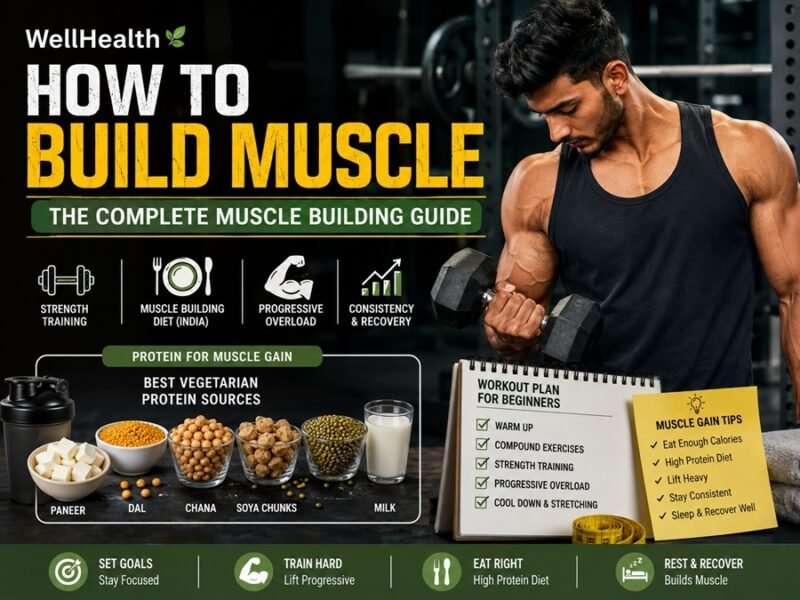
A Real Weekly Workout Plan (Not Just “Do Compound Lifts”)
Most guides tell you to do squats, deadlifts, and bench press without telling you how to actually structure a week. Here is a simple, beginner-friendly 4-day split that works for most people just starting out.
Day 1: Chest & Triceps
- Bench press or push-ups: 3 sets of 8 to 12 reps
- Incline dumbbell press: 3 sets of 10 reps
- Triceps dips or pushdowns: 3 sets of 12 reps
Day 2: Back & Biceps
- Pull-ups or lat pulldowns: 3 sets of 8 to 10 reps
- Bent-over rows: 3 sets of 10 reps
- Bicep curls: 3 sets of 12 reps
Day 3: Rest or light activity (walking, stretching, yoga)
Day 4: Legs
- Squats: 3 sets of 8 to 12 reps
- Lunges: 3 sets of 10 reps per leg
- Calf raises: 3 sets of 15 reps
Day 5: Shoulders & Core
- Overhead press: 3 sets of 10 reps
- Lateral raises: 3 sets of 12 reps
- Planks: 3 sets of 30 to 45 seconds
Day 6 and 7: Rest
The exact exercises matter less than the principle behind them. Add a little more weight or one extra rep every week or two. That slow, steady increase is what actually builds muscle, not switching your entire routine every few days because you saw a new workout online.
If you are a complete beginner, two to three sessions a week is plenty to start. You do not need to train every day, and honestly, trying to will usually backfire.
Nutrition: What to Actually Eat (Including Vegetarian Options)
Protein is the one thing almost every article gets right, but most stop at “eat more protein” without telling you where to actually get it, especially if you are vegetarian, which describes a large share of people searching for this in India.
Daily protein target: Aim for roughly 1.6 to 2.2 grams of protein per kilogram of body weight. So if you weigh 70 kg, that is somewhere between 112 and 154 grams of protein a day, spread across your meals rather than eaten all at once.
Good protein sources, vegetarian and non-vegetarian:
| Vegetarian | Non-Vegetarian |
|---|---|
| Paneer | Eggs |
| Dal and lentils | Chicken breast |
| Soya chunks | Fish |
| Sattu | Lean mutton |
| Greek yogurt or curd | Whey protein (optional add-on) |
| Chana (chickpeas) | |
| Peanuts and almonds |
Alongside protein, you also need enough total calories, ideally a mild surplus of 250 to 500 calories above what your body burns in a day. Muscle does not grow well in a calorie deficit, since your body prioritizes survival over building new tissue when it thinks food is scarce. Complex carbs like rice, roti, and oats give you the energy to actually push through workouts, and healthy fats from ghee, nuts, and cooking oils support hormone production, which plays a role in muscle growth too.
Recovery and Sleep: The Part Everyone Skips
Training breaks muscle down. Sleep and rest are what actually build it back up. Most adults need 7 to 9 hours of sleep a night for this repair process to work properly. Consistently sleeping less than that slows recovery, and over time it can stall progress even if your training and diet are perfect.
Give the same muscle group 48 to 72 hours of rest before training it again. This is exactly why the workout split above alternates muscle groups instead of hitting the same ones daily, your muscles need that recovery window to actually grow, not just get repeatedly fatigued.
How Long Does It Actually Take to Build Muscle?
This is the part most guides are vague about, and vague timelines are usually what lead people to quit early.
- First few weeks: You will likely notice strength improvements, lifting slightly heavier or doing a few more reps, before you see any visible muscle change. This is mostly your nervous system getting better at recruiting muscle fibers, not new muscle tissue yet.
- 6 to 8 weeks in: Visible muscle changes typically start showing up for beginners around this point, assuming consistent training and proper nutrition.
- Realistic monthly gains: Beginners can generally expect to gain around 1 to 2 pounds (roughly 0.5 to 1 kg) of actual muscle per month with consistent training and eating. This rate naturally slows down as you get more experienced, your body simply has less “easy” room to grow once the beginner phase passes.
If you are not seeing results in the first two weeks, that is completely normal, not a sign that something is wrong.
Common Mistakes That Quietly Stall Progress
- Not eating enough. This is the single biggest reason people fail to gain muscle. Training hard without enough fuel is like trying to build a house without enough bricks.
- Skipping progressive overload. Lifting the same weight for the same reps month after month gives your muscles no reason to keep adapting.
- Training with poor form. This does not just risk injury, it also means the target muscle is not actually being worked properly, and you get slower results even while training hard.
- Switching routines too often. Jumping to a new workout plan every week means you never give any single approach enough time to actually work.
- Skimping on sleep or overtraining. Training seven days a week without adequate rest usually leads to burnout or injury rather than faster gains.
Frequently Asked Questions
Is the “wellhealth how to build muscle tag” approach different from regular muscle-building advice?
No. It follows the same core, well-established principles as any credible fitness guidance, progressive overload, adequate protein and calories, and proper recovery. There is no shortcut or special method involved, just consistent application of the fundamentals.
How much protein do I need to build muscle?
Roughly 1.6 to 2.2 grams per kilogram of body weight per day, spread across your meals. Both vegetarian sources like paneer, dal, and soya, and non-vegetarian sources like eggs and chicken can meet this target.
Can vegetarians build muscle effectively?
Yes. Paneer, lentils, soya chunks, sattu, curd, and nuts together can meet daily protein needs. It may take slightly more planning to hit your protein target compared to a non-vegetarian diet, but it is entirely achievable.
How many days a week should a beginner train?
Two to three sessions a week is enough to start seeing results as a beginner. You can gradually increase frequency as your body adapts and recovers well.
How soon will I see visible muscle growth?
Strength improvements often show up within the first couple of weeks, while visible muscle changes typically take 6 to 8 weeks of consistent training and proper nutrition for most beginners.
Do I need supplements to build muscle?
No, supplements are optional. Whey protein can help you hit your daily protein target more conveniently, but it is not required if your diet already covers your protein needs through whole foods.
The Bottom Line
Building muscle is not complicated, but it does require consistency, showing up for your workouts, eating enough of the right foods, and actually resting when your body needs it. There is no tag, program, or shortcut that replaces those basics. Follow a structured plan, track your progress, and give it the 6 to 8 weeks it genuinely takes before judging results.
This article is for general fitness information. If you have any existing health conditions or are new to exercise, it is a good idea to check with a doctor or a certified trainer before starting a new workout or diet plan.
Apzo Media publishes practical, verified health and fitness guides every week, explore more to keep your fitness journey grounded in what actually works.