
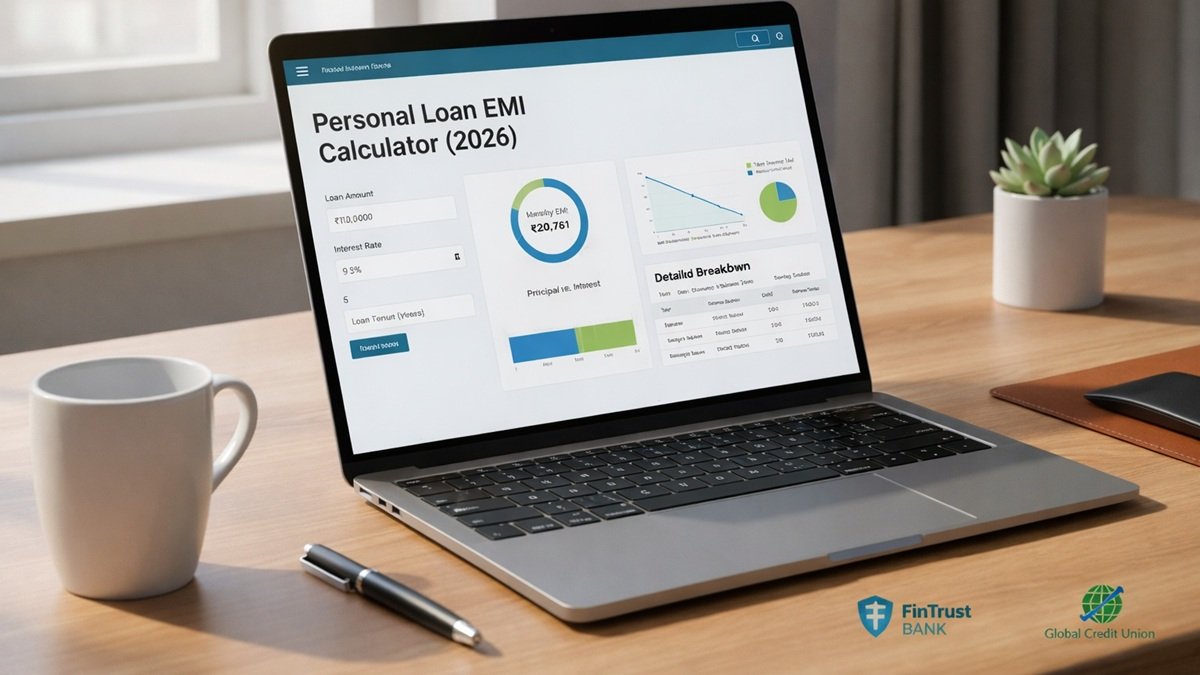


Planning to take a personal loan but unsure about monthly repayments? A personal loan EMI calculator helps you calculate your monthly installment based on loan amount, interest rate, and tenure. It instantly shows your EMI, total interest payable, and total repayment amount—giving you complete clarity before you apply.
Understanding your EMI is crucial for financial planning. Whether you’re borrowing ₹2 lakh for a wedding or ₹10 lakh for home renovation, knowing exactly how much you’ll pay each month helps you budget better and avoid financial stress.
This guide breaks down everything you need to know: how EMI calculators work, the exact formula used, real examples across top banks, and tips to reduce your EMI burden. Interest rate data is sourced from official bank websites and updated as per the latest RBI lending framework (2026).
What is a Personal Loan EMI Calculator?
A personal loan EMI calculator is a digital tool that computes your Equated Monthly Installment (EMI) in seconds. You simply input three values:
- Loan amount (Principal)
- Interest rate (Annual percentage)
- Loan tenure (Months or years)
The calculator instantly shows:
- Monthly EMI amount
- Total interest payable over the loan period
- Total repayment amount (principal + interest)
Using a calculator saves time and eliminates manual errors. Instead of complex spreadsheets or pen-and-paper calculations, you get accurate results immediately.
How Does the EMI Calculation Work?
Personal loan EMIs are calculated using the reducing balance method, where interest is charged on the outstanding principal amount. As you repay, your principal reduces, which means the interest component decreases over time while the principal component increases.
The EMI Formula
The standard formula is:
EMI = [P × R × (1+R)^N] / [(1+R)^N – 1]
Where:
- P = Principal loan amount
- R = Monthly interest rate (annual rate ÷ 12 ÷ 100)
- N = Loan tenure in months
Real Example Calculation
Let’s calculate EMI for:
- Loan amount: ₹5,00,000
- Interest rate: 11% per annum
- Tenure: 3 years (36 months)
Step 1: Convert annual rate to monthly
R = 11 ÷ 12 ÷ 100 = 0.009167
Step 2: Apply formula
EMI = [500000 × 0.009167 × (1.009167)^36] / [(1.009167)^36 – 1]
EMI = ₹16,394
Total repayment: ₹5,90,184
Total interest: ₹90,184
Try calculating EMI for ₹5 lakh with different tenures below to see how monthly payments change with loan duration.
Bank-Wise Personal Loan EMI Comparison (2026)
Interest rates vary significantly across banks. Here’s a current comparison of major lenders:
State Bank of India (SBI)
- Interest rate: 10.50% – 15.50%
- EMI for ₹5 lakh (3 years): ₹16,274 (at 10.50%)
- Processing fee: Up to 1.50% + GST
- Maximum tenure: 6 years
HDFC Bank
- Interest rate: 10.75% – 21.00%
- EMI for ₹5 lakh (3 years): ₹16,355 (at 10.75%)
- Processing fee: Up to 2.50% + GST
- Maximum tenure: 5 years
ICICI Bank
- Interest rate: 10.85% – 19.00%
- EMI for ₹5 lakh (3 years): ₹16,387 (at 10.85%)
- Processing fee: Up to 2.50% + GST
- Maximum tenure: 6 years
Axis Bank
- Interest rate: 10.49% – 22.00%
- EMI for ₹5 lakh (3 years): ₹16,271 (at 10.49%)
- Processing fee: Up to 2.00% + GST
- Maximum tenure: 5 years
Kotak Mahindra Bank
- Interest rate: 10.99% – 20.00%
- EMI for ₹5 lakh (3 years): ₹16,433 (at 10.99%)
- Processing fee: Up to 3.00% + GST
- Maximum tenure: 6 years
Key insight: Even a 0.5% difference in interest rate can save thousands over the loan period. Always compare offers before finalizing.
Flat Rate vs Reducing Rate: What’s the Difference?
Many borrowers don’t understand this crucial distinction.
Flat Interest Rate
Interest is calculated on the original principal throughout the tenure, regardless of how much you’ve repaid.
Example: ₹5 lakh at 10% flat for 3 years
- Annual interest = ₹50,000
- Total interest = ₹1,50,000
- EMI = (₹5,00,000 + ₹1,50,000) ÷ 36 = ₹18,056
Reducing Balance Rate
Interest is calculated only on the outstanding principal, which decreases with each payment.
Example: ₹5 lakh at 10% reducing for 3 years
- EMI = ₹16,134
- Total interest = ₹80,824
The difference? You pay ₹69,176 less with reducing balance—almost 46% savings on interest.
Most banks use reducing balance rates, but always confirm before signing loan documents.
Understanding Your Amortization Schedule
An amortization schedule breaks down each EMI into principal and interest components. This reveals how your payments are structured over time.
Sample Schedule (First 6 Months)
For ₹5 lakh at 11% for 3 years (EMI: ₹16,394):
Month 1:
- EMI: ₹16,394
- Principal: ₹11,811
- Interest: ₹4,583
- Outstanding: ₹4,88,189
Month 2:
- EMI: ₹16,394
- Principal: ₹11,919
- Interest: ₹4,475
- Outstanding: ₹4,76,270
Month 6:
- EMI: ₹16,394
- Principal: ₹12,463
- Interest: ₹3,931
- Outstanding: ₹4,37,463
Notice how the interest portion decreases while principal increases with each payment. By the final months, you’re paying mostly principal.
This structure explains why prepaying loans early saves significant interest.
Real-Life EMI Examples by Salary Bracket
Financial advisors recommend keeping EMI under 40% of monthly income. Here’s how different salary levels can manage personal loans:
Salary: ₹30,000/month
Ideal EMI limit: ₹12,000
Safe loan amount: ₹3.5 lakh (3 years at 11%)
EMI: ₹11,476
Salary: ₹50,000/month
Ideal EMI limit: ₹20,000
Safe loan amount: ₹6 lakh (3 years at 11%)
EMI: ₹19,673
Salary: ₹75,000/month
Ideal EMI limit: ₹30,000
Safe loan amount: ₹9 lakh (3 years at 11%)
EMI: ₹29,509
Salary: ₹1,00,000/month
Ideal EMI limit: ₹40,000
Safe loan amount: ₹12 lakh (3 years at 11%)
EMI: ₹39,346
Case study: Rajesh earns ₹50,000 monthly. He needs ₹8 lakh for medical expenses. At 11% for 3 years, his EMI would be ₹26,231—exceeding his safe limit. By extending tenure to 5 years, EMI drops to ₹17,415, which fits comfortably within his budget.
Adjust tenure to see how monthly payments change based on your financial capacity.
7 Ways to Reduce Your Personal Loan EMI
1. Negotiate Lower Interest Rates
Banks offer better rates to customers with high CIBIL scores (750+) and stable income. If you have good credit history, negotiate aggressively.
2. Extend Loan Tenure
Longer tenure means lower EMI, though you’ll pay more total interest. Balance affordability with cost.
3. Make Partial Prepayments
Most banks allow prepayment without penalties. Even ₹10,000-20,000 extra payments can reduce tenure significantly.
4. Balance Transfer
If you find a lender offering 1-2% lower rates, consider transferring your loan. Calculate processing fees to ensure net savings.
5. Improve CIBIL Score
Scores above 750 qualify for premium rates. Pay credit card bills on time and reduce credit utilization.
6. Compare Multiple Banks
Don’t settle for the first offer. Check at least 4-5 lenders and compare interest rates, processing fees, and prepayment charges.
7. Opt for Step-Up EMI Plans
Some banks offer EMI structures that start low and increase gradually—ideal if you expect salary hikes.
Frequently Asked Questions
What is a personal loan EMI calculator?
A personal loan EMI calculator is an online tool that calculates your monthly installment based on loan amount, interest rate, and tenure. It shows EMI, total interest, and repayment amount instantly.
How accurate are EMI calculators?
EMI calculators are highly accurate for standard reducing balance loans. However, they may not account for processing fees, GST, or other bank-specific charges.
Can I use an EMI calculator for other loans?
Yes. The same formula applies to home loans, car loans, and education loans, though some may have additional components.
What happens if I miss an EMI payment?
Missing EMIs damages your credit score, attracts late payment penalties, and may lead to legal action. Always set up auto-debit to avoid missed payments.
Should I choose longer or shorter tenure?
Shorter tenure means higher EMI but lower total interest. Longer tenure offers affordable EMI but increases total cost. Choose based on your monthly budget and financial goals.
Do all banks use reducing balance method?
Most banks use reducing balance for personal loans. Always confirm in your loan agreement before signing.
Choose Your Personal Loan Wisely
A personal loan EMI calculator empowers you to make informed borrowing decisions. By understanding how EMI is calculated, comparing bank offers, and optimizing tenure, you can secure a loan that fits your budget without straining your finances.
Before applying, calculate EMIs across different scenarios. Consider both monthly affordability and total interest payable. Remember that the cheapest EMI isn’t always the best choice—factor in processing fees, prepayment flexibility, and customer service quality.
Ready to explore your options? Use the calculator above to estimate your EMI, then compare offers from SBI, HDFC, ICICI, and other leading banks. Check your CIBIL score before applying to unlock the best interest rates available.
For personalized guidance, read our detailed guides on SBI personal loan EMI calculators, HDFC personal loan interest rates, ICICI personal loan charges, and how to improve your CIBIL score for better loan terms.
Read Also: Punjab and Sind Bank Personal Loan Interest Rates