



Sustainability is no more a far-fetched idea. Investors and stakeholders care about it. Survey reports covered by leading channels reveal that 86% of organisations in India acknowledge the significance of sustainability in shaping business strategies.
One way to measure sustainability adherence? The MSCI ESG rating. It is like a report card for a company, but with real consequences. A high rating says they are on top of the game. A low rating? It raises eyebrows. Here’s exploring the key factors that are a part of the MSCI ESG rating.
What is an MSCI ESG Rating?
The MSCI ESG rating checks how well a company handles environmental, social, and governance risks. It’s simple: good management, good rating.
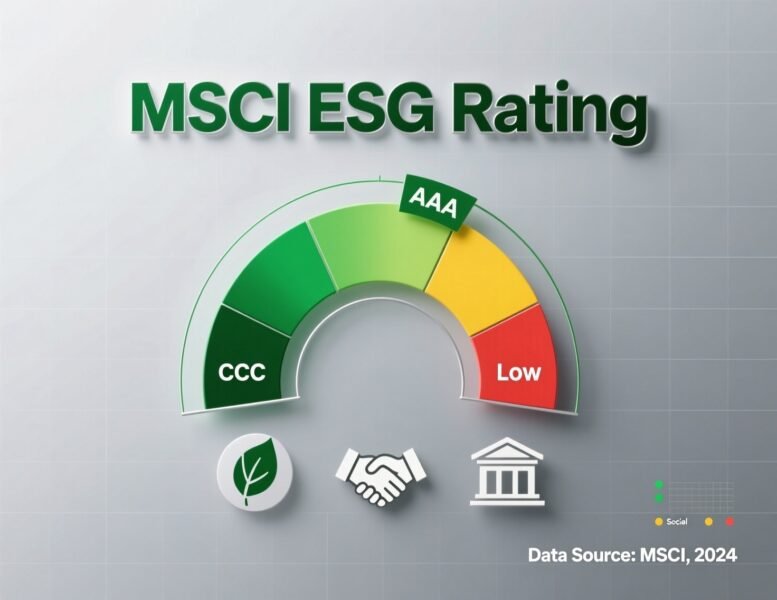
Ratings go from AAA (leader) to CCC (laggard). It allows companies to compare themselves to peers. And yes, investors notice. These ratings matter to them and help with decision-making.
The scale is:
- Leaders (AAA, AA): Companies with strong or excellent management of financially relevant ESG risks.
- Average (A, BBB, BB): Companies with a mixed or average track record of managing ESG issues.
- Laggards (B, CCC): Companies with poor or very poor management of significant ESG risks, which may also be involved in significant controversies.
Factors that Shape the MSCI ESG Rating
Let’s understand the factors one by one:
Environmental Factors
The “E” is about the planet. MSCI asks: Are you hurting it or helping it?
Key points:
- Carbon footprint: All emissions count. Scope 1, 2, and 3.
- Energy: Are you using renewables or still stuck on fossil fuels
- Waste and water: Mismanagement here can bite your rating.
- Climate strategy: Are you ready for regulations or extreme weather?
Companies that actively reduce risks score higher. Ignore it, and your rating (and reputation) can drop.
Social Factors
The “S” is about people. Employees, communities, customers: they all matter.
Look at:
- Labour practices: Safety, pay, diversity.
- Human rights: Supply chain compliance matters.
- Community impact: Are you giving back?
- Customer responsibility: Product safety, privacy, transparency.
Treat people well, and MSCI notices. Mess up, and it shows in the form of your rating.
Governance Factors
The “G” is about rules, ethics, and leadership. It takes into account the formalities and legalities.
MSCI checks:
- Board setup: Independence, skill, diversity.
- Pay: Exec compensation tied to performance.
- Ethics: Anti-corruption policies are key.
- Risk management: Do you plan for trouble or just hope it won’t happen?
Good governance translates to fewer scandals and less risk. It also increases the chances of happier investors.
Data Quality & Transparency
Ratings are only as good as the data you give. Missing or incorrect data? It can bring bad news.
Remember, transparency is the king. To ace the process, you must:
- Disclose ESG metrics.
- Show targets.
- Report progress.
It makes you look credible, and investors love credibility.
Industry Matters
Not all ESG risks are equal. MSCI adjusts ratings by industry, and it is fairly understandable. How? Let’s consider examples for better clarity.
Steel? Your emissions and resource use matter a lot. The industry runs energy-heavy operations, so carbon intensity and waste management top the checklist. A steel maker with clean energy adoption or recycling systems earns serious points.
Finance? Here, it’s more about governance and social impact. How transparent are your lending practices? Do you finance high-emission projects or support green innovation? Even diversity in leadership or ethical selling affects your score.
Tech? Data privacy, supply chain ethics, and electronic waste are key. Using renewable energy in data centres or improving recycling practices can move the needle up.
See the pattern? Each sector gets its own lens. MSCI tailors its evaluation to what truly matters for that industry. The score isn’t one-size-fits-all. It’s context-based, and that’s fair, too. After all, a steel plant and a software firm don’t face the same sustainability challenges.
Why MSCI Matters
Finally, it comes to how MSCI ESG ratings impact.
- Investors: ESG funds pay attention.
- Capital costs: High ratings can lower borrowing rates.
- Reputation: Strong ESG = good press, happy stakeholders.
- Risk management: Spot gaps before they become crises.
Knowing what drives the rating helps leaders make smart moves.
Conclusion
MSCI ESG ratings measure environmental, social, and governance performance. The score depends on E, S, G, plus data quality and transparency.
Ratings are industry-specific, so context matters. Good ratings boost investor confidence, reduce risk, and improve reputation. All in all, ESG is not optional. Understanding MSCI ESG ratings is important to improve ratings and keep investors smiling.