



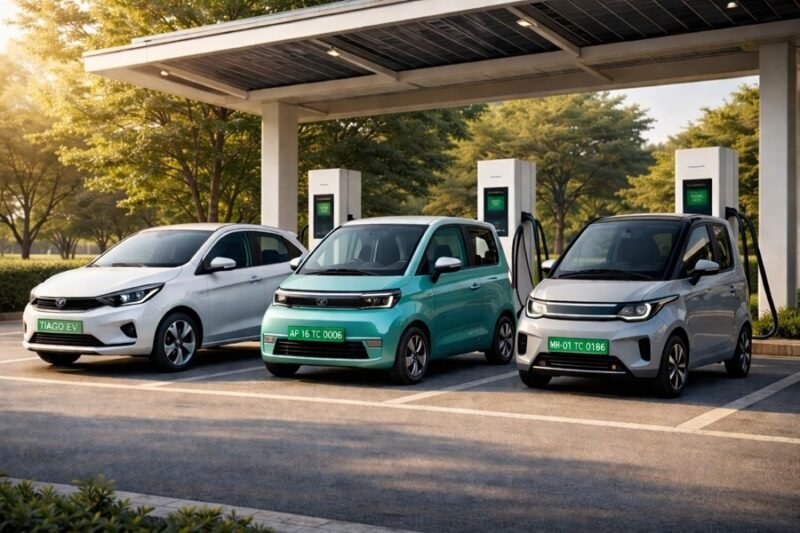
NEW DELHI, INDIA — As of February 2026, India’s electric vehicle (EV) market has reached a critical tipping point with a fresh wave of affordable launches. The Indian electric vehicle market is witnessing an unprecedented surge, particularly in the budget-friendly segment. For 2026, car buyers seeking an affordable entry into electric mobility have three compelling options under the crucial ₹10 lakh price point. This shift is led by established players like Tata Motors and MG Motor, alongside innovative micro-mobility startups, signaling a significant transformation in urban transport across the country. The availability of these models—Tata Tiago EV, MG Comet EV, and PMV Eas-E—makes owning an electric car more accessible than ever before.
Also Read:-
– India’s EV Revolution: Top 3 Electric Cars You Can Buy Under ₹10 Lakhs
– Budget EV Showdown: Tata vs. MG vs. PMV – Which Is Best Under ₹10 Lakhs?
Key Highlights
- Market Leaders: Tata Tiago EV continues to dominate the segment with its practical design and multiple battery options.
- Urban Innovator: The MG Comet EV offers a unique, tech-forward solution specifically designed for navigating congested city streets.
- Micro-EV Challenger: PMV Electric’s Eas-E presents a compact and highly economical two-seater alternative for personal urban commuting.
- Affordability: All three models offer variants that fall under the ₹10 lakh (ex-showroom) price bracket, lowering the barrier to EV adoption for a wide range of consumers.
2026 Budget EV Comparison
Feature | Tata Tiago EV | MG Comet EV | PMV Eas-E |
|---|---|---|---|
Starting Price (Ex-Showroom) | Approx. ₹7.99 Lakh | Approx. ₹6.99 Lakh | Approx. ₹4.79 Lakh |
Seating Capacity | 5-Seater | 4-Seater | 2-Seater |
Claimed Range | Up to 315 km | Up to 230 km | Up to 200 km |
Best For | Families, Highway Use | City Commuting, Tech Lovers | Solo Commuters, Tight Parking |
Charging Time (AC) | Approx. 3.6 hours (7.2kW) | Approx. 7 hours (3.3kW) | Approx. 4 hours (Standard) |
Read Also: Tata Sierra 2025 Launched: Price, Design, Interiors & Variants (Full Review)
A Deeper Dive into India’s Most Affordable EVs
The dream of owning an electric car is becoming a reality for millions of Indians, thanks to a growing ecosystem of affordable models. As fuel prices remain a concern and environmental awareness increases, these budget-friendly EVs are not just alternatives but are becoming the primary choice for many urban and semi-urban buyers. Let’s explore the top contenders for 2026.
1. Tata Tiago EV: The All-Rounder
The Tata Tiago EV has firmly established itself as the benchmark in the entry-level electric car space. Leveraging the success and familiarity of its internal combustion engine (ICE) counterpart, the Tiago EV offers a conventional and practical package that appeals to a broad audience, including small families.
Performance and Range
Tata offers the Tiago EV with two distinct lithium-ion battery pack options. The smaller 19.2 kWh pack delivers a claimed range of around 250 km, making it ideal for daily city runs. The larger 24 kWh battery pack extends this range to an impressive 315 km, providing users with the confidence to undertake occasional inter-city trips. This flexibility allows buyers to choose a variant that best suits their budget and driving needs.
Features and Practicality
As a 5-seater hatchback, the Tiago EV does not compromise on practicality. It provides adequate space for passengers and a usable boot, making it a suitable primary car for many households. The car is equipped with modern features like automatic climate control, a touchscreen infotainment system with smartphone connectivity, and connected car technology. Its support for DC fast charging, which can juice up the battery from 10% to 80% in under an hour, adds another layer of convenience.
2. MG Comet EV: The Urban Specialist
MG Motor took a bold and unconventional approach with the Comet EV. Instead of adapting a traditional car design, MG introduced a purpose-built “smart urban mobility solution.” Its quirky, futuristic design and compact dimensions are tailored specifically for the challenges of navigating India’s crowded cityscapes.
Design and Usability
The Comet EV’s standout feature is its small footprint. It is significantly shorter and narrower than a typical hatchback, which makes parking in tight spots and maneuvering through dense traffic remarkably easy. Despite its small exterior, the clever interior packaging allows it to seat four adults for short trips, though it is most comfortable for two or three. The tall-boy design ensures ample headroom, creating a surprisingly airy cabin.
Technology and Efficiency
Powered by a 17.3 kWh battery, the Comet EV offers a claimed range of 230 km on a single charge. While not the highest in its class, this range is more than sufficient for the daily urban commute it’s designed for. The interior is dominated by a large, dual-screen setup for the infotainment and instrument cluster, giving it a premium and tech-forward feel. The lack of a front boot and a minimal rear luggage area reinforces its identity as a city-centric vehicle, not a long-distance tourer. Its estimated running cost of just over ₹500 per 1,000 km makes it an incredibly economical choice.
3. PMV Eas-E: The Micro-Mobility Pioneer
Challenging the conventional definition of a car, the PMV Eas-E is a micro-EV that prioritizes personal mobility and extreme affordability. Created by Mumbai-based startup PMV Electric, the Eas-E (Easy Electric) is a two-seater quadricycle aimed at daily commuters looking for the most economical electric option available.
Concept and Target Audience
The Eas-E is designed for a single purpose: efficient, low-cost urban travel. It features a unique 1+1 tandem seating arrangement, with the passenger sitting directly behind the driver. This narrow design makes it exceptionally nimble in traffic, allowing it to navigate gaps that are inaccessible to larger cars. It’s an ideal solution for office commutes, local errands, and as a secondary household vehicle.
Range and Cost-Effectiveness
PMV offers the Eas-E with different battery specifications, providing claimed ranges from 120 km up to 200 km per charge. The car can be fully charged in under four hours using a standard 15A home socket, eliminating the need for special charging infrastructure. Its incredibly low starting price, which is significantly less than its competitors, combined with minimal running costs, makes it the most accessible electric four-wheeler in the Indian market. While its features are basic, it includes essentials like an LCD digital instrument cluster, Bluetooth connectivity, and even a remote parking assist feature.
Summary and Final Thoughts
As of 2026, the Indian market offers clear choices for prospective EV buyers on a budget. The Tata Tiago EV stands out as the most balanced and versatile option, suitable for families and mixed-use driving. The MG Comet EV excels as a stylish and tech-savvy urban vehicle, perfect for those who prioritize ease of driving and parking in the city. Finally, the PMV Eas-E carves its own niche as a hyper-economical micro-EV, offering the lowest entry point into four-wheeled electric mobility for individual commuters. The presence of these three distinct vehicles underscores the maturation of India’s EV market, providing real, accessible options for a diverse set of needs.
Which of these budget-friendly electric cars do you think best fits the needs of the average Indian commuter?