



Maruti Suzuki has just pulled the wraps off the facelifted 2026 Baleno, and the timing could not be better. With the festive season around the corner, the country’s best selling premium hatchback walks in with a bolder face, a new engine borrowed from the Swift, and a safety kit that nothing else in its segment can match right now. If you have been holding off on booking a Baleno waiting for this update, here is everything that has changed.
How Much Does The 2026 Baleno Cost
Let’s get straight to the number everyone is searching for. The new Baleno starts at Rs 6.10 lakh, ex-showroom, for the entry level Sigma petrol manual trim. That is just Rs 20,000 more than what the outgoing base variant used to cost, which is a fair ask given the amount of new hardware packed in.
This is an introductory festive price, so treat it as a launch offer rather than the permanent tag. Maruti typically nudges prices up once the festive window closes, so if the base price is what’s tempting you, booking early makes sense.
Here is how the variant walk looks right now:
| Variant | Petrol MT | Petrol AMT | CNG MT |
|---|---|---|---|
| Sigma | Rs 6.10 lakh | To be announced | To be announced |
| Delta | To be announced | To be announced | To be announced |
| Zeta | To be announced | To be announced | To be announced |
| Alpha | To be announced | To be announced | Not offered |
| Alpha(O) | To be announced | To be announced | Not offered |
All prices are introductory and ex-showroom.
Going by what Maruti has hinted at, the full range should stretch up to roughly Rs 9.5 lakh for the top-spec Alpha(O) automatic once every variant price is out. Bookings are already open at NEXA dealerships and on Maruti’s own website for a token amount of Rs 11,000.
What’s New On The Outside
The Baleno has always had a friendly, curvy silhouette, and Maruti hasn’t messed with that formula. Think of it like a familiar face that just got a fresh haircut. The changes are real, but they are concentrated almost entirely up front.
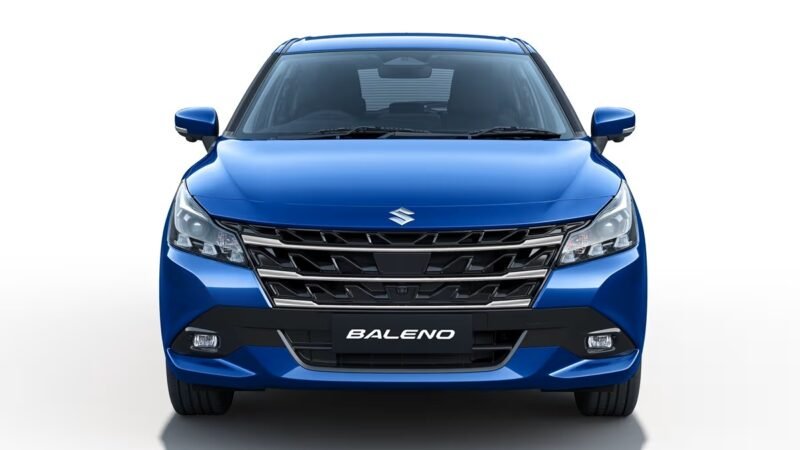
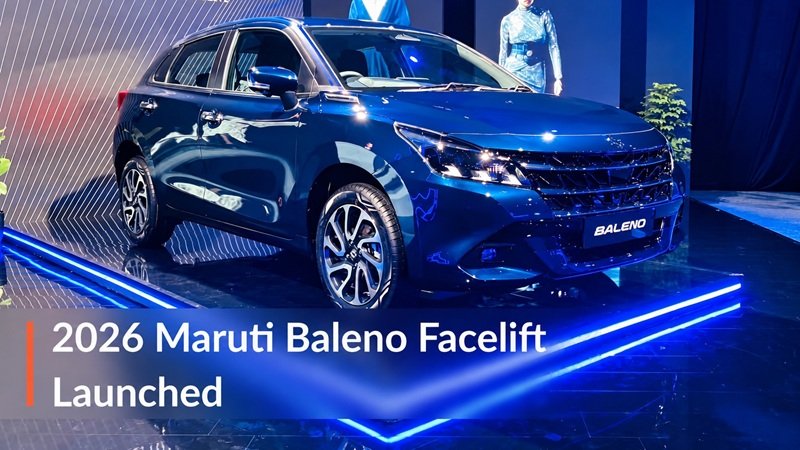
The biggest talking point is the grille. It has grown noticeably larger and now wears a chunky chrome treatment that gives the car a lot more road presence than before. Interestingly, this isn’t just a styling choice. The bigger grille also houses the radar module needed for the new ADAS system, so form is following function here. Maruti has also shifted the Suzuki badge from inside the grille to just above it, a small detail that changes the face more than you’d expect at first glance.
A new front bumper wraps around this larger grille, and the LED fog lamp housings have been redesigned too. The swept back LED headlamps with their signature dotted DRL pattern carry over from the outgoing car, so the Baleno still looks unmistakably like a Baleno.
Move to the side profile and things are far more familiar. The 16-inch alloy wheel design is unchanged, the curvy roofline and raked windscreen remain, and you still get chrome door handles with LED turn indicators on the mirrors. Maruti has added a chrome insert on the front fender and a shark fin antenna as small visual updates.
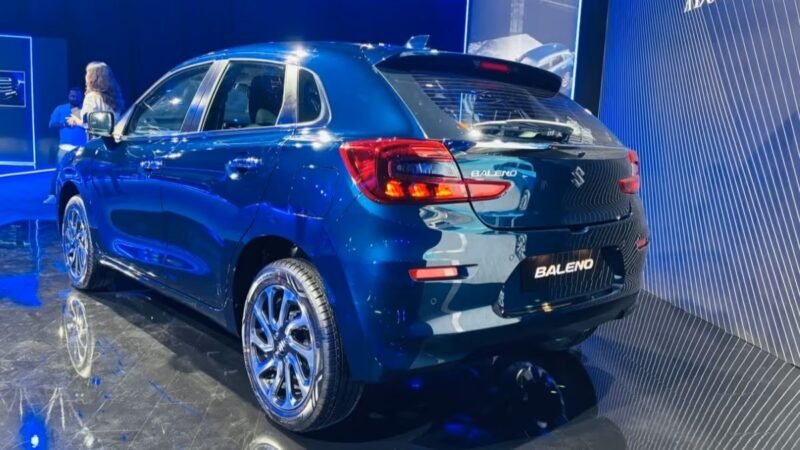
At the rear, it’s largely as before. A reworked bumper is the only real change, while the slim C-shaped LED tail lamps that gave the Baleno its premium look continue unchanged. Dimensions are exactly the same as before too: 3,990mm long, 1,745mm wide, 1,530mm tall, riding on a 2,520mm wheelbase. So if boot space or cabin room was a concern earlier, nothing has shifted there.
Colour options have gone up to seven, with a new Enigmatic Teal shade joining Nexa Blue, Grandeur Grey, Arctic White, Splendid Silver, Opulent Red and Bluish Black. If you want our honest opinion, the Nexa Blue shade shown at the launch event genuinely suits this car’s design language the best.
Cabin Updates: Small Changes, Real Comfort Gains
Step inside and Maruti has kept the layout you already know. The curvy dashboard with its large silver insert, the free-standing touchscreen, and the slim AC vents are all carried over. The twin-dial analogue instrument cluster flanked by a colour MID also continues instead of switching to a fully digital display, which some rivals have already moved to. Maruti clearly believes this layout still works, and honestly, it’s easy to read and doesn’t feel dated.
What actually makes a difference this time are the additions. Ventilated front seats are the headline feature here, and they are a genuine segment-first for the Baleno’s class. If you have ever gotten into a car that’s been parked under the sun in an Indian summer, you’ll know exactly why this matters. There’s also a new wireless phone charging pad with active cooling, so your phone won’t overheat and throttle while it’s juicing up on a hot day, and a Clarion branded sound system replaces the standard unit for noticeably better audio quality.
Features carried over include the head-up display, the 9-inch touchscreen with wireless Android Auto and Apple CarPlay, automatic climate control with physical buttons (a relief if you dislike touch-based AC controls), cruise control, auto-dimming inside mirror, and a height adjustable driver seat. The flat-bottom steering wheel also continues, which adds a sporty touch to what is otherwise a practical family hatchback.
Two things are still missing though: a sunroof and a rear centre armrest. Given how many buyers in this segment now expect at least one of these, it’s a genuine gap, especially since rivals like the Hyundai i20 offer a sunroof as standard fare higher up their range.
Under The Hood: A New Engine Family Altogether
This is where the 2026 Baleno makes its biggest leap. Maruti has retired the older K-series 1.2-litre, 4-cylinder engine that powered the Baleno for years, replacing it with the newer 1.2-litre, 3-cylinder Z-series engine that first debuted in the Swift back in 2024 and now also does duty in the Dzire.
Here’s how the numbers stack up:
| Engine | Power | Torque | Transmission | Fuel Efficiency |
|---|---|---|---|---|
| 1.2L Petrol | 83 PS | 112 Nm | 5-speed MT / 5-speed AMT | 23.80 kmpl (MT) / 24.77 kmpl (AMT) |
| 1.2L Petrol + CNG | 70 PS | 102 Nm | 5-speed MT | 33.61 km/kg |
Yes, peak power has actually dropped slightly compared to the outgoing 90hp unit. But going by what we’ve already experienced with this engine in the Swift, it trades a bit of outright grunt for noticeably better real world efficiency and a smoother, more relaxed driving character in daily traffic. For most Baleno buyers who use the car for commuting rather than chasing performance numbers, this is likely to work out well in practice.
The bigger story here is the CNG option. Maruti has introduced a factory-fitted CNG kit with an AMT gearbox, and this actually makes the Baleno the first Maruti Suzuki passenger car ever to combine CNG power with an automatic transmission. If you’ve driven a CNG car with a manual gearbox in stop-go city traffic, you already know how much of a relief an AMT option is going to be for a huge chunk of Indian buyers who want the running costs of CNG without the clutch work.
Safety: The Baleno’s Strongest Card
This is genuinely the segment’s biggest highlight. The new Baleno gets Level 2 ADAS, a feature that no rival in the premium hatchback space currently offers. This includes adaptive cruise control, lane keep assist, autonomous emergency braking, and high beam assist among other functions.
Beyond ADAS, the safety sheet reads well across the board: six airbags as standard across trims, ABS with EBD, electronic stability control, hill hold assist, a tyre pressure monitoring system, a 360-degree camera, rear parking sensors, and ISOFIX child seat anchorages. The previous generation Baleno had scored a 4-star rating in Bharat NCAP crash tests, and with this many active and passive safety additions, the facelift is well placed to match or improve on that when it gets tested.
For a car that starts at just over Rs 6 lakh, having factory-fitted ADAS is a genuinely big deal. It’s the kind of feature buyers previously had to step up to a much pricier SUV to get.
How Does It Compare To Rivals
The Baleno continues to go up against the Hyundai i20, Tata Altroz, and its own badge-engineered cousin, the Toyota Glanza. Here’s a quick reality check: none of these rivals currently offer Level 2 ADAS, which instantly gives the Baleno a unique selling point that’s hard to ignore if driver assistance features matter to you. The Altroz counters with a strong five-star safety rating and a diesel engine option that the Baleno has never had, while the i20 still holds an edge in outright cabin quality and offers a sunroof. Where the Baleno pulls ahead again is the new CNG-AMT combination, since neither the i20 nor the Altroz currently offer an automatic CNG option.
Frequently Asked Questions
What is the starting price of the 2026 Maruti Baleno facelift?
The 2026 Baleno facelift starts at Rs 6.10 lakh, ex-showroom, for the base Sigma petrol manual variant. This is an introductory festive price.
What engine does the new Baleno use?
It uses a new 1.2-litre, 3-cylinder Z-series naturally aspirated petrol engine producing 83 PS and 112 Nm, the same engine family used in the Swift and Dzire. A CNG version is also available, making 70 PS and 102 Nm.
Does the 2026 Baleno get a sunroof?
No, a sunroof and a rear centre armrest continue to be unavailable on the Baleno, even after this update.
Is the Baleno available with an automatic CNG option?
Yes, and this is a first for Maruti Suzuki. The Baleno now offers a factory-fitted CNG kit paired with an AMT gearbox, something no Maruti model has offered before.
What is the mileage of the new Baleno?
The petrol manual returns 23.80 kmpl, the petrol AMT returns 24.77 kmpl, and the CNG version is rated at 33.61 km/kg, all as per ARAI figures.
Does the Baleno facelift get ADAS?
Yes, higher variants come with Level 2 ADAS including adaptive cruise control, lane keep assist and automatic emergency braking, a feature none of its direct rivals currently offer.
Should You Book One
If you were already eyeing a Baleno, this facelift gives you real reasons to go ahead: a sharper face, genuinely useful comfort features like ventilated seats, and safety tech that’s simply unmatched in this price bracket. The only real trade off is that headline power figure dropping slightly, but based on how this same engine has performed in the Swift, that shouldn’t be a dealbreaker for the vast majority of buyers.
Our advice would be to wait just a little longer for Maruti to reveal full variant-wise pricing before you finalise your trim, since the Sigma base variant price alone doesn’t tell you the complete story. But if driver assistance features and a CNG automatic are on your must-have list, the new Baleno has just made a very strong case for itself.