





If you have ever typed a number into a bank’s FD calculator and wondered whether that figure is even accurate, you are not alone. Most bank calculators only show you their own rates, and they rarely explain what happens to your returns after tax. That is exactly the gap Apzo Media‘s fixed deposit rates calculator is built to fill.
This fixed deposit interest rate calculator helps you estimate your maturity amount, compare returns across different banks, and understand what you will actually take home after tax deductions. Below the calculator, we have broken down everything from the math behind FD interest to which type of fixed deposit makes sense for your specific situation, whether you are a first-time investor, a senior citizen looking for monthly income, or an NRI trying to figure out how Indian FD rules apply to you.
Let’s get into the details.
What Is a Fixed Deposit and How Does It Actually Work
A fixed deposit is a savings instrument where you park a lump sum with a bank or NBFC for a fixed period, ranging anywhere from 7 days to 10 years, in exchange for a guaranteed interest rate. Once you book the FD, the rate does not change even if the bank later revises its rates up or down. That is the whole appeal of it. In a world where stock markets swing and mutual fund NAVs go up and down daily, an FD gives you one thing that is genuinely rare: certainty about what you will get back.
Here is how it plays out in practice. Say you deposit ₹2,00,000 for 3 years at 7% interest, compounded quarterly. You know on day one exactly what you will receive on maturity, down to the rupee. No market risk, no surprises.
This is why fixed deposits remain the go-to option for retirees who need predictable income, parents setting aside money for a child’s school fees five years down the line, and anyone who simply wants a portion of their savings to be completely safe. Read our complete guide to how fixed deposits work for a deeper breakdown of FD types and benefits.
How to Use the Apzo Media Fixed Deposit Rates Calculator
Using the fixed deposit interest calculator takes less than a minute. Here is what each field means and why it matters:
Principal amount: The lump sum you plan to invest. Most banks require a minimum of ₹1,000 to ₹10,000 depending on the institution.
Tenure: How long you want to lock in the money. Shorter tenures (7 days to 1 year) usually offer lower rates than medium tenures (1 to 5 years), which tend to have the best rates at most banks right now.
Interest rate: Enter the rate your bank is offering, or use our comparison table below if you are still shopping around.
Compounding frequency: Most Indian banks compound FD interest quarterly. Some offer monthly or annual compounding, and the frequency does change your final number, even if only slightly.
Depositor type: Toggle between regular and senior citizen. Banks typically offer an extra 0.25% to 0.75% for depositors above 60 years of age.
FD type: Choose cumulative if you want the interest to compound and get paid out at maturity, or non-cumulative if you want regular payouts (monthly, quarterly, or half-yearly) instead.
One thing worth remembering: the rates shown are indicative. Actual rates depend on the bank you choose, and they change periodically based on RBI policy and each bank’s own liquidity needs. Always confirm the current rate directly with your bank before booking.
The Formula Behind Your FD Maturity Amount
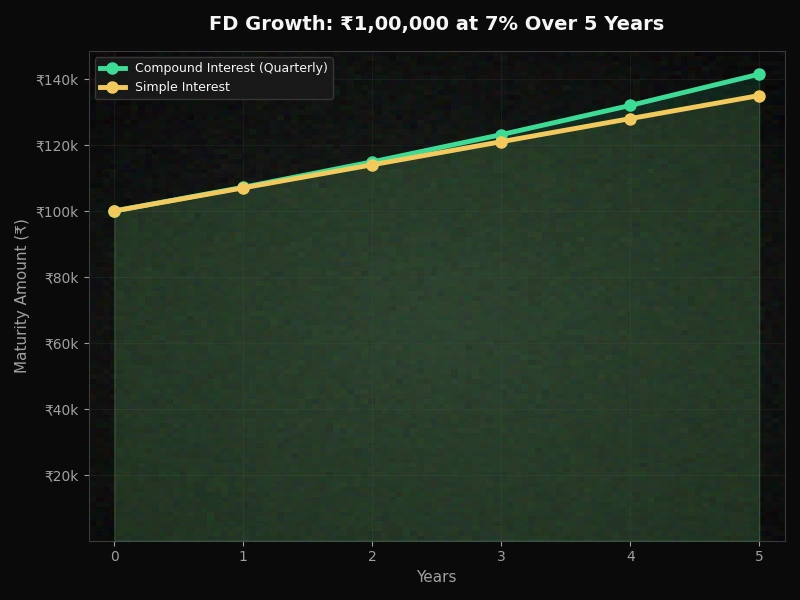
You do not need to do this math by hand, that is what our fixed deposit interest rate calculator is for, but understanding the formula helps you make sense of the number you see and spot if something looks off.
For simple interest FDs (typically used for very short tenures):
M = P + (P × r × t / 100)
Where P is your principal, r is the annual rate, and t is the tenure in years.
Example: You invest ₹1,00,000 for 2 years at 6.5% simple interest.
M = 1,00,000 + (1,00,000 × 6.5 × 2 / 100) = ₹1,13,000
For compound interest FDs (the standard for most FDs in India, compounded quarterly):
A = P (1 + r/n)^(n×t)
Where n is the number of times interest compounds per year (4 for quarterly).
Example: You invest ₹5,00,000 for 3 years at 7.2% per annum, compounded quarterly.
A = 5,00,000 × (1 + 0.072/4)^(4×3) = ₹6,17,073 approximately
Notice the difference. Compounding earns you more than simple interest on the same principal, rate, and tenure, because you are earning interest on your interest every quarter. This is exactly why cumulative FDs tend to build a larger corpus than non-cumulative ones, even at the same headline rate.
Current FD Interest Rates Comparison (2026)
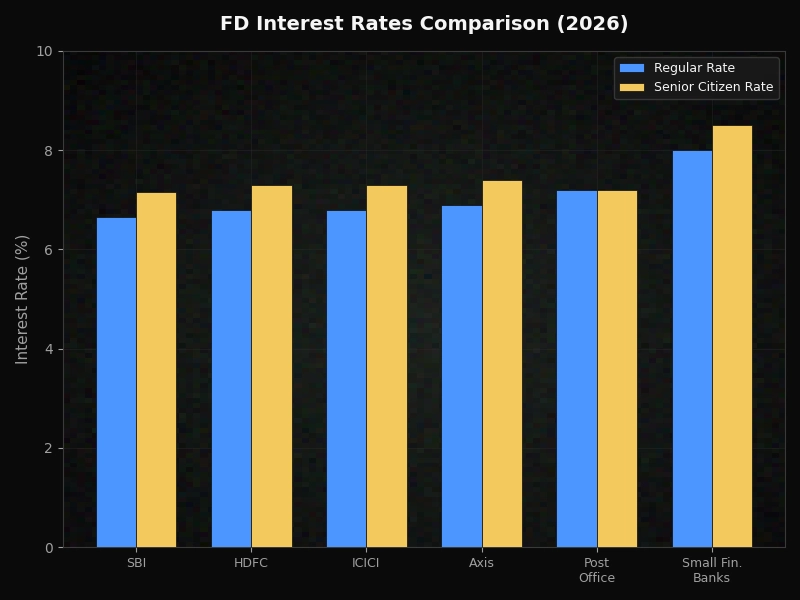
Rates change often, so treat this table as a starting reference point and always confirm live rates through the fixed deposit rates calculator above or directly with the bank before investing.
| Bank/Institution | Regular Rate (1-3 yr range) | Senior Citizen Rate | Best Tenure for Highest Rate |
| SBI | 6.50% – 6.80% | 7.00% – 7.30% | 400-444 days |
| HDFC Bank | 6.60% – 7.00% | 7.10% – 7.50% | 15-18 months |
| ICICI Bank | 6.60% – 7.00% | 7.10% – 7.50% | 15-18 months |
| Axis Bank | 6.70% – 7.10% | 7.20% – 7.60% | 17 months |
| Post Office Time Deposit | 6.90% – 7.50% | Not applicable | 5 years |
| Small Finance Banks | 7.50% – 8.50% | 8.00% – 9.00% | Varies by bank |
Small finance banks generally offer noticeably higher rates than the large private and public sector banks, since they need to attract deposits more aggressively. The trade-off is that they carry slightly different risk profiles, though deposits up to ₹5 lakh per bank are protected under DICGC insurance regardless of which bank you choose. You can also check RBI’s official guidelines on deposit insurance for more detail.
FD Returns for Different Types of Investors
Not everyone invests in fixed deposits for the same reason, and the right FD strategy looks different depending on who you are.
If You Are a Senior Citizen or Retired
You get two advantages most other depositors do not: a higher interest rate and easier access to your income through monthly or quarterly payout FDs instead of waiting for maturity. If your total income (including FD interest) stays below the taxable threshold, submit Form 15H to your bank so it does not deduct TDS unnecessarily. A common approach here is laddering, splitting a large sum across FDs with staggered maturities so you always have some money becoming liquid every few months without breaking a single large deposit.
If You Are a Salaried Employee or First-Time Investor
FDs are a solid place to park your emergency fund or short-term goals (buying a car in 18 months, a wedding in 2 years). For anything beyond 5 years, it is worth comparing FD returns against debt mutual funds, since the tax treatment differs. A simple starting move: put 3 to 6 months of expenses into a short-term FD as your safety net, then think about other instruments for longer-term wealth building.
If You Are Saving for Your Child’s Future
Tie your FD tenure to the actual milestone, school admission in 4 years, college in 10 years, rather than picking a random duration. Banks allow FDs in a minor’s name with a guardian as the operator, and the account converts to the child’s name once they turn 18. If your goal is more than 7-8 years away, also compare against a mix of FD and equity-linked options, since inflation eats into pure FD returns over long horizons.
If You Are a Conservative Investor
FDs sit at the safest end of the spectrum, ahead of a savings account in returns but behind debt mutual funds in flexibility. If capital protection matters more to you than chasing an extra 1-2% return, an FD ladder across 3 to 5 banks gives you safety, decent returns, and staggered liquidity all at once.
If You Are an NRI
You will come across three types of deposits: NRE account (rupee account, fully repatriable, interest is tax-free in India), NRO (for income earned in India, taxable, repatriation is capped), and FCNR (held in foreign currency, protects you from rupee depreciation). One detail that catches many NRIs off guard: the senior citizen rate benefit does not apply to NRE or NRO deposits, regardless of your age. If you are just getting started, our step-by-step guide for NRIs to start banking in India walks through account selection in more detail.
If You Already Have an FD and Want to Check Your Maturity Value
Plug in the exact principal, rate, and tenure from your FD receipt into the fixed deposit rates calculator to cross-check the maturity value the bank quoted you. If you are considering breaking the FD early, use the calculator with your bank’s premature withdrawal rate (usually 0.5% to 1% lower than your booked rate) to see the real impact before you decide.
What Happens to Your FD Interest After Tax
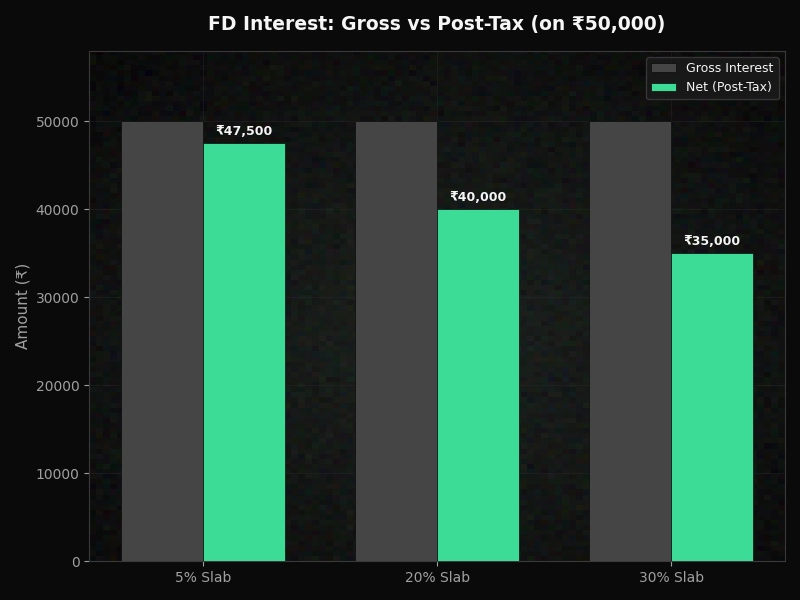
This is the part most calculators skip entirely, and it genuinely changes how attractive a fixed deposit looks.
Banks deduct TDS (Tax Deducted at Source) once your FD interest crosses ₹40,000 in a financial year (₹50,000 for senior citizens), across all your FDs with that bank. If your total taxable income is below the exemption limit, you can avoid this deduction by submitting Form 15G (if you are under 60) or Form 15H (60 and above) at the start of the financial year. You can check the exact rules on the Income Tax Department’s official website.
But TDS is not the same as your final tax liability. FD interest gets added to your total income and taxed at your income slab rate. Here is what that looks like on ₹50,000 of FD interest earned in a year:
- In the 5% tax slab: you keep ₹47,500
- In the 20% tax slab: you keep ₹40,000
- In the 30% tax slab: you keep ₹35,000
The same FD, the same interest earned, but a very different take-home amount depending on your tax bracket. This is worth factoring in before you decide how much of your savings to put into fixed deposits versus other tax-efficient options.
There is also a separate category called tax-saving FD, a 5-year lock-in FD that qualifies for deduction under Section 80C, up to ₹1.5 lakh. The catch is that the interest earned on it is still fully taxable, and there is no premature withdrawal allowed.
Is FD Interest Actually Beating Inflation
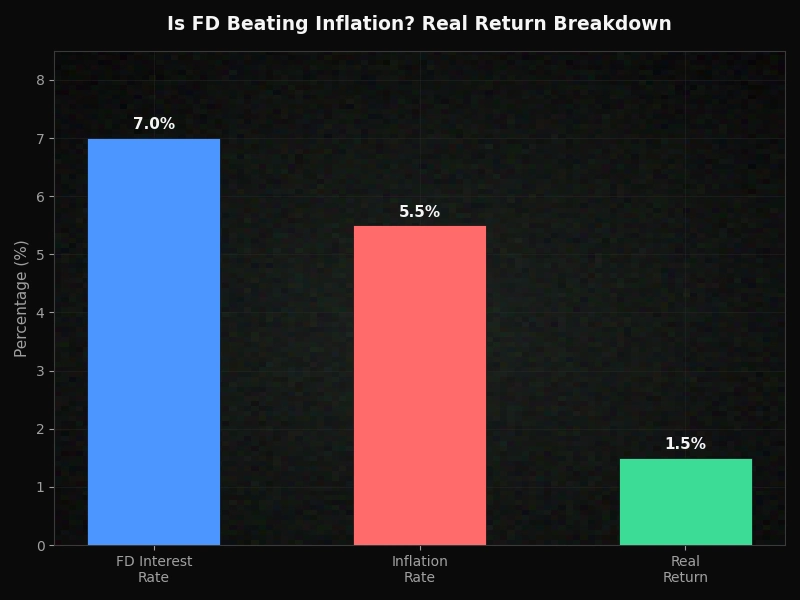
Here is a question worth sitting with for a second. If your FD gives you 7% and inflation is running at 5.5%, your real return is only about 1.5%. Once you factor in tax on top of that, the real, after-tax return can shrink even further, sometimes close to zero or even negative in high-tax brackets.
This does not mean FDs are a bad choice. It means fixed deposits are excellent for capital protection and predictability, but they are not built to grow your wealth aggressively over the long run. Most financial planners suggest keeping FDs for your safety net and short-term goals, while using other instruments for anything you are investing toward over 7+ years.
FD vs Other Investment Options
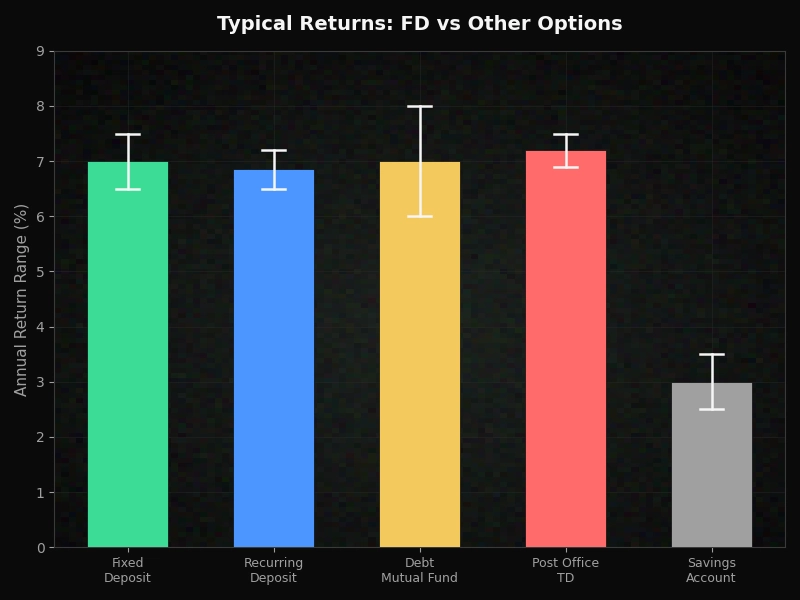
When you compare fixed deposits against recurring deposits, debt mutual funds, and post office schemes side by side, the right choice becomes clearer.
| Feature | Fixed Deposit | Recurring Deposit | Debt Mutual Fund | Post Office TD | Savings Account |
| Safety | Very High | Very High | Moderate to High | Very High | Very High |
| Liquidity | Low (penalty on early exit) | Low | High | Low | Very High |
| Typical Returns | 6.5% – 7.5% | 6.5% – 7.2% | 6% – 8% | 6.9% – 7.5% | 2.5% – 3.5% |
| Taxation | Slab rate | Slab rate | Slab rate (post-2023 rules) | Slab rate | Slab rate |
| Minimum Investment | ₹1,000 – ₹10,000 | ₹100 – ₹500/month | ₹500 – ₹5,000 | ₹1,000 | Varies |
No single option wins across every category. The right mix depends on how soon you need the money and how much volatility you can stomach.
Premature Withdrawal: What It Actually Costs You
Life happens, and sometimes you need your FD money before maturity. Most banks charge a penalty of 0.5% to 1% off your originally booked rate if you withdraw early. So if you booked at 7% for 3 years but break it after 18 months, you might only earn 6% for the period you actually held it, not the full 7%.
Run the numbers through the fixed deposit rates calculator using the reduced rate before you decide. Sometimes breaking one FD to avoid a high-interest personal loan still makes sense even with the penalty. Other times, it genuinely does not, and a short-term loan against the FD itself is the smarter route since it usually costs less than the penalty plus lost interest combined.
Common Mistakes People Make With Fixed Deposits
Booking with the first bank they check. Rate differences of even 0.5% add up meaningfully on larger sums over a 3-5 year tenure. Always compare at least 3-4 banks before booking.
Ignoring the TDS conversation entirely. If you are eligible to submit Form 15G or 15H and skip it, you are letting the bank hold onto money that is rightfully yours until you claim it back during tax filing.
Choosing a 5-year tenure when the goal is 2 years away. Mismatched tenure means either breaking the FD early (penalty) or letting the money sit locked when you needed it.
Putting the entire corpus into one single FD. Laddering across tenures and banks gives you both better average returns and more flexibility.
Forgetting to update the nominee. A surprisingly common oversight that creates real complications for family members later.
Frequently Asked Questions
What is the current FD interest rate for 1 year?
Most major banks currently offer between 6.5% and 7% for a 1-year FD, with senior citizens getting an additional 0.25% to 0.5% on top of that. Small finance banks often offer higher rates for the same tenure.
How is FD maturity amount calculated?
For cumulative FDs, banks use the compound interest formula A = P(1 + r/n)^(nt), where interest is typically compounded quarterly. Our fixed deposit interest calculator applies this formula automatically once you enter your principal, rate, and tenure.
Is FD interest taxable?
Yes. FD interest is added to your total income and taxed according to your income tax slab. Banks also deduct TDS if your annual interest crosses ₹40,000 (₹50,000 for senior citizens) per bank.
What is the minimum amount to open an FD?
This varies by bank, typically starting anywhere from ₹1,000 to ₹10,000. Some digital-first banks and NBFCs allow FDs starting from as low as ₹500.
Can I withdraw my FD before maturity?
Yes, most FDs allow premature withdrawal, though banks usually apply a penalty of 0.5% to 1% off your booked interest rate. A few special tax-saving FDs do not permit early withdrawal at all.
Which bank gives the highest FD interest rate for senior citizens?
Small finance banks generally offer the highest senior citizen FD rates, sometimes reaching 8.5% to 9%, compared to 7% to 7.6% at most large private and public sector banks.
Is FD better than a savings account?
For money you do not need immediate daily access to, yes. FDs offer significantly higher interest than savings accounts (which typically pay 2.5% to 3.5%), in exchange for locking in the funds for a fixed period.
Do NRIs get the same FD interest rates as residents?
Rates are broadly similar, but NRIs invest through NRE, NRO, or FCNR accounts, each with different tax and repatriation rules. Notably, the extra senior citizen rate does not apply to NRE or NRO deposits.
FD calculator kaise use karte hain?
Bas apna principal amount, tenure, aur interest rate daaliye, calculator turant maturity amount dikha dega. Agar aap senior citizen hain to us option ko bhi select karna na bhoolein, kyunki usse rate thoda zyada milta hai.
1 lakh ki FD par kitna interest milega?
Ye depend karta hai bank, tenure, aur interest rate par. Example ke taur par, agar aap ₹1,00,000 ko 3 saal ke liye 7% rate par quarterly compounding ke saath invest karte hain, to maturity par lagbhag ₹1,23,144 milega.
FD todne par kitna nuksan hota hai?
Zyadatar banks premature withdrawal par 0.5% se 1% tak ka penalty lagate hain, matlab aapko booked rate se kam interest milega. Calculator me reduced rate daal kar aap exact nuksan check kar sakte hain.
Senior citizen ko FD par extra interest kitna milta hai?
Aam taur par 0.25% se 0.75% extra milta hai, aur kuch small finance banks to isse bhi zyada offer karte hain. Har bank ka rate alag hota hai, isliye compare karna zaroori hai.
Kya FD par tax lagta hai?
Haan, FD ka interest aapki total income me add hoke aapke tax slab ke hisaab se tax lagta hai. Agar saal me interest ₹40,000 (senior citizens ke liye ₹50,000) se zyada hai, to bank TDS bhi kaat sakta hai.
Final Thoughts
FD returns come down to three things you actually control: which bank you choose, how long you lock in your money for, and whether you plan around the tax implications instead of ignoring them until filing season. The fixed deposit rates calculator above handles the math instantly, but the real value comes from understanding what that final number means for your specific situation, whether that is retirement income, a child’s education fund, or simply a safe place to park money while you figure out your next move.
At Apzo Media, we built this tool to give you a clear, unbiased starting point, not to push any single bank’s product. Bookmark this fixed deposit rates calculator so you can re-check your numbers every time rates change.
Ready to Plan Your Next FD?
Run 2 to 3 different scenarios through the calculator above, compare tenures and banks side by side, and see exactly what you will take home after tax. If you want to understand FD types and benefits in more depth before you invest, check out our complete Fixed Deposit guide, or explore NRI banking options if you are investing from abroad.
Still unsure which tenure fits your goal? Scroll back up and run a quick comparison using the calculator, it takes less than a minute.
Disclaimer: This article is for informational purposes only and does not constitute financial or investment advice. FD interest rates, tax rules, and TDS thresholds mentioned here are indicative and subject to change based on RBI policy and individual bank decisions. Please verify current rates directly with your bank or NBFC, and consult a certified financial advisor or chartered accountant before making investment decisions based on your personal financial situation.
About the Author
This article is written by Satendra Kashyap at Apzo Media, where he covers banking, savings, and investment topics with a focus on breaking down complex financial rules into clear, practical information for Indian investors and NRIs. His content is fact-checked against RBI guidelines and official bank sources, and updated periodically to reflect current interest rates and tax rules. Have a correction or question? Reach out through the Apzo Media contact page.






One response to “Fixed Deposit Rates Calculator: Calculate FD Interest and Maturity Amount Online”