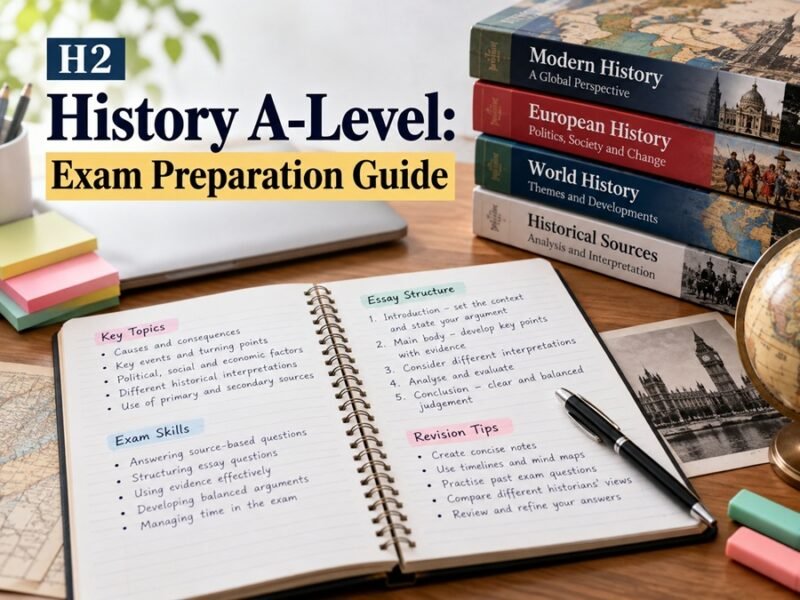



Quick answer: H2 History is the higher-level History subject within the Singapore-Cambridge GCE A-Level system, distinct from UK A-Level History, which does not use an H1/H2/H3 structure. Students searching for “h2 history a level questions” are usually preparing for essay and source-based questions under this Singapore qualification, and this guide explains the format, question types, and how to build strong, evidence-based answers.
If you have landed here searching for “h2 history a level questions”, you are probably trying to work out exactly what you are being tested on and how to prepare for it properly. That is a sensible starting point, because the term “H2 History” does not mean the same thing everywhere. This guide clarifies what the qualification involves, outlines the kinds of questions you can expect, and offers original practice material and revision strategies to help you build the skills examiners reward: clear argument, strong use of evidence, and careful analysis.
Throughout this guide, any practice questions provided are original examples written for study purposes. They are not taken from genuine past papers, and they should be used to build technique rather than treated as predictions of what will appear in a real examination.
Understanding H2 History A Level Questions
The label “H2” comes from the Singapore-Cambridge GCE A-Level system, where subjects are offered at three levels of depth: H1, H2, and H3. H1 subjects are studied in less depth, H2 subjects form the core of most students’ timetables and typically count most heavily towards university admission, and H3 subjects are specialised, higher-level options usually taken alongside an H2 subject in the same discipline.
H2 History, therefore, refers to the standard, full-depth History subject within that system. It requires students to engage with historical knowledge, source material, and extended essay writing across specified topics and time periods.
This is different from the UK A-Level system, where History is simply offered as “A-Level History” without an H1/H2/H3 tier structure. UK students study specification content set by an examination board and sit papers covering British and non-British history, often including coursework or a source-based component, depending on the specification chosen.
If you are preparing for a UK A-Level History qualification, the general principles in this guide, particularly around essay structure, source analysis, and revision technique, still apply, but you should check your specific examination board’s syllabus for exact topic coverage, paper structure, and assessment objectives. If you are preparing for H2 History, the same applies: always confirm current syllabus details and assessment formats using official guidance, since requirements can be revised between examination cohorts.
Where to Find History A-Level Questions
Before using any practice questions, including the original examples in this guide, make sure you are also working with official material. The most reliable places to find genuine History A-Level questions are:
- The official website of your examination board or assessment body, where syllabus documents and specimen papers are usually published.
- Your school or college’s history department, which often holds archived past papers and mark schemes.
- Official past-paper archives, where available, which allow you to see exactly how questions have been phrased and marked in previous years.
Official sources matter because question wording, assessment objectives, and marking criteria can change between syllabus versions. A practice question written for general study purposes, like the ones later in this guide, is useful for building skills, but it cannot replace the specific wording and standards set by your actual syllabus.
Types of History Examination Questions
Most A-Level History qualifications, including H2 History, assess students through a combination of question types designed to test different skills. While exact formats vary by syllabus, you are likely to encounter some combination of the following.
Essay questions ask you to construct an extended, evidence-based argument in response to a historical issue, often phrased as “To what extent…”, “How far…”, or “Assess the significance of…”. These questions reward a clear line of argument supported by specific historical knowledge.
Source-based questions present one or more historical sources, such as extracts from speeches, letters, newspaper articles, or official documents, and ask you to evaluate their content, reliability, or usefulness for understanding a particular historical issue.
Interpretation questions ask you to engage with different historians’ views or interpretations of an event, testing your ability to compare perspectives and reach a reasoned judgement about which interpretation is more convincing, and why.
Not every syllabus uses all three formats in the same way, so check your specific assessment objectives to understand exactly what is required in each paper.
Practice History Questions by Topic
The following are original practice questions, written for revision purposes. They are not genuine past-paper questions, and they are intentionally broad so they can be adapted to whichever historical period or syllabus content you are studying.
1. Causes and consequences
“Assess the extent to which economic factors, rather than political ones, explain the outbreak of a major twentieth-century conflict of your choice.”
This question asks you to weigh competing causal factors. Consider which economic pressures were present (such as trade disputes, resource competition, or financial instability), and compare them directly against political causes (such as alliance systems, nationalism, or leadership decisions). A strong answer does not simply list causes but explains how they interacted, and reaches a judgement about which mattered most.
2. Change and continuity
“How far did the position of women in your chosen society change between two dates of your choosing?”
This question requires you to identify what actually changed (legal rights, employment, political participation, for example) and what stayed broadly the same. Strong answers avoid treating change as automatic progress and instead use specific evidence to show the pace and limits of change.
3. Significance of historical events
“Explain why a specific reform, treaty, or event of your choice is considered significant in the period you are studying.”
Significance questions ask you to justify importance using criteria such as short-term impact, long-term consequences, or the extent to which the event changed subsequent decisions. Avoid simply describing what happened; explain why it mattered.
4. Historical interpretations
“To what extent do you agree with the view that a particular leader’s policies were the main reason for a significant historical outcome?”
Here, you should engage directly with the “view” given in the question, decide how far you agree, and support your judgement with evidence. Where relevant, briefly acknowledge an alternative interpretation before explaining why your own argument is more convincing.
5. Source analysis and evaluation
“Using a source of your choice, assess how useful it is for understanding the motives behind a historical decision.”
This question tests evaluation skills. Consider the source’s origin, purpose, and context (who wrote it, when, and why), alongside its content, to judge how reliable and useful it is for the specific purpose stated in the question.
How to Structure a Strong History Essay
A clear structure helps examiners follow your argument and ensures you address the question directly rather than simply narrating events.
Introduction: State your argument clearly in response to the question. Avoid restating the question word for word; instead, set out the position you will defend and briefly outline the main factors you will discuss.
Main paragraphs: Each paragraph should focus on one factor, argument, or piece of evidence, and should explain how it answers the question, not just describe what happened. A useful approach is to state your point, support it with specific historical evidence, and then explain its significance in relation to the question.
Counterarguments: Strong essays acknowledge alternative explanations or interpretations before explaining why your own argument remains more convincing. This demonstrates balanced judgement rather than a one-sided account.
Conclusion: Summarise your argument and directly answer the question, ideally reaching a clear, reasoned judgement rather than a vague restatement of your introduction.
How to Analyse Historical Sources
Source analysis is often one of the more challenging skills for students, partly because it requires evaluation rather than description.
When analysing a source, consider:
- Content: What does the source actually say or show?
- Provenance: Who created it, and when?
- Purpose: Why was it created? Was it intended to persuade, inform, or record events?
- Context: What was happening at the time it was produced, and how might this have shaped its content?
- Limitations: What does the source not tell you, and how might bias or perspective affect its reliability?
A common mistake is treating a source purely as a fact, without questioning why it was created or who it was created for. Strong answers use the source’s content and its context together to build a judgement about its usefulness or reliability for a specific purpose.
Common Mistakes to Avoid in History Exams
Several recurring issues can hold back otherwise capable students:
- Unsupported claims: Making an assertion without backing it up with specific evidence, such as named events, dates, or figures.
- Excessive narrative: Describing events in detail without explaining their relevance to the question asked.
- Weak evaluation: Accepting a source’s content at face value without considering its provenance, purpose, or limitations.
- Irrelevant information: Including everything you know about a topic rather than selecting what directly answers the question.
- Unclear conclusions: Ending an essay without a clear, reasoned judgement that directly responds to the question.
Avoiding these issues often matters more than simply knowing more facts, since examiners reward focused, well-supported argument over broad but unfocused knowledge.
Effective Revision Strategies for History Students
Preparing for History exams, including H2 History, benefits from structured, active revision rather than passive rereading.
Organise notes by theme, not just chronology. Structuring notes around causes, consequences, and turning points, rather than a simple timeline, makes it easier to build arguments quickly in an exam.
Practise essay plans under timed conditions. Writing a full essay plan, including your argument and key evidence, in a set time helps you develop the speed needed in a real exam without requiring a full essay every time.
Review feedback carefully. If a teacher or tutor has marked your work, go through their comments and identify recurring issues, such as weak evaluation or unclear structure, so you can target those specific skills in future practice.
Use official mark schemes. Where available, compare your practice answers against the assessment objectives and marking guidance from your syllabus to understand exactly what examiners are looking for.
Revisit source-based skills regularly. Source evaluation is a skill that improves with repeated practice, so build it into your revision schedule alongside essay writing, rather than leaving it until close to the exam.
Frequently Asked Questions
What does H2 mean in H2 History?
H2 refers to one of three levels (H1, H2, H3) within the Singapore-Cambridge GCE A-Level system. H2 subjects are studied in full depth and typically carry significant weight in university admissions decisions.
Is H2 History the same as UK A-Level History?
No. H2 History sits within the Singapore-Cambridge A-Level system’s tiered structure, while UK A-Level History does not use an H1/H2/H3 framework. Both involve essay and source-based questions, but syllabus content, structure, and assessment objectives differ, so always check your specific qualification’s official guidance.
Where can I find official past papers for History A-Levels?
Check your examination board or assessment body’s official website, your school or college’s history department, or recognised past-paper archives. These sources provide genuine questions and official mark schemes, which practice questions written for revision cannot replace.
How should I structure a History essay answer?
Start with a clear introduction stating your argument, develop focused paragraphs that use evidence to support each point, acknowledge counterarguments, and finish with a conclusion that directly answers the question with a reasoned judgement.
What is the best way to revise for a History exam?
Combine thematic note organisation, timed essay-plan practice, regular source-analysis exercises, and careful review of feedback and official mark schemes. Consistent, active revision across these areas tends to be more effective than rereading notes passively.
Are the practice questions in this guide genuine past-paper questions?
No. The practice questions in this guide are original examples written for study purposes. They are designed to help you build essay and source-analysis skills, but they should be used alongside genuine past papers from official sources.
Preparing with Purpose
Strong History exam performance, whether for H2 History or UK A-Level History, comes down to a consistent set of skills: building a clear argument, selecting relevant evidence, evaluating sources carefully, and reaching reasoned judgements rather than simply narrating events. Use the practice questions and strategies in this guide to build those skills, but always pair your preparation with official syllabus documents and genuine past papers from your examination board, since these remain the most reliable guide to exactly what you will face on exam day.