


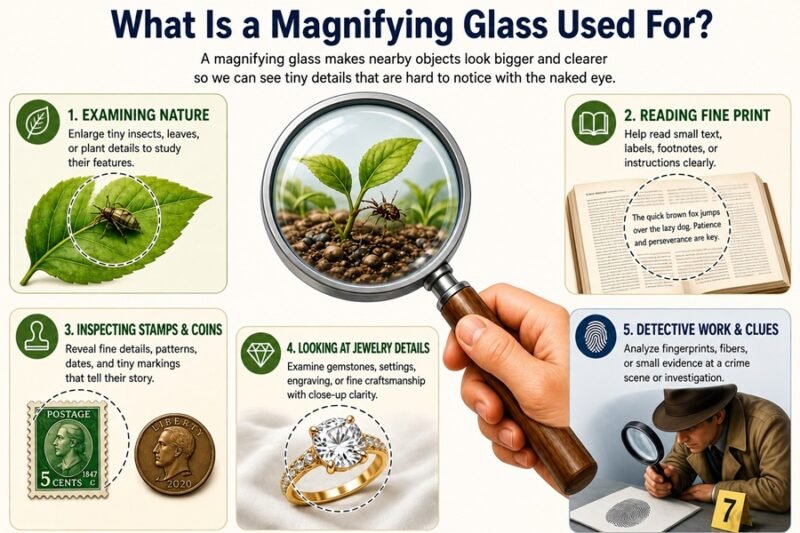
A magnifying glass is used to make small objects, text, or details appear larger so they’re easier to see. It’s just a curved piece of glass or plastic in a frame, but it shows up in more places than you’d expect: a grandparent’s reading chair, a jeweler’s workbench, a kid’s backyard bug hunt, a forensic lab.
If you’ve ever squinted at the tiny print on a medicine bottle at midnight, or tried to figure out if that old coin in your drawer is actually worth something, you’ve probably reached for one. Below is a rundown of the most common uses, an explanation of how the magnification actually works, and some guidance on picking the right strength for what you need.
What Is a Magnifying Glass?
A magnifying glass is a hand-held lens (sometimes mounted on a stand) that makes objects look bigger than they really are. The lens is convex, meaning it curves outward like a shallow dome, and that curve is what bends light to create the enlarged image.
There’s nothing electronic about it. No batteries, usually no moving parts, just shaped glass or plastic doing the work.
They come in more forms than most people realize:
- The classic handle-and-frame version you’d see in a detective movie
- Flat magnifying sheets you lay directly over a page
- Folding pocket loupes jewelers and collectors carry around
- Stand magnifiers that hold the lens steady over your work so both hands stay free
What Is a Magnifying Glass Used For?
Reading Small Print
This is the use most people are already familiar with. Medication labels, restaurant menus in a dim room, insurance documents, the fine print at the bottom of a contract: all of it tends to be printed in a size that’s hard to read comfortably, especially as eyesight changes with age. A magnifying glass, often one with a built-in light, brings that text back into focus without needing a trip to the optometrist.
Examining Coins and Stamps
Collectors depend on magnification to catch details that decide whether something is common or genuinely valuable. A mint mark, a hairline printing error, a small design variation between two otherwise identical stamps: these are the kinds of things that separate a two-dollar coin from a two-hundred-dollar one, and they’re often invisible without a lens.
Jewelry and Gemstones
Jewelers use loupes to check a stone’s clarity and cut, and to spot inclusions, which are the small internal flaws that affect how much a gemstone is worth. The same lens is useful for checking a piece’s craftsmanship or reading the tiny hallmark stamp that confirms whether a ring is actually gold.
Crafts and Sewing
Cross-stitch, embroidery, quilting, and hand sewing all involve threading needles and following stitch patterns that are genuinely difficult to see clearly. A hands-free magnifier, worn around the neck or clipped to a stand, keeps the work in focus while leaving both hands free to actually do it.
Studying Insects and Plants
Handing a kid a magnifying glass and sending them into the backyard is still one of the simplest ways to spark curiosity about nature. Suddenly an ant isn’t just a black speck, it has visible legs, antennae, and body segments. A leaf isn’t just green, it has veins running through it in a pattern. It’s a low-cost, no-setup way to turn an ordinary walk outside into something worth paying attention to.
Electronics and Precision Work
Anyone who’s tried to read the tiny print on a resistor or find a specific screw on a circuit board knows how small those markings can get. Hobbyists repairing old electronics, model builders assembling miniature parts, and watchmakers working on tiny movements all rely on magnification to avoid costly mistakes with components they can barely see.
Education and Science
In a classroom, a magnifying glass is usually a student’s first real introduction to close observation. Kids use them to look at rock samples, seeds, fabric under the microscope’s less powerful cousin, or basic biology specimens. It’s a simple, cheap way to build observation skills before students ever touch an actual microscope.
Other Everyday Uses
A few more situations where a magnifying glass earns its keep:
- Reading nutrition labels or ingredient lists that are printed impossibly small
- Checking serial numbers or model numbers in an appliance manual
- Looking closely at an old family photograph to make out a face or a date
- Verifying a signature or checking small print on an official document
- Solving a crossword or confirming a spelling in a dictionary
- Starting a fire in a survival situation by focusing sunlight onto dry tinder (only in daylight, with real caution, and never anywhere near dry brush or anything you don’t want to catch fire)
How Does a Magnifying Glass Work?
A magnifying glass works because of its convex shape. When light passes through a curved lens, the lens bends those light rays, a process called refraction. A convex lens bends the rays inward, so they angle toward each other as they pass through the glass.
When you hold the lens close to an object and look through it, your eye takes in an enlarged image because of how those bent rays reach it. The object itself hasn’t grown. The lens has simply changed the path the light takes before it hits your eye, and your brain reads that as a bigger object.
Two things control how much magnification you get:
- The curve of the lens. A more sharply curved lens bends light more and magnifies more.
- The distance between the lens and the object. Hold it too close or too far and the image blurs. There’s a sweet spot, different for every lens, where the object snaps into focus.
That’s why you naturally move a magnifying glass back and forth a little before an object comes into clear view. You’re finding that sweet spot without even thinking about it.
Why Does a Magnifying Glass Make Things Look Bigger?
It comes down to how your eyes interpret light angles. Normally, light bounces off an object and travels to your eye in straight lines, and your brain judges size based on the angle those lines make when they arrive.
A convex lens changes those angles before the light ever reaches you. It spreads the rays out wider than they’d naturally travel, so your brain reads the object as bigger than it actually is. Nothing about the object changed. Only the angle of the light did.
Magnifying Glass vs. Microscope
Both use lenses to enlarge small details, but they’re built for very different jobs.
| Magnifying Glass | Microscope | |
|---|---|---|
| Lens setup | One lens | Multiple lenses working together |
| Typical magnification | Roughly 2x to 20x | Commonly 40x up to 1000x or more |
| Portability | Handheld, no setup needed | Usually stays on a desk or bench |
| Common use | Reading, hobbies, quick inspection | Viewing cells, bacteria, fine scientific detail |
| Power source | None, unless it has a built-in light | Often needs a light source |
If you’re checking a coin, reading fine print, or looking at a bug on a leaf, a magnifying glass is all you need. If you need to see something like a cell or bacteria, something no single lens could ever reveal, that’s when a microscope becomes necessary.
How to Choose the Right Magnifying Glass
The right strength depends on what you’re actually going to use it for.
- 2x to 4x for general reading: newspapers, menus, everyday text
- 5x to 10x for hobbies like stamp or coin collecting, sewing, or checking small labels
- 10x to 15x for jewelry inspection, small electronics, and detailed craft work
- 15x to 20x or higher for very fine precision work, like watch repair or examining tiny mechanical parts
Higher magnification comes with a smaller field of view, so a very strong lens shows less of the object at once. For most everyday situations, something in the 3x to 8x range feels comfortable and practical. If you’re buying one for a specific hobby, it’s worth checking what magnification other people in that hobby typically use before you decide.
A couple of other things worth thinking about before you buy:
- Lens size. Bigger lenses show more of the object at once, usually at a lower magnification.
- Built-in lighting. Genuinely useful for reading in a dim room or inspecting something in shadow.
- Hands-free options. Worth it if you need both hands, like when you’re sewing or assembling a model.
Frequently Asked Questions
What is the main purpose of a magnifying glass?
Its main purpose is to make small objects, text, or details easier to see by enlarging them through a curved lens.
What can you see with a magnifying glass?
Just about anything small enough to benefit from enlargement: text, insects, plant details, coins, stamps, jewelry, small mechanical parts, and fine print on labels or documents.
Can a magnifying glass be used for reading?
Yes. It’s one of the most common uses, especially for reading small text like medication labels, menus, or fine print in books and contracts.
How does a magnifying glass magnify objects?
It uses a convex lens to bend light rays as they pass through. That bending changes the angle at which the light reaches your eye, which makes the object look larger than it actually is.
What is the difference between a magnifying glass and a microscope?
A magnifying glass uses a single lens and typically magnifies up to about 20 times an object’s actual size, which is enough for everyday tasks. A microscope uses multiple lenses and can magnify far beyond that, which is what makes it possible to see something as small as a cell or bacteria.
The Takeaway
A magnifying glass is a simple tool that ends up being useful in more situations than you’d expect: reading fine print, checking if an old coin is worth keeping, or letting a kid get a genuinely close look at a bug for the first time. Once you understand it’s just a curved lens bending light, choosing the right strength gets a lot easier. Whether it’s a quick task around the house or a hobby that depends on catching fine detail, there’s a magnifying glass strength built for it.
Must Read: Sustainable Living Tips: 10 Zero-Cost Ways to Save the Planet and Your Wallet